CES 2019: “Family tech” gadgets appeal to parental anxiety
Advertisement
Read this article for free:
or
Already have an account? Log in here »
To continue reading, please subscribe:

Digital Subscription
One year of digital access for only $205*
- Enjoy unlimited reading on winnipegfreepress.com
- Read the E-Edition, our digital replica newspaper
- Access News Break, our award-winning app
- Play interactive puzzles
*First annual payment billed as $205.00 + GST for one year. This annual subscription will automatically renew at $233.00 + GST every 52 weeks (10% off the regular annual price of $259.35). Offer available to new and qualified returning subscribers only. Cancel any time.
To continue reading, please subscribe:
Add Free Press access to your Brandon Sun subscription for only an additional
$1 for the first 4 weeks*
- Enjoy unlimited reading on winnipegfreepress.com
- Read the E-Edition, our digital replica newspaper
- Access News Break, our award-winning app
- Play interactive puzzles
*Your next Brandon Sun subscription payment will increase by $1.00 and you will be charged $17.95 plus GST for four weeks. After four weeks, your payment will increase to $24.95 plus GST every four weeks.
Read unlimited articles for free today:
or
Already have an account? Log in here »
Hey there, time traveller!
This article was published 10/01/2019 (2820 days ago), so information in it may no longer be current.
LAS VEGAS – Every year, the CES gadget show brings more devices promising to make life a little bit easier for harried parents.
Sure, the kids might love them too: who wouldn’t want a computerized Harry Potter wand that also teaches coding? The Las Vegas show’s growing “family tech” sector encompasses products that range from artificially intelligent toys and baby monitors to internet-connected breast pumps.
Their common thread is an appeal to parental anxiety about raising smart kids, occupying their time, tracking their whereabouts and making sure they’re healthy and safe.
Some also come with subtle trade-offs. “Technology makes us forget what we know about life,” said psychologist Sherry Turkle, a professor at the Massachusetts Institute of Technology who studies people’s relationships with machines. She’s particularly concerned about robots that seek to befriend or babysit young children.
NOT-SO-IMAGINARY FRIENDS
Take the cute, furry Woobo, meant to be a real-life version of a child’s imaginary friend that can help set tooth-brushing routines, answer complex questions and play educational games. It’s part of a new cottage industry of sociable toys, which includes robots like Cozmo and Sony’s dog-like Aibo.
A gentle pull at the ears switches the screen-faced Woobo into listening mode. The $149 toy talks in a child-like voice and makes a game out of boring chores that might otherwise require a parent’s nagging. Its makers say Woobo doesn’t glue kids to its screen because it invites them to go find things in the home, help parents cook dinner or play family games like charades.
“Our focus on the content side is not to replace parents,” said Shen Guo, who co-founded Cambridge, Massachusetts-based Woobo after graduating from the Rhode Island School of Design. “It’s to enhance family time.”
But its appeal for a child’s emotional attachment and nurturing sets off alarm bells for Turkle, who has been warning against what she calls “artificial intimacy” since the Tamagotchi digital pet craze of the 1990s.
Research has shown the benefits of children playing out their inner feelings and worries by projecting them onto inert dolls. But Turkle says that doesn’t work when the toys seem real enough to have their own feelings.
“Pretend empathy is not a good thing,” Turkle said. “Everything we know about children’s development is that if you read to a child, what’s going on is the relationship, the talking, the connection, the mentoring, the safety, the sense that people love learning. Why do we think this is a good idea to give this to some robot?”
IS YOUR BABY BREATHING?
Talk to makers of the next generation of baby monitors unveiled at CES and you’d be surprised that generations of children survived infancy without artificial intelligence systems analyzing their every breath.
“Babies want to breathe. Babies want to live,” says Colt Seman, co-founder of Los Angeles-based startup Miku, which promises to monitor breathing and heart rate without letting parents get overly worked up about it.
Regulators haven’t approved any baby monitors for medical use and instead recommend parents focus on providing a safe sleeping environment. Some doctors worry that such devices create additional stress for parents.
Unlike most past offerings, the latest crop of baby monitors that measure vital signs are “contactless” — meaning they don’t work by attaching some electronics to a baby’s sock or chest. Raybaby’s device resembles a one-eyed robot that detects breathing patterns using radar technology. The non-ionizing radiation it emits is at low levels, but might still turn off some parents already concerned about keeping their babies too close to smartphones.
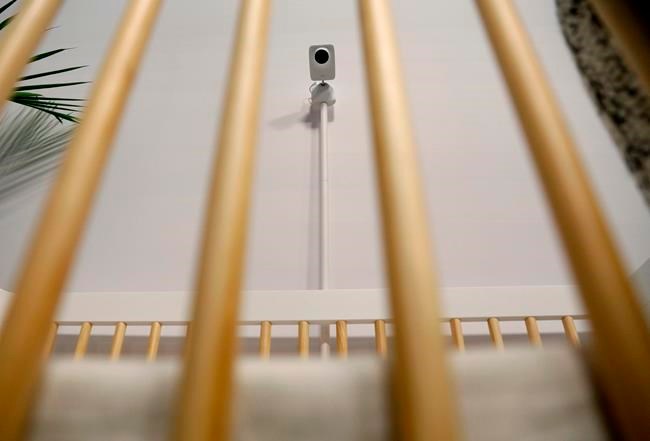
Most of the other devices rely on computer vision. A camera by Nanit watches a baby from above and measures sleeping patterns by tracking the slight movements of a specially-designed swaddle. It also uses the data it collects to recommend more consistent sleep times. Nanit’s Aaron Pollack acknowledges that some parents might still check Nanit’s phone app to check breathing data five times a night “out of sheer anxiety.”
“We’re not trying to prevent that,” he said. “We’re just trying to give you some piece of mind.”
Two others, Miku and Utah-based Smartbeat, each boast of a level of precision and analytical rigour that could eventually help predict when the baby is going to get sick. Both have phone alert systems to report worrisome breathing irregularities. Smartbeat’s analysis is purely image-based, while Miku also uses radar. Miku’s sleeker hardware comes at a cost: It’s $399, well above the $250 Smartbeat.

TECH IN THE WOMB
Of course, parental anxiety begins even before a child is born — hence Owlet’s new $299 pregnancy band that wraps around a woman’s abdomen to track fetal heartbeats by taking an electrocardiogram. The idea is to put on the stretchy band before going to sleep starting about three to four months before the due date.
It sends a morning wellness report to a user’s smartphone app, with details including an expectant mother’s contractions and sleep positions — and warnings if fetal heartbeat or movements fall outside acceptable ranges.
An owl-faced medallion above the mother’s belly gives the band the look of a superhero emblem — and why not? Pregnancy is tough.
“It’s really just having that extra piece of mind, between doctor’s visits, that everything is OK,” said Owlet spokeswoman Misty Bond.