No stethoscope for pain: Scientists seek real way to measure

Advertisement

Advertise with us

WASHINGTON - Is the pain stabbing or burning? On a scale from 1 to 10, is it a 6 or an 8?

Read this article for free:


or

Already have an account? Log in here »

To continue reading, please subscribe:

Subscribe and receive a limited-edition Free Press branded hat or tote.

Digital Subscription

One year of digital access for only $205*

  • Enjoy unlimited reading on winnipegfreepress.com
  • Read the E-Edition, our digital replica newspaper
  • Access News Break, our award-winning app
  • Play interactive puzzles

*First annual payment billed as $205.00 + GST for one year. This annual subscription will automatically renew at $233.00 + GST every 52 weeks (10% off the regular annual price of $259.35). Offer available to new and qualified returning subscribers only. Cancel any time.

To continue reading, please subscribe:

Add Free Press access to your Brandon Sun subscription for only an additional

$1 for the first 4 weeks*

  • Enjoy unlimited reading on winnipegfreepress.com
  • Read the E-Edition, our digital replica newspaper
  • Access News Break, our award-winning app
  • Play interactive puzzles
Start now

*Your next Brandon Sun subscription payment will increase by $1.00 and you will be charged $17.95 plus GST for four weeks. After four weeks, your payment will increase to $24.95 plus GST every four weeks.

Hey there, time traveller!
This article was published 10/01/2019 (2825 days ago), so information in it may no longer be current.

WASHINGTON – Is the pain stabbing or burning? On a scale from 1 to 10, is it a 6 or an 8?

Over and over, 17-year-old Sarah Taylor struggled to make doctors understand her sometimes debilitating levels of pain, first from joint-damaging childhood arthritis and then from fibromyalgia.

“It’s really hard when people can’t see how much pain you’re in, because they have to take your word on it and sometimes, they don’t quite believe you,” she said.
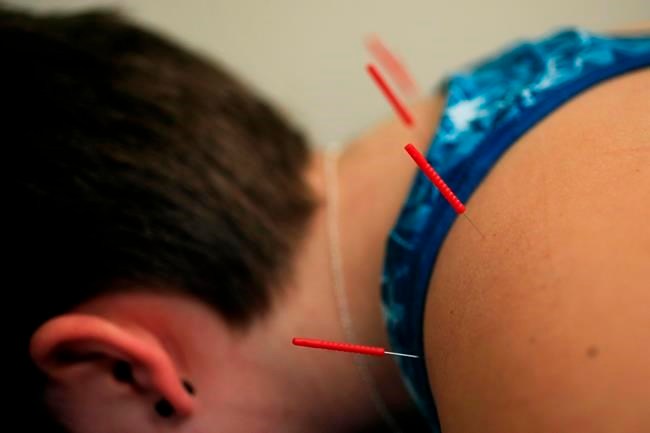
Acupuncture needles are applied on Sarah Taylor's back during an acupuncture treatment at the Children's National Medical Center in Washington, Monday, Dec. 10, 2018. Over and over, the 17-year-old struggled to make doctors understand her sometimes debilitating levels of pain, first from joint-damaging childhood arthritis and then from fibromyalgia.
Acupuncture needles are applied on Sarah Taylor's back during an acupuncture treatment at the Children's National Medical Center in Washington, Monday, Dec. 10, 2018. Over and over, the 17-year-old struggled to make doctors understand her sometimes debilitating levels of pain, first from joint-damaging childhood arthritis and then from fibromyalgia. "It's very frustrating to be in pain and you have to wait like six weeks, two months, to see if the drug's working," said Sarah, who uses a combination of medications, acupuncture and lots of exercise to counter her pain. Children's National Medical Center is testing an experimental device that aims to measure pain according to how pupils react to certain stimuli. (AP Photo/Manuel Balce Ceneta)

Now scientists are peeking into Sarah’s eyes to track how her pupils react when she’s hurting and when she’s not — part of a quest to develop the first objective way to measure pain.

“If we can’t measure pain, we can’t fix it,” said Dr. Julia Finkel, a pediatric anesthesiologist at Children’s National Medical Center in Washington, who invented the experimental eye-tracking device.

At just about every doctor’s visit you’ll get your temperature, heart rate and blood pressure measured. But there’s no stethoscope for pain. Patients must convey how bad it is using that 10-point scale or emoji-style charts that show faces turning from smiles to frowns.

That’s problematic for lots of reasons. Doctors and nurses have to guess at babies’ pain by their cries and squirms, for example. The aching that one person rates a 7 might be a 4 to someone who’s more used to serious pain or genetically more tolerant. Patient-to-patient variability makes it hard to test if potential new painkillers really work.

Nor do self-ratings determine what kind of pain someone has — one reason for trial-and-error treatment. Are opioids necessary? Or is the pain, like Sarah’s, better suited to nerve-targeting medicines?

“It’s very frustrating to be in pain and you have to wait like six weeks, two months, to see if the drug’s working,” said Sarah, who uses a combination of medications, acupuncture and lots of exercise to counter her pain.

The National Institutes of Health is pushing for development of what its director, Dr. Francis Collins, has called a “pain-o-meter.” Spurred by the opioid crisis , the goal isn’t just to signal how much pain someone’s in. It’s also to determine what kind it is and what drug might be the most effective.

“We’re not creating a lie detector for pain,” stressed David Thomas of NIH’s National Institute on Drug Abuse, who oversees the research. “We do not want to lose the patient voice.”

Around the country, NIH-funded scientists have begun studies of brain scans, pupil reactions and other possible markers of pain in hopes of finally “seeing” the ouch so they can better treat it. It’s early-stage research, and it’s not clear how soon any of the attempts might pan out.

“There won’t be a single signature of pain,” Thomas predicted. “My vision is that someday we’ll pull these different metrics together for something of a fingerprint of pain.”

NIH estimates 25 million people in the U.S. experience daily pain. Most days Sarah Taylor is one of them. Now living in Potomac, Maryland, she was a toddler in her native Australia when the swollen, aching joints of juvenile arthritis appeared. She’s had migraines and spinal inflammation. Then two years ago, the body-wide pain of fibromyalgia struck; a flare-up last winter hospitalized her for two weeks.

One recent morning, Sarah climbed onto an acupuncture table at Children’s National, rated that day’s pain a not-too-bad 3, and opened her eyes wide for the experimental pain test.

“There’ll be a flash of light for 10 seconds. All you have to do is try not to blink,” researcher Kevin Jackson told Sarah as he lined up the pupil-tracking device, mounted on a smartphone.

The eyes offer a window to pain centres in the brain, said Finkel, who directs pain research at Children’s Sheikh Zayed Institute for Pediatric Surgical Innovation.
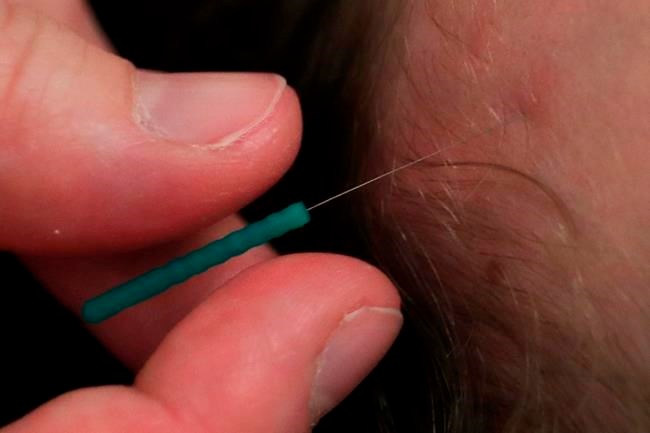
Anesthesiologist and Acupuncture Specialist Sarah Reece-Stremtan applies acupuncture needle on Sarah Taylor's forehead during an acupuncture treatment at the Children's National Medical Center in Washington, Monday, Dec. 10, 2018. Over and over, the 17-year-old struggled to make doctors understand her sometimes debilitating levels of pain, first from joint-damaging childhood arthritis and then from fibromyalgia.
Anesthesiologist and Acupuncture Specialist Sarah Reece-Stremtan applies acupuncture needle on Sarah Taylor's forehead during an acupuncture treatment at the Children's National Medical Center in Washington, Monday, Dec. 10, 2018. Over and over, the 17-year-old struggled to make doctors understand her sometimes debilitating levels of pain, first from joint-damaging childhood arthritis and then from fibromyalgia. "It's very frustrating to be in pain and you have to wait like six weeks, two months, to see if the drug's working," said Sarah, who uses a combination of medications, acupuncture and lots of exercise to counter her pain. Children's National Medical Center is testing an experimental device that aims to measure pain according to how pupils react to certain stimuli. (AP Photo/Manuel Balce Ceneta)

How? Some pain-sensing nerves transmit “ouch” signals to the brain along pathways that also alter muscles of the pupils as they react to different stimuli. Finkel’s device tracks pupillary reactions to light or to non-painful stimulation of certain nerve fibers, aiming to link different patterns to different intensities and types of pain.

Consider the shooting hip and leg pain of sciatica: “Everyone knows someone who’s been started on oxycodone for their sciatic nerve pain. And they’ll tell you that they feel it — it still hurts — and they just don’t care,” Finkel said.

What’s going on? An opioid like oxycodone brings some relief by dulling the perception of pain but not its transmission — while a different kind of drug might block the pain by targeting the culprit nerve fiber, she said.

Certain medications also can be detected by other changes in a resting pupil, she said. Last month the Food and Drug Administration announced it would help AlgometRx, a biotech company Finkel founded, speed development of the device as a rapid drug screen.

Looking deeper than the eyes, scientists at Harvard and Massachusetts General Hospital found MRI scans revealed patterns of inflammation in the brain that identified either fibromyalgia or chronic back pain.

Other researchers have found changes in brain activity — where different areas “light up” on scans — that signal certain types of pain. Still others are using electrodes on the scalp to measure pain through brain waves.

Ultimately, NIH wants to uncover biological markers that explain why some people recover from acute pain while others develop hard-to-treat chronic pain.

“Your brain changes with pain,” Thomas explained. “A zero-to-10 scale or a happy-face scale doesn’t capture anywhere near the totality of the pain experience.”

___

The Associated Press Health & Science Department receives support from the Howard Hughes Medical Institute’s Department of Science Education. The AP is solely responsible for all content.

Report Error Submit a Tip

More Stories

No stethoscope for pain: Scientists seek real way to measure

Lauran Neergaard, The Associated Press 7 minute read Preview

No stethoscope for pain: Scientists seek real way to measure

Lauran Neergaard, The Associated Press 7 minute read Thursday, Jan. 10, 2019

WASHINGTON - Is the pain stabbing or burning? On a scale from 1 to 10, is it a 6 or an 8?

Over and over, 17-year-old Sarah Taylor struggled to make doctors understand her sometimes debilitating levels of pain, first from joint-damaging childhood arthritis and then from fibromyalgia.

"It's really hard when people can't see how much pain you're in, because they have to take your word on it and sometimes, they don't quite believe you," she said.

Now scientists are peeking into Sarah's eyes to track how her pupils react when she's hurting and when she's not — part of a quest to develop the first objective way to measure pain.

Read
Thursday, Jan. 10, 2019

The freedom to create can be a balm for the soul

Deborah Schnitzer 5 minute read 2:01 AM CDT

My mother-in-law, Malka, came to Toronto in 1958 from postwar Poland. She came with unbearable losses authored by the Third Reich fascist fantasies that had destroyed her world.

She suffered the murder of her husband and second child, a newborn. She endured a hatred of her very being that defies reason and reckoning, yet she came, nonetheless, with profound wits about her and a courage groomed by the black market in Siberia where she somehow kept her first-born toddler alive by placing her in an unlit closet where the child would be safe while Malka bartered for food.

After the war, she married a survivor whose wife and children and been exterminated. Together, they had a son; I married that son, his story and the longest hatred it embodied.

Even given the profound and forbidding ugliness of the world Malka fled, she somehow created, in her third act, a single piece of art she found beautiful.

Broadening prediction-market gambling a bad idea

Editorial 4 minute read Preview

Broadening prediction-market gambling a bad idea

Editorial 4 minute read Saturday, Oct. 3, 2026

Let’s make a prediction: sooner or later, when Canadian governments find a way to take their own cut of the action, prediction-contract gambling on everything from sports to entertainment to political decisions is going to come to Canada.

And that’s a horrible, dangerous, pernicious idea.

Unless you have particular access to information — either inside information or strategic information based on skills or education — you’re not likely to make money at it. In fact, structurally, you’re likely to lose. In prediction markets, you basically pay an amount, plus fees from the company involved, to bet on whether something will or will not happen within a certain time frame. The amount you pay for your contract depends on how other people are also betting.

As Wealthsimple describes it, “You buy whichever side you think is right. Prices move with demand, so if the market leans towards one outcome, the more that side costs. If a lot of people are backing the TSX to finish above 38,000, yes gets more expensive and no gets cheaper.”

Read
Saturday, Oct. 3, 2026

Letters, Oct. 5

7 minute read 2:01 AM CDT

Fighting the good fight

Re: Transit, roads and city council’s priorities (Oct. 2)

Many thanks to Erna Buffie for once again speaking up for transit.

When will Winnipeg finally make the shift from a car-dependent culture to a greener and more efficient way?

Brandonmeat packer thriving on its own

Abiola Odutola 3 minute read Preview

Brandonmeat packer thriving on its own

Abiola Odutola 3 minute read Saturday, Oct. 3, 2026

BRANDON — Canada Packers has strengthened its business and laid the foundation for future growth during its first year as an independent company, its president says.

The Brandon-based pork producer, separated from Maple Leaf Foods in October 2025, established its own leadership, strategy, systems, culture and identity while continuing operations across its hog production farms and regional hog barns in southern and eastern Manitoba.

The company’s first year was focused on building a successful standalone business while continuing to serve customers, communities and shareholders, president Dennis Organ said.

“Market conditions over the past year have been more challenging than we anticipated when we became a separate entity,” he said in an email. “Despite that, we continued to execute against our priorities, including increasing processing volumes, maintaining disciplined operations and strengthening the business.”

Read
Saturday, Oct. 3, 2026

Today’s horoscope

Georgia Nicols 4 minute read Preview

Today’s horoscope

Georgia Nicols 4 minute read Yesterday at 2:00 AM CDT

MOON ALERT: Caution! Avoid shopping (except food and gas) and important decisions until after 6:30 p.m. today. After that, the moon moves from Cancer into Leo.

ARIES (March 21-April 19)

Don’t expect much co-operation from partners, spouses and close friends. This is why you might feel cut off from others or a bit lonely. There’s the sense a gulf exists between you and everyone else. But this is temporary. Courage!

TAURUS (April 20-May 20)

Read
Yesterday at 2:00 AM CDT