When managing birdfeeders, think bird health and safety

Advertisement

Advertise with us

Feeding birds in winter is one of the nation's most popular wildlife-watching activities, yet many ornithologists say it's often more rewarding for people than for birds. And it might even put wild birds at risk.

Read this article for free:


or

Already have an account? Log in here »

To continue reading, please subscribe:

Subscribe and receive a limited-edition Free Press branded hat or tote.

Digital Subscription

One year of digital access for only $205*

  • Enjoy unlimited reading on winnipegfreepress.com
  • Read the E-Edition, our digital replica newspaper
  • Access News Break, our award-winning app
  • Play interactive puzzles

*First annual payment billed as $205.00 + GST for one year. This annual subscription will automatically renew at $233.00 + GST every 52 weeks (10% off the regular annual price of $259.35). Offer available to new and qualified returning subscribers only. Cancel any time.

To continue reading, please subscribe:

Add Free Press access to your Brandon Sun subscription for only an additional

$1 for the first 4 weeks*

  • Enjoy unlimited reading on winnipegfreepress.com
  • Read the E-Edition, our digital replica newspaper
  • Access News Break, our award-winning app
  • Play interactive puzzles
Start now

*Your next Brandon Sun subscription payment will increase by $1.00 and you will be charged $17.95 plus GST for four weeks. After four weeks, your payment will increase to $24.95 plus GST every four weeks.

Hey there, time traveller!
This article was published 05/02/2019 (2784 days ago), so information in it may no longer be current.

Feeding birds in winter is one of the nation’s most popular wildlife-watching activities, yet many ornithologists say it’s often more rewarding for people than for birds. And it might even put wild birds at risk.

“Feeding birds is not necessary for their survival except in extreme weather conditions,” said Stephen Kress, vice-president for bird conservation at the National Audubon Society. “Feeders can definitely help them get through that kind of weather.”

Most birds are insect eaters and aren’t attracted to backyard feeders. “For those birds, I recommend planting natural habitat and native plants,” Kress said.
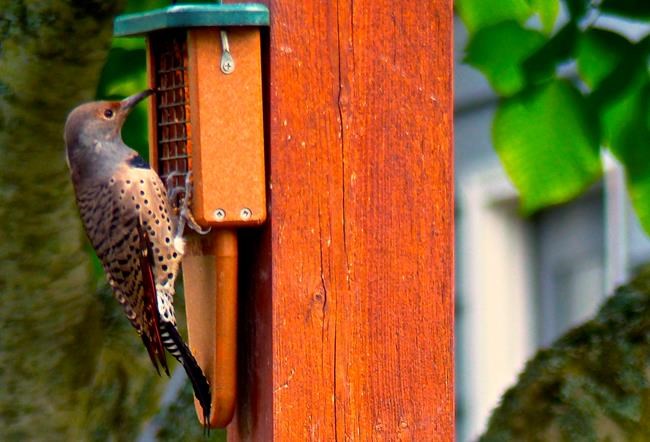
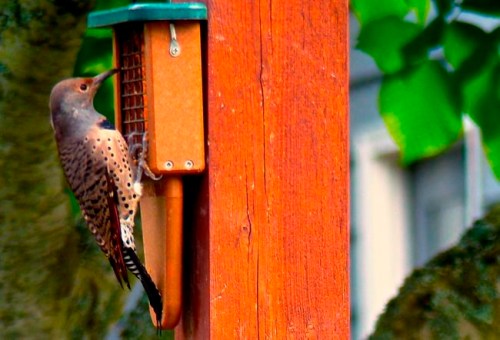
This Oct. 4, 2014 photo taken near Langley, Wash., shows a Northern Flicker feeding at an oversized suet feeder built especially for woodpeckers. Some birds are more aggressive eaters than others so it's wise to feed at different locations using different kinds of seeds and feeders. (Dean Fosdick via AP)

Besides, birds who do eat seed “will be more likely to come to feeders if there is some cover nearby. They’ll be able to feed and dodge back into the safety of shrubbery.”

The most common error people make when managing bird feeders is incorrect placement — putting them in locations where birds are frightened by foot traffic, vulnerable to predation by cats, or at risk of flying into windows.

“If a feeder is within 3 feet of a window, it’s better,” Kress said. “If a bird is spooked, it won’t be killed when it strikes the glass. And keep your cats indoors so they can’t stalk vulnerable birds and animals.”

Learn which bird species frequent your area so you can avoid feeder wars and understand the pecking order.

“Some birds are more aggressive at feeders,” Kress said. “Their eating habits are such that they can consume a lot and not leave much for the others.”

One answer to that is to feed at multiple locations using different kinds of seeds and feeders. Nyjer seeds, for instance, attract goldfinches, while tube feeders with wire covers prevent large birds from entering.

Pay attention to seed quality and freshness. Unprotected seed left too long in feeders will turn mouldy, and mould can kill foraging wildlife. Refresh your feeders every few days and clean them frequently by soaking in a solution of 10 per cent bleach.

“You can feed more effectively and efficiently by using black-oil sunflower seeds, as it is the preferred seed by most feeder birds,” said Adam Rohnke, a senior Extension associate at Mississippi State University. “An added benefit is reducing waste seed (on the ground) from seed mixes which can attract rodents.”

“Boost the number and diversity of bird species by providing different types of feeders to resemble their natural feeding behaviours,” Rohnke said in an email. “For example, ground-dwelling birds such as doves, towhees and others prefer low platform feeders because they feed on the ground.”

Along with black-oil sunflower and nyjer seeds, feeder-friendly birds like suet (woodpeckers, jays, songbirds), fruit (orioles, bluebirds, waxwings) and mealworms (robins, chickadees, wrens).

Do not feed wild birds anything salty (whole peanuts, crackers, potato chips) or food that could choke them (plain bread, fats).

Provide a steady supply of clean water but shop around for shallow birdbath designs. Most are too deep for birds, Kress said.

Placing a few large stones in a birdbath can provide perches.

“Hummingbirds like to bathe in leaves, so spray large leaves to attract them,” Kress said.

___

Online: For more about feeding birds, see this Stanford University fact sheet:

http://web.stanford.edu/group/stanfordbirds/text/essays/Feeding_Birds.html

You can contact Dean Fosdick at deanfosdick@netscape.net

Report Error Submit a Tip

More Stories

Desperate Poilievre wants Canadians to believe the sky is falling when it’s just cloudy outside

Tom Brodbeck 5 minute read Preview

Desperate Poilievre wants Canadians to believe the sky is falling when it’s just cloudy outside

Tom Brodbeck 5 minute read Friday, Sep. 18, 2026

Pierre Poilievre has a problem.

Canadians just don’t seem to be paying much attention to him anymore.

So, naturally, the Conservative Opposition leader has decided to turn up the volume.

At a recent party caucus retreat in Penticton, B.C., Poilievre delivered the familiar message: Canada is in trouble, Canadians are hurting and the Liberal government is making everything worse.

Read
Friday, Sep. 18, 2026

Give-and-take relationship of Roman leaders takes centre stage in Harris’s historical fiction

Reviewed by Kathryne Cardwell 4 minute read Preview

Give-and-take relationship of Roman leaders takes centre stage in Harris’s historical fiction

Reviewed by Kathryne Cardwell 4 minute read Yesterday at 2:01 AM CDT

British novelist Robert Harris’s latest work is a reflection on tyranny, corruption and betrayal among all-powerful political leaders.

You might be forgiven for thinking it’s a contemporary thriller — it’s actually historical fiction set in ancient Rome.

A former BBC journalist, Harris debuted as a novelist in 1992 with Fatherland, an alternative history where Nazi Germany won the Second World War.

Since then, the prolific author has become best-known for his works of historical fiction, especially his ancient Rome trilogy released from 2006-2015 and the novel Conclave, which was published in 2016 and was made into the film of the same name in 2024.

Read
Yesterday at 2:01 AM CDT

When managing birdfeeders, think bird health and safety

Dean Fosdick, The Associated Press 3 minute read Preview

When managing birdfeeders, think bird health and safety

Dean Fosdick, The Associated Press 3 minute read Tuesday, Feb. 5, 2019

Feeding birds in winter is one of the nation's most popular wildlife-watching activities, yet many ornithologists say it's often more rewarding for people than for birds. And it might even put wild birds at risk.

"Feeding birds is not necessary for their survival except in extreme weather conditions," said Stephen Kress, vice-president for bird conservation at the National Audubon Society. "Feeders can definitely help them get through that kind of weather."

Most birds are insect eaters and aren't attracted to backyard feeders. "For those birds, I recommend planting natural habitat and native plants," Kress said.

Besides, birds who do eat seed "will be more likely to come to feeders if there is some cover nearby. They'll be able to feed and dodge back into the safety of shrubbery."

Read
Tuesday, Feb. 5, 2019

Puzzles Palace

1 minute read Monday, Jul. 27, 2026

To solve our puzzles, please subscribe with this special offer: |

Cabernet Sauvignon star of wine festival

Ben Sigurdson 5 minute read Preview

Cabernet Sauvignon star of wine festival

Ben Sigurdson 5 minute read Yesterday at 3:00 AM CDT

The Winnipeg Wine Festival will celebrate the king of red wine grapes next weekend — the theme of this year’s festival, which takes place Sept. 25 and 26 at the RBC Convention Centre, is Cabernet Sauvignon.

Cab Sauv, as it’s also known, is the world’s most widely planted wine grape of any colour, first coming to prominence in the 1800s in France’s Bordeaux region, where the grape is still popular. Rather than single-variety wines, Bordeaux reds tend to be blends, with those coming from the left bank of the Gironde estuary being Cabernet-dominant, while right-bank wines are Merlot-dominant, with Cabernet Sauvignon playing a supporting role. Cabernet and Merlot work well together and many other countries have followed suit in blending the two.

A team at University of California Davis put Cabernet Sauvignon through a DNA test in 1996 and discovered its parent grapes are Cabernet Franc and Sauvignon Blanc — it’s likely that at some point the two varieties, planted next to each other in some vineyard, crossed and mutated and became the grape we know today. (Someone growing grapes in the 19th century must have had an inkling of what was up, as the grape has been called Cabernet Sauvignon since long before the DNA test.)

Flavour-wise, most Cabernet Sauvignon wines are big and bold, with a core of deep dark berry flavours, some graphite and spice notes and relatively bright acidity. It’s a grape that is well-suited to barrel aging, with most examples seeing at least some time in wood.

Read
Yesterday at 3:00 AM CDT

A Winnipeg lawyer has been disbarred after admitting to six counts of professional misconduct and two counts of providing incompetent service involving eight clients.

The career-ending decision marks the sixth time Gisele Champagne has been disciplined by the Law Society of Manitoba since she was called to the bar in 1992.

“Disbarment is the appropriate remedy when a lawyer has demonstrated a repeated pattern of conduct that violates professional standards,” a law society panel said in a written decision released Wednesday.

“A lawyer who has been unable to learn from past discipline proceedings to fulfill his or her obligation to provide ethical and high-quality legal services must at some point lose the privilege of practising law.”