Happy Beer Day! Iceland marks 30th anniversary of end of ban

Advertisement

Advertise with us

REYKJAVIK, Iceland - Thirty years ago, a sobering dry spell in Iceland's history came to an end.

Read this article for free:


or

Already have an account? Log in here »

To continue reading, please subscribe:

Subscribe and receive a limited-edition Free Press branded hat or tote.

Digital Subscription

One year of digital access for only $205*

  • Enjoy unlimited reading on winnipegfreepress.com
  • Read the E-Edition, our digital replica newspaper
  • Access News Break, our award-winning app
  • Play interactive puzzles

*First annual payment billed as $205.00 + GST for one year. This annual subscription will automatically renew at $233.00 + GST every 52 weeks (10% off the regular annual price of $259.35). Offer available to new and qualified returning subscribers only. Cancel any time.

To continue reading, please subscribe:

Add Free Press access to your Brandon Sun subscription for only an additional

$1 for the first 4 weeks*

  • Enjoy unlimited reading on winnipegfreepress.com
  • Read the E-Edition, our digital replica newspaper
  • Access News Break, our award-winning app
  • Play interactive puzzles
Start now

*Your next Brandon Sun subscription payment will increase by $1.00 and you will be charged $17.95 plus GST for four weeks. After four weeks, your payment will increase to $24.95 plus GST every four weeks.

Hey there, time traveller!
This article was published 01/03/2019 (2774 days ago), so information in it may no longer be current.

REYKJAVIK, Iceland – Thirty years ago, a sobering dry spell in Iceland’s history came to an end.

On Friday, the country celebrates the anniversary of the lifting of a decades-long ban on beer with — what else? — a nationwide Beer Day.

The drink was outlawed in Iceland for 74 years, while all other booze was completely legal. The alcoholic anomaly finally ended on March 1, 1989.
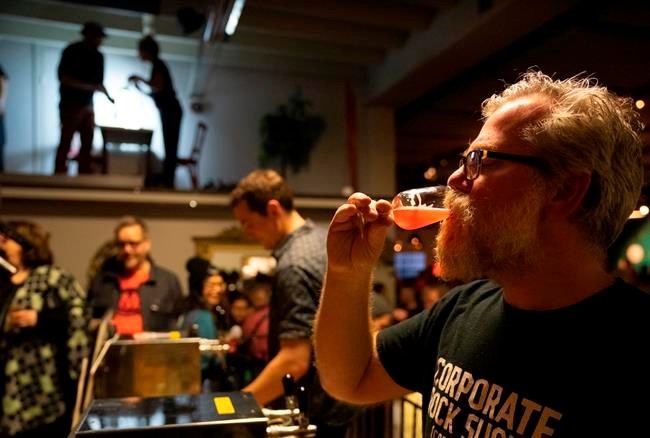
In this photo taken on Saturday, Feb. 23, 2019, brewer Sigurdur Snorrason drinks a craft beer at a festival in Reykjavik. Icelanders are celebrating the end, three decades ago, of a sobering dry spell in their country’s history. On Friday, March 1 the country toasts the anniversary of the lifting of a decades-long ban on beer with _ what else? _ a nationwide Beer Day. (AP Photo/Egill Bjarnason)

The beer ban was a leftover from the country’s prohibition era, which started in 1915 when the population voted in a referendum to outlaw all alcoholic drinks.

The ban was partially lifted seven years later out of economic necessity — Spain refused to buy Iceland’s main export, fish, unless Iceland bought Spanish wines.

Prohibition was repealed in another national referendum in 1933. But the majority vote was tight and to appease a powerful temperance movement Iceland’s parliament decided beer would remain illegal.

Historian Stefan Palsson, moonlighting as a teacher at a brewery-based “School of Beer,” said that at the time Icelanders didn’t miss it.

“They drank in order to become drunk and beer wasn’t really efficient for that,” he said.

Alcohol abuse remains an issue. One in 10 Icelandic males over the age of 15 have been to rehab at least once in their lifetime, according to SAA, the country’s leading addiction treatment centre.

With alcoholism still widespread, most Icelanders favour strict government restrictions on alcohol sales. Apart from the country’s bars, alcohol — beer included — is only sold at government-run monopoly stores, with limited opening hours and high taxes.

A pint of beer costs about 1,100 krona ($9) in bars, while a bottle of Smirnoff vodka costs the equivalent of $67 in the stores that sell it.

A thirst for change began in the 1970s when Icelanders increasingly started vacationing in sunny European beach resorts and developed a taste for a cooling beer.

Back home, local bartenders responded by inventing the “bjorliki” cocktail, a pseudo-beer made by blending non-alcoholic pilsner with aquavit — in very variable ratios.

Yet a large part of the population still opposed lifting the beer ban when parliament debated the issue for the last time in 1988.

Steingrimur Sigfusson, who is parliamentary speaker today, at the time painted a gloomy picture of the chaos that would result as “hundreds of taverns” opened up to crowds with no experience of the beverage. He voted against the proposition.

He still defends the country’s restrictive alcohol policy that aims to limit binge and teen drinking.

“The worst-case predictions never came true but underage drinking did increase,” Sigfusson said.

The ban finally ended on a Wednesday. All four bars in Reykjavik were jam packed with drinkers toasting their new-found freedom while the country’s population of 260,000 celebrated by buying more than 340,000 cans of beer at overcrowded Vinbudin monopoly stores.

“I wasn’t sure what to make of this day — we knew so little about beer,” said Sigurdur Snorrason, founder of the RVK brewing company, at a craft beer festival in the capital Reykjavik celebrating the milestone anniversary.

Hreindis Ylva was born the day the ban was lifted. She is celebrating her 30th birthday Friday with friends in a wooden house in Reykjavik’s open air museum. She won’t be sipping any suds, though.

“I think beer looks delicious served in a glass, but the taste is not for me,” she said. “This cool birthday is completely wasted on me.”
Report Error Submit a Tip

More Stories

Brandonmeat packer thriving on its own

Abiola Odutola 3 minute read Preview

Brandonmeat packer thriving on its own

Abiola Odutola 3 minute read Yesterday at 2:01 AM CDT

BRANDON — Canada Packers has strengthened its business and laid the foundation for future growth during its first year as an independent company, its president says.

The Brandon-based pork producer, separated from Maple Leaf Foods in October 2025, established its own leadership, strategy, systems, culture and identity while continuing operations across its hog production farms and regional hog barns in southern and eastern Manitoba.

The company’s first year was focused on building a successful standalone business while continuing to serve customers, communities and shareholders, president Dennis Organ said.

“Market conditions over the past year have been more challenging than we anticipated when we became a separate entity,” he said in an email. “Despite that, we continued to execute against our priorities, including increasing processing volumes, maintaining disciplined operations and strengthening the business.”

Read
Yesterday at 2:01 AM CDT

Khan should’ve taken high road: Goertzen

Carol Sanders 5 minute read Preview

Khan should’ve taken high road: Goertzen

Carol Sanders 5 minute read Friday, Oct. 2, 2026

The veteran Progressive Conservative who championed Obby Khan’s leadership bid says the former Blue Bomber dropped the ball by dissing his Tory teammates before he stepped down.

“I wouldn’t recommend it, and I didn’t recommend it,” Kelvin Goertzen (Steinbach) said in an interview Friday.

Khan resigned as PC leader and quit the caucus Monday saying some members were secretly plotting his ouster, even after he won a confidence vote on Sept. 25.

On Tuesday, Khan lashed out in a CJOB interview, naming the alleged plotters, saying constituents deserved to know which of their elected representatives “lacked moral integrity.” Khan told the Free Press he was “deeply emotionally hurt,” and felt stabbed in the back.

Read
Friday, Oct. 2, 2026

Happy Beer Day! Iceland marks 30th anniversary of end of ban

Egill Bjarnason, The Associated Press 4 minute read Preview

Happy Beer Day! Iceland marks 30th anniversary of end of ban

Egill Bjarnason, The Associated Press 4 minute read Friday, Mar. 1, 2019

REYKJAVIK, Iceland - Thirty years ago, a sobering dry spell in Iceland's history came to an end.

On Friday, the country celebrates the anniversary of the lifting of a decades-long ban on beer with — what else? — a nationwide Beer Day.

The drink was outlawed in Iceland for 74 years, while all other booze was completely legal. The alcoholic anomaly finally ended on March 1, 1989.

The beer ban was a leftover from the country's prohibition era, which started in 1915 when the population voted in a referendum to outlaw all alcoholic drinks.

Read
Friday, Mar. 1, 2019

Creative powerhouse Perry Rosemond never lost Winnipeg roots

Ben Waldman 7 minute read Preview

Creative powerhouse Perry Rosemond never lost Winnipeg roots

Ben Waldman 7 minute read Yesterday at 6:00 AM CDT

He created King of Kensington, directed the troops in the Royal Canadian Air Farce, and his creative eye was behind the lens for television shows starring Johnny Cash, Tom Jones, Mr. Dress-Up and the Friendly Giant.

He also wrote and developed the Canadian version of Sesame Street during his time as the head of school and preschool programming for CBC in Toronto, and directed a televised special in 2002 for Winnipeg sketch comedy troupe Royal Liechtenstein Theatre Company.

But before his name featured in the credits of some of the most iconic and influential pieces of the Cancon canon, Perry Rosemond was an only child living in a crammed, multi-generational home in Winnipeg’s North End, racing each day to beat the morning bell next door at William Whyte School.

In memoirs that have yet to be published, the late television producer recalled his childhood. “(T)here were 14 of us in the house at 193 Andrews St., and it wasn’t that big of a house,” he writes.

Read
Yesterday at 6:00 AM CDT

Winnipeggers witness unveiling of Japanese Canadian monument in B.C.

Morgan Modjeski 6 minute read Preview

Winnipeggers witness unveiling of Japanese Canadian monument in B.C.

Morgan Modjeski 6 minute read Yesterday at 8:39 PM CDT

As Miki Stewart gathered with her family at the Japanese Cultural Association of Manitoba on Saturday afternoon, she was thinking of her parents, Yoshimaru and Yoshi Abe.

Both Stewart, 80, and her sister Yumi Falk, 81, alongside an older brother, were born in the Tashme internment camp in British Columbia. They were among more than 2,600 Japanese Canadians who were forcefully removed and interred at the camp following the bombing of Pearl Harbour and Canada’s declaration of war on Japan in 1941.

“They didn’t talk much about how they suffered,” Stewart said of her parents. “But they did.”

She was amongst a group of more than 150 people who gathered at the association’s McPhillips headquarters on Saturday afternoon to watch the unveiling of the Japanese Canadian Monument in Victoria B.C.

Read
Yesterday at 8:39 PM CDT

Bombers get ‘whopped’ in Montreal

Taylor Allen 5 minute read Preview

Bombers get ‘whopped’ in Montreal

Taylor Allen 5 minute read Yesterday at 11:32 PM CDT

MONTREAL — It’s hard to fathom that the Winnipeg Blue Bombers smacked these Montreal Alouettes five weeks ago.

The team that pulled off that 44-28 upset at Princess Auto Stadium was nowhere to be found in La Belle Province on Saturday night.

You can, however, now find them in the basement of the West Division at 7-8 after getting completely outmatched and outclassed by the Als in a 37-10 beatdown.

“This was bad,” left tackle Stanley Bryant told the Free Press postgame. “They basically had their way all around. They whopped our ass.”

Read
Yesterday at 11:32 PM CDT