American virus deaths at 100,000: What does a number mean?
Advertisement
Read this article for free:
or
Already have an account? Log in here »
To continue reading, please subscribe:

Digital Subscription
One year of digital access for only $205*
- Enjoy unlimited reading on winnipegfreepress.com
- Read the E-Edition, our digital replica newspaper
- Access News Break, our award-winning app
- Play interactive puzzles
*First annual payment billed as $205.00 + GST for one year. This annual subscription will automatically renew at $233.00 + GST every 52 weeks (10% off the regular annual price of $259.35). Offer available to new and qualified returning subscribers only. Cancel any time.
To continue reading, please subscribe:
Add Free Press access to your Brandon Sun subscription for only an additional
$1 for the first 4 weeks*
- Enjoy unlimited reading on winnipegfreepress.com
- Read the E-Edition, our digital replica newspaper
- Access News Break, our award-winning app
- Play interactive puzzles
*Your next Brandon Sun subscription payment will increase by $1.00 and you will be charged $17.95 plus GST for four weeks. After four weeks, your payment will increase to $24.95 plus GST every four weeks.
Read unlimited articles for free today:
or
Already have an account? Log in here »
Hey there, time traveller!
This article was published 27/05/2020 (2315 days ago), so information in it may no longer be current.
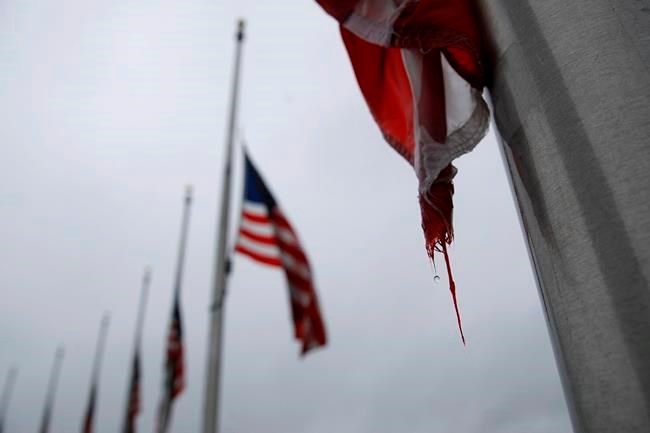
The fraught, freighted number of this particular American moment is a round one brimming with zeroes: 100,000. A hundred thousands. A thousand hundreds. Five thousand score. More than 8,000 dozen. All dead.
On Wednesday, the United States’ official reported coronavirus death toll reached six digits. One hundred thousand lives wiped out by a disease unknown to science a half a year ago.
And as the unwanted figure arrives — nearly a third of the global death toll in the first five months of a very trying year — what can looking at that one and those five zeroes tell us? What does any number deployed in momentous times to convey scope and seriousness and thought really mean?
“We all want to measure these experiences because they’re so shocking, so overwhelming that we want to bring some sense of knowability to the unknown,” says Jeffrey Jackson, a history professor at Rhodes College in Tennessee who teaches about the politics of natural disasters.
This is not new. In the mid-1800s, a new level of numerical precision was emerging in Western society around the same time the United States fought the Civil War. Facing such massive death and challenges counting the dead, Americans started to realize that numbers and statistics represented more than knowledge; they contained power, according to historian Drew Gilpin Faust.
“Their provision of seemingly objective knowledge promised a foundation for control in a reality escaping the bounds of the imaginable,” Faust wrote in “This Republic of Suffering,” her account of how the Civil War changed Americans’ relationship with death.
“Numbers,” she wrote, “represented a means of imposing sense and order on what Walt Whitman tellingly depicted as the `countless graves’ of the `infinite dead.’”
Today’s Americans have precedents for visualizing and understanding 100,000 people — dead and alive. They have numerous comparisons at hand.
For example: Beaver Stadium, seen often on TV as the home to Penn State football and one of the country’s largest sports venues, holds 106,572 people when full. The 2018 estimated population of South Bend, Indiana, was 101,860. About 100,000 people visit the Statue of Liberty every 10 days.
The total amount of U.S. Civil War deaths — combat and otherwise — was 655,000. For World War I it was more than 116,000, for World War II more than 405,000 and for the Korean and Vietnam wars more than 36,000 and more than 58,000 respectively. Those don’t include non-U.S. deaths.
Gun violence killed more than 37,000 people a year on average between 2014 and 2018 in the United States. And 9-11 took exactly 2,996 lives, a figure that the U.S. coronavirus tally passed in early April.
At some point with numbers, though, things start feeling more abstract and less comprehensible. This has informed the methodology of remembering the Holocaust by humanizing it: The death of 6 million Jews, after all, among many others, is a figure so enormous that it resists comprehension.
“It’s really hard for people to grasp statistics when it comes to numbers after a certain scale,” says Lorenzo Servitje, an assistant professor of literature and medicine at Lehigh University.
“Can you picture 30,000 people Or 50,000 people? And when you get into the millions, what do you even do with that?” he says. “It’s so outside of our everyday life that it’s hard to grasp meaning from them.”
The New York Times tried to address that problem Sunday, dedicating its entire front page to naming the virus dead — an exercise that, even in a tiny typeface, only captured 1% of those now gone. “A count,” the newspaper said, “reveals only so much.”
Adding to the complexity is how different coronavirus deaths are from, say, a 9-11, a mass shooting or a cataclysmic natural disaster. Unlike those, the COVID saga is unfolding gradually over time, growing steadily more severe, and resists the time-tested American appetite for loud and immediate storylines.
“Each day we’ve become accustomed to the new reality that we don’t realize how far we’ve travelled from what normal is,” says Daryl Van Tongeren, an associate professor of psychology at Hope College in Michigan who studies how people find meaning in suffering.
Our brains, he says, are wired to be empathetic to suffering — to a point.
“With too much suffering over time, it’s overwhelming and we begin to become callous. And our empathy essentially runs out,” Van Tongeren says. “We’re so accustomed to death right now, at 100,000, that our empathy has become lower.”
Finally, there are numbers living within the round 100,000 number that cry out for their own interpretations. The disproportionate number of dead Americans of colour, for example. Or the systematic way the disease is ravaging places where older Americans live, taking them in numbers that — if they were dying in mass shootings — might provoke a very different kind of reaction.
Don’t focus so much on the numbers, some admonish. Others criticize official counts, calling them inflated and inaccurate. More likely, because of spotty testing and undiagnosed cases, the number 100,000 falls significantly short.
But regardless of whether 100,000 has already truly happened or is yet to come, the meaning of this numerical milestone — human-imposed though it may be — raises some fundamental questions.
Have we decided to live with death, at least to a point? What would it mean if, around Labor Day, we reconvened in this space to discuss the 200,000th dead American? What would that number cause us to contemplate?
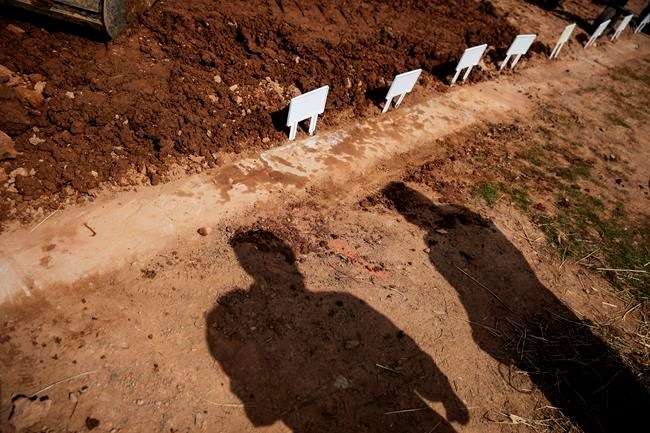
In the 14th century, the Black Death ravaged humanity, taking many millions. No one knows how many died. Today, when the dead are counted, some coherence is reached. The thinking is this: If the virus can’t be stopped, at least it can be quantified by human effort — far more palatable than a society where we couldn’t even establish who was no longer among us.

“As humans we like clean stories,” says Roland Minton, a mathematics professor at Roanoke College in Virginia. “And classifying things by number of digits can be a nice, clear way of classifying things.”
So when Whitman wrote of “countless graves,” he was not merely being poetic. Then, the idea of uncounted dead was more than metaphor; it was a direct description of what had happened.
Replacing that situation with accurate numbers, as society grew more sophisticated, did not solve everything. But it was something. Just as 100,000 means something this week in American life. Maybe not everything — not a vaccine, not a treatment — and maybe not clarity, exactly. Not yet. But something.
___
Ted Anthony, director of digital innovation for The Associated Press, has been writing about American culture since 1990. Follow him on Twitter at http://twitter.com/anthonyted
Related Articles
Solve LTC crisis before talking reform: Trudeau
Advertisement Advertise With Us
Advertisement Advertise With Us