Decline in new US virus deaths may be temporary reprieve

Advertisement

Advertise with us

The number of deaths per day from the coronavirus in the U.S. has fallen in recent weeks to the lowest level since late March, even as states increasingly reopen for business. But scientists are deeply afraid the trend may be about to reverse itself.

Read this article for free:


or

Already have an account? Log in here »

To continue reading, please subscribe:

Subscribe and receive a limited-edition Free Press branded hat or tote.

Digital Subscription

One year of digital access for only $205*

  • Enjoy unlimited reading on winnipegfreepress.com
  • Read the E-Edition, our digital replica newspaper
  • Access News Break, our award-winning app
  • Play interactive puzzles

*First annual payment billed as $205.00 + GST for one year. This annual subscription will automatically renew at $233.00 + GST every 52 weeks (10% off the regular annual price of $259.35). Offer available to new and qualified returning subscribers only. Cancel any time.

To continue reading, please subscribe:

Add Free Press access to your Brandon Sun subscription for only an additional

$1 for the first 4 weeks*

  • Enjoy unlimited reading on winnipegfreepress.com
  • Read the E-Edition, our digital replica newspaper
  • Access News Break, our award-winning app
  • Play interactive puzzles
Start now

*Your next Brandon Sun subscription payment will increase by $1.00 and you will be charged $17.95 plus GST for four weeks. After four weeks, your payment will increase to $24.95 plus GST every four weeks.

Hey there, time traveller!
This article was published 18/06/2020 (2279 days ago), so information in it may no longer be current.

The number of deaths per day from the coronavirus in the U.S. has fallen in recent weeks to the lowest level since late March, even as states increasingly reopen for business. But scientists are deeply afraid the trend may be about to reverse itself.

“For now, it’s too soon to be reassured that deaths are going down and everything’s OK,” said Dr. Cyrus Shahpar of Resolve to Save Lives, a non-profit organization that works to prevent epidemics.

Deaths from COVID-19 across the country are down to about 680 a day, compared with around 960 two weeks ago, according to an Associated Press analysis of data compiled by Johns Hopkins University. The analysis looked at a seven-day rolling average of deaths through Wednesday.
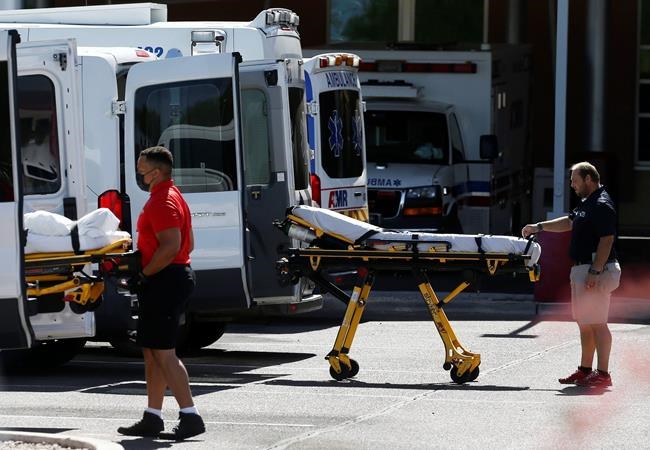
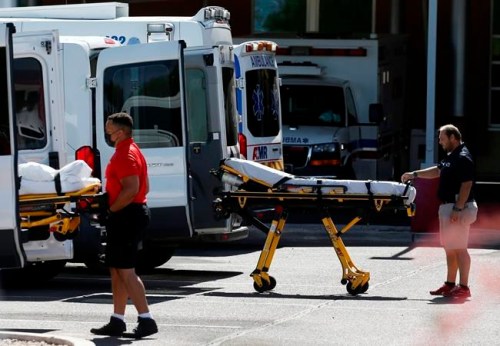
FILE - In this June 16, 2020, file photo, medical transports and ambulances are parked outside the emergency-room entrance at Banner Desert Medical Center, in Mesa, Ariz. The number of deaths per day from the coronavirus in the U.S. has fallen in recent weeks to the lowest level since late March, even as states increasingly reopen for business. But scientists are deeply afraid the trend may be about to reverse itself. (AP Photo/Ross D. Franklin, File)

A multitude of reasons are believed to be at play, including the advent of effective treatments and improved efforts at hospitals and nursing homes to prevent infections and save lives.

But already there are warning signs.

For one thing, the number of newly confirmed cases per day has risen from about 21,400 two weeks ago to 23,200, the AP analysis found.

And in Florida, Georgia, Texas and Arizona — states that loosened their stay-at-home restrictions early — daily deaths have been quietly rising since early June, said Ali Mokdad, professor of health metrics sciences at the University of Washington in Seattle.

“These are not numbers. These are human beings,” Mokdad said. “We’re going to see a rise in deaths in many places in the United States.”
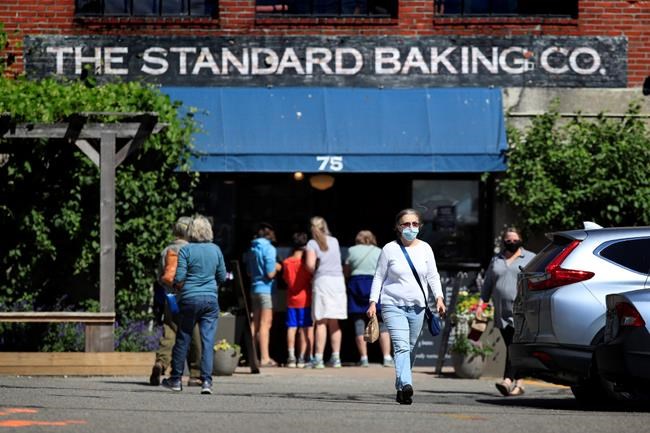
FILE - In this June 16, 2020, file photo, The Standard Baking Company serves customers at their door front in Portland, Maine. The number of deaths per day from the coronavirus in the U.S. has fallen in recent weeks to the lowest level since late March, even as states increasingly reopen for business. But scientists are deeply afraid the trend may be about to reverse itself. (AP Photo/Robert F. Bukaty, File)

The outbreak has killed about 118,000 people in the U.S. and nearly a half-million worldwide, according to Johns Hopkins’ count, though the real numbers are believed to be higher. Potential vaccines are in early stages of testing, and it is unlikely any will be ready before early next year.

Experts note that a rise in deaths could take awhile to show up in the U.S. statistics. Stay-at-home orders imposed in March, combined with the use of face masks and other social-distancing measures, have been bringing down the daily death toll since mid-April, and the U.S. as a whole is still seeing the positive effects, even though people are starting to work, shop and eat out again.

Doctors watching for an uptick in deaths will be on the alert for certain signals to emerge in a specific order, Shahpar said.

First, cellphone data will show people moving around more. Next, doctors will report more flu-like illnesses, and the proportion of people testing positive for the virus will rise. Hospitalizations will then go up and, finally, so will deaths.

Several factors are believed to be pushing the curves for deaths and cases in opposite directions.
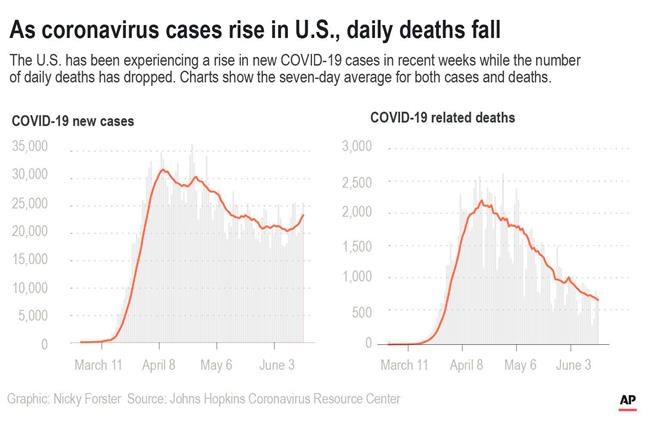
The U.S. overall is experiencing a significant rise in coronavirus-related cases in recent weeks while Covid-19-related fatalities continue to drop. ;

Rising case numbers can partially be explained by the wider availability of testing. Mild cases, previously undetected because of limits on who could be tested, are now showing up in the numbers.

As for the drop in deaths, “it is probably several things happening at once,” said Dr. Shmuel Shoham, a professor of medicine at Johns Hopkins University School of Medicine. Lessons learned from the “awful early days” are now benefiting the severely sick and people in nursing homes, Shoham said.

It looks that way in Washington state’s King County, where the first nursing home outbreak in the U.S. killed 45 people at the Life Care Center in suburban Seattle. County data shows deaths in similar facilities declining over the past two months. And no single facility in the county has come close to the death toll at Life Care, which was struck unaware.

While it is unclear how much specific treatments may have contributed to the decline in deaths, doctors are trying antivirals such as remdesivir, plasma donated from people who have recovered from the virus and steroids such as dexamethasone, which grabbed attention this week with reports confirming it can save the lives of many of the sickest patients.

While all viruses mutate, scientists say the coronavirus so far is not changing in a way that has made it less deadly.
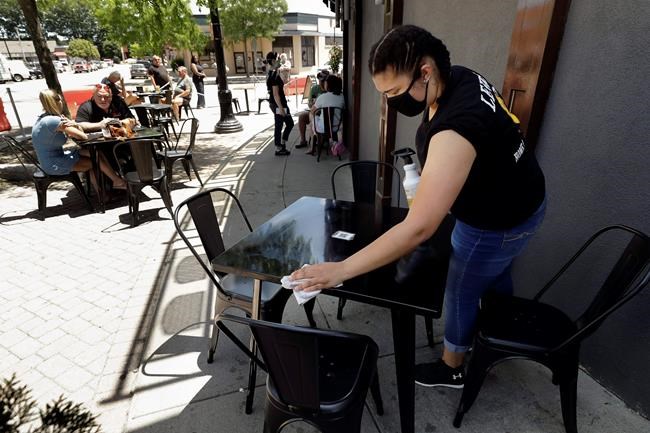
FILE - In this June 18, 2020, file photo, Jayda Boykin, of Norwood, Mass., a worker at Lewis' Bar and Grille, cleans a table and chairs, in an outdoor dining area on a sidewalk at the restaurant, in Norwood, Mass. The number of deaths per day from the coronavirus in the U.S. has fallen in recent weeks to the lowest level since late March, even as states increasingly reopen for business. But scientists are deeply afraid the trend may be about to reverse itself. (AP Photo/Steven Senne, File)

The decline in deaths this spring might well be tied in part to warmer weather as people spend more time outdoors where circulating air disperses the virus. But that does not bode well for the U.S. come this fall and winter.

Mokdad noted that deaths are on the rise in the Southern Hemisphere, where it’s now winter.

“This virus is going to have a second wave. It’s going to follow the pattern of pneumonia,” he said. “What we’re seeing in the Southern Hemisphere will be happening here.”

___

The Associated Press Health and Science Department receives support from the Howard Hughes Medical Institute’s Department of Science Education. The AP is solely responsible for all content.
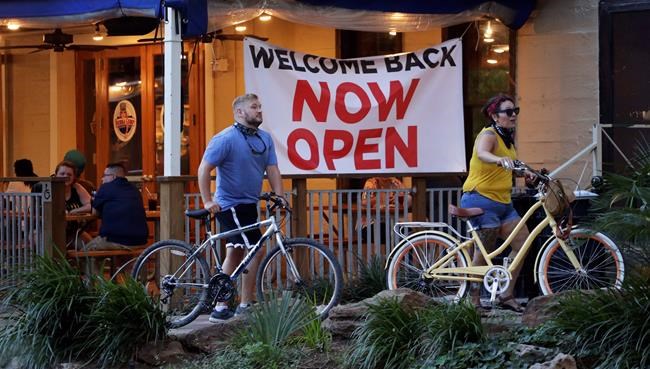
FILE - In this June 15, 2020, file photo, visitors to the River Walk pass a restaurant that has reopened in San Antonio. The number of deaths per day from the coronavirus in the U.S. has fallen in recent weeks to the lowest level since late March, even as states increasingly reopen for business. But scientists are deeply afraid the trend may be about to reverse itself. (AP Photo/Eric Gay, File)
Report Error Submit a Tip

More Stories

Decline in new US virus deaths may be temporary reprieve

Carla K. Johnson And Nicky Forster, The Associated Press 6 minute read Preview

Decline in new US virus deaths may be temporary reprieve

Carla K. Johnson And Nicky Forster, The Associated Press 6 minute read Thursday, Jun. 18, 2020

The number of deaths per day from the coronavirus in the U.S. has fallen in recent weeks to the lowest level since late March, even as states increasingly reopen for business. But scientists are deeply afraid the trend may be about to reverse itself.

“For now, it’s too soon to be reassured that deaths are going down and everything’s OK,” said Dr. Cyrus Shahpar of Resolve to Save Lives, a non-profit organization that works to prevent epidemics.

Deaths from COVID-19 across the country are down to about 680 a day, compared with around 960 two weeks ago, according to an Associated Press analysis of data compiled by Johns Hopkins University. The analysis looked at a seven-day rolling average of deaths through Wednesday.

A multitude of reasons are believed to be at play, including the advent of effective treatments and improved efforts at hospitals and nursing homes to prevent infections and save lives.

Read
Thursday, Jun. 18, 2020

Menstruation, consent move up in sex-ed lesson plan

Maggie Macintosh 5 minute read Preview

Menstruation, consent move up in sex-ed lesson plan

Maggie Macintosh 5 minute read 6:00 AM CDT

Manitoba’s newest curriculum introduces the menstrual cycle earlier and repeatedly calls for explicit lessons on how students can give, seek, and decline to provide their consent.

The education department has released its sweeping proposal to overhaul how exercise, nutrition and sexuality are taught between kindergarten and Grade 12.

Grade 5 has long served as a key turning point for “the talk,” said J Fiedler, a sexual and reproductive health educator who provided input on the new curriculum.

“There’s no ‘the talk’ anymore. Now, there’s continuations of multiple ‘talks,’ which can hopefully reduce stress for students and stigma that people experience talking about sexuality.”

Read
6:00 AM CDT

Child hospitalized after being hit in Walmart parking lot

1 minute read Saturday, Sep. 12, 2026

Police are investigating after a child was struck by a vehicle in a Walmart parking lot on Kenaston Boulevard Friday evening.

At 9 p.m. officers from the Winnipeg Police Service traffic division attended to a motor vehicle-pedestrian collision in the 1600 block of Kenaston, police said Saturday.

A school-aged child was taken to hospital in unstable condition, police said, but the child was later upgraded to stable condition.

Police said the child sustained minor injuries and an investigation is ongoing.

50 years ago, we thought we could change the world

Robert Milan and Miriam Cooley 8 minute read Preview

50 years ago, we thought we could change the world

Robert Milan and Miriam Cooley 8 minute read 2:00 AM CDT

We began as a small loose unorganized group of teaching friends and educators who shared the same political and social convictions.

Read
2:00 AM CDT

Downtown no place to be after dark, huge majority of Winnipeggers say in survey

Joyanne Pursaga 8 minute read Preview

Downtown no place to be after dark, huge majority of Winnipeggers say in survey

Joyanne Pursaga 8 minute read Friday, Sep. 11, 2026

Most Winnipeggers are afraid to walk alone downtown and believe the city needs more police officers, a new survey finds.

Winnipeg Police Service released its 2026 citizen survey Friday.

Downtown safety appears to remain a major concern, with just 44 per cent saying they feel very or reasonably safe walking alone in the area during the day. The number plummets to eight per cent overall at night, down from nine per cent in 2024, the last time the survey was conducted.

This year, 14 per cent of men felt very or reasonably safe walking alone downtown at night, compared to just three per cent of women.

Read
Friday, Sep. 11, 2026

Treating the disease we simply won’t insure

Rafiq Andani 5 minute read 2:00 AM CDT

There is a condition affecting tens of thousands of Canadians. In 2024, one national measure estimated that almost 120,000 people had the condition. The estimate captures only part of the problem.