Olympic Games, Tokyo-style: The pandemic era, in miniature

Advertisement

Advertise with us

TOKYO (AP) — Ghostly airports, devoid of bustle. Cavernous arenas where no crowds will roar. Stringent rules that are spottily enforced — and spottily ignored. Complaints over restrictions, including comparisons to Nazi Germany. Worries about outsiders causing superspreader events. And a general unease that life as we know it is upside down.

Read this article for free:


or

Already have an account? Log in here »

To continue reading, please subscribe:

Subscribe and receive a limited-edition Free Press branded hat or tote.

Digital Subscription

One year of digital access for only $205*

  • Enjoy unlimited reading on winnipegfreepress.com
  • Read the E-Edition, our digital replica newspaper
  • Access News Break, our award-winning app
  • Play interactive puzzles

*First annual payment billed as $205.00 + GST for one year. This annual subscription will automatically renew at $233.00 + GST every 52 weeks (10% off the regular annual price of $259.35). Offer available to new and qualified returning subscribers only. Cancel any time.

To continue reading, please subscribe:

Add Free Press access to your Brandon Sun subscription for only an additional

$1 for the first 4 weeks*

  • Enjoy unlimited reading on winnipegfreepress.com
  • Read the E-Edition, our digital replica newspaper
  • Access News Break, our award-winning app
  • Play interactive puzzles
Start now

*Your next Brandon Sun subscription payment will increase by $1.00 and you will be charged $17.95 plus GST for four weeks. After four weeks, your payment will increase to $24.95 plus GST every four weeks.

Hey there, time traveller!
This article was published 23/07/2021 (1898 days ago), so information in it may no longer be current.

TOKYO (AP) — Ghostly airports, devoid of bustle. Cavernous arenas where no crowds will roar. Stringent rules that are spottily enforced — and spottily ignored. Complaints over restrictions, including comparisons to Nazi Germany. Worries about outsiders causing superspreader events. And a general unease that life as we know it is upside down.

The coronavirus pandemic that interrupted the world and is digging in its heels once again in Asia? Or the seriously peculiar Olympic Games that are about to happen in its midst? Both, actually.

The Olympics are often billed, enthusiastically and with no small amount of self-interest, as a slice of the globalized 21st-century world in miniature – humanity’s very best on display. But for these weeks in Tokyo, the entire affair instead feels more like an industrial-strength clip reel of humanity’s last 18 months.
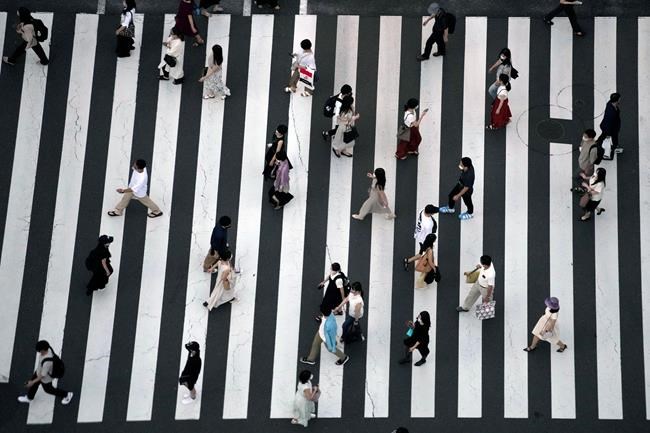
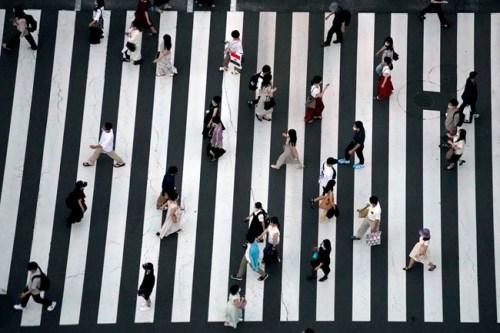
People wearing protective masks to help curb the spread of the coronavirus walk along a pedestrian crossing Thursday, July 22, 2021, in Tokyo. The Japanese capital confirmed more than 1900 new coronavirus cases on Thursday. (AP Photo/Eugene Hoshiko)

Like so many Olympics, the Games reflect the world in which they are taking place. This time, it’s a microcosm of the pandemic with all its challenges and fears, all of its irritations and surreal landscapes, jammed into a single metropolitan area during a brief moment in history eyed warily by a COVID-wearied civilization.

“The Olympic movement is living in the middle of society, and we are not living in a tranquil world,” said Thomas Bach, president of the International Olympic Committee. “We are living in a very fragile world, and therefore we have to react to this.”

For those who have watched the pandemic unfold across the world during the past 18 months — and who among us hasn’t? — the list of similarities between the Pandemic Olympics and the fragile world writ large is, in fact, a long one.

Among the shared traits, seen in recent days:

People talking past each other as they try to make their points more and more vehemently. Questionable information propagating and spreading. Sudden, unexpected positive tests that upend the best-laid plans. Inequities in vaccine distribution and access. Sporting events that should contain many thousands of people, instead brimming with empty seats and silence.

And did we mention “no high-fives,” as the signs that festoon Tokyo’s largely deserted Narita International Airport demand?
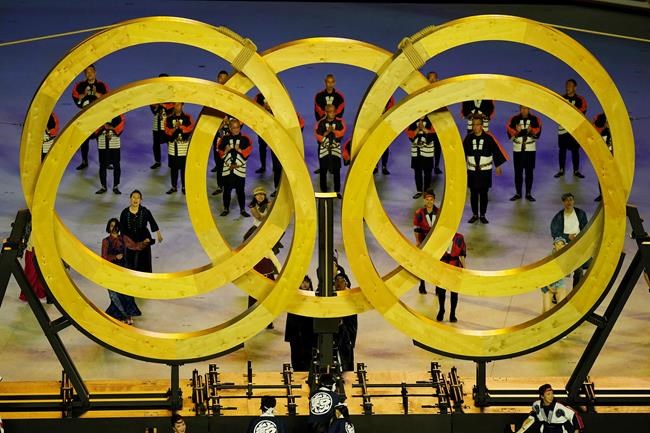
The Olympic rings are shown being built during a performance at the opening ceremonies during the Tokyo Olympics in Tokyo, Japan on Friday, July 23, 2021. THE CANADIAN PRESS/Nathan Denette

Why, then, is this pandemic microcosm taking place at all, despite the fact that virus spikes across Asia are shutting down much of the continent once again? Choose your reason — based on your level of cynicism.

There’s a case to be made, of course, for the idealistic storyline perpetually pushed by the IOC, which goes something like this: Even in a nonviral year, the gathering of disparate nations and their paragons of excellence is a necessary tonic for a complex, contentious, fragmented world. And during a pandemic? Maybe even more so.

Sure, yes, fine. But there have been other, more mercantile and tactical reasons to press forward. The media contracts that will richly reward the IOC and broadcast networks. The partnerships and sponsorships that help keep the gears of corporate endorsement grinding.

And the deep desire of some in Japan — in the face of significant public reluctance and sometimes outright anger — to “deliver,” as the newly fashionable word goes, an Olympics that reflects well upon the country despite repeated potholes of corruption, sexual harassment and offensive humor.

“The value of Tokyo 2020 is still exciting, and we want to send our messages to the world,” organizing committee President Seiko Hashimoto said Thursday.

Many such messages are being sent, just as they have been around the world during the pandemic. But not all of them might meet Hashimoto’s approval.
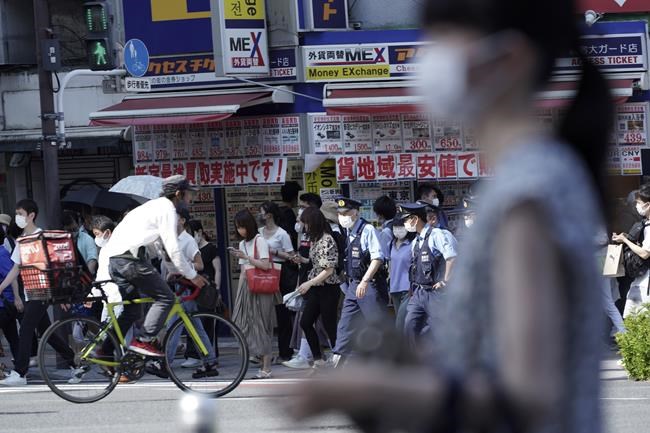
People and police officers wearing face masks to help curb the spread of the coronavirus walk past a busy crossing at Shinjuku district in Tokyo Friday, July 23, 2021, hours before the opening ceremony of the Summer Olympics starts. (AP Photo/Kantaro Komiya)

Like leaders elsewhere, she might not like the people in Tokyo who, beseeched not to go out to bars, took their drinking into the streets and complained of hypocrisy by luminaries arriving in town. And there’s the message of vaccinations: Only 22% of Japanese have been fully vaccinated, a strikingly low number despite massive efforts — and a source of worry in the runup to the Games.

Perhaps the most universal question, be it the Olympics or the pandemic overall, is the continuing and fundamental clash of values within families, companies and communities around the notion of risk-taking: Is plowing ahead and soldiering on with life the wiser choice, or is the ever-invoked “overabundance of caution” the way to go?

“There is no zero risk in life,” WHO director general Tedros Adhanom Ghebreyesus said this week, praising the Tokyo Games even as he took aim once again at the overall global pandemic response.

As with the larger pandemic, though, there is a lot of airspace between zero risk and reckless risk. The world has spent more than a year negotiating that transaction — globally, regionally, locally, within individual households. And it hasn’t always done well. Will these Olympics be any different?

Yes, almost all recent Games have been filled with risks, perceived and otherwise. Risks of terrorism (Sochi, Salt Lake City, London), of political and military unrest (Pyeongchang) and of general crime (Rio). But more than any other Olympics in memory, this Tokyo edition is an intricate exercise in risk management. That comes through in almost every statement from every official, in every question from every journalist, and out of the mouths of so many of the world’s athletes.

But if the Olympics are a microcosm of the pandemic, the small sliver reflecting the larger whole, could they ultimately have an effect on that larger whole? If nothing else, the next two weeks — the challenges they present to athletes and organizers, the dangerous things that are avoided and why — could offer some hints to the larger world on how to move forward, or how not to.

FILE - In this July 22, 2021, file photo, security officer passes a sign displaying COVID-19 protocols in the Main Press Center at the 2020 Summer Olympics, in Tokyo, Japan. (AP Photo/John Minchillo, File)

Over and over, the Olympics insist that they represent the world, a world condensed for a fleeting moment into cooperation and international comity and a common reach for excellence. Sounds like something that Pandemic Planet could really use right about now.

___

Ted Anthony, director of new storytelling and newsroom innovation for The Associated Press, was AP’s director of Asia-Pacific news from 2014 to 2018. This is his sixth Olympics. Follow him on Twitter at http://twitter.com/anthonyted

Report Error Submit a Tip

More Stories

U of W Collegiate students thank residential school survivors with the lessons they’ve learned

Maggie Macintosh 6 minute read Preview

U of W Collegiate students thank residential school survivors with the lessons they’ve learned

Maggie Macintosh 6 minute read 6:49 PM CDT

It’s become a back-to-school tradition for teachers to invite Indigenous elders to their classrooms to share first-hand accounts about the ongoing impacts of Canada’s residential school system.

This fall, the University of Winnipeg Collegiate was among the schools that sent an invitation — but its purpose wasn’t to educate students about the system’s horrors.

“Truth and Reconciliation week is so emotional and draining for residential school survivors,” said Christine M’Lot, a longtime instructor of the school’s Grade 9 truth and reconciliation course.

“I wanted to do something a little bit different and offer a thank you.”

Read
6:49 PM CDT

Influx of young talent gives Jets a noticeable boost

Ken Wiebe and Mike McIntyre 8 minute read Preview

Influx of young talent gives Jets a noticeable boost

Ken Wiebe and Mike McIntyre 8 minute read 5:55 PM CDT

A weekly lap around the NHL by Free Press hockey writers Ken Wiebe and Mike McIntyre

The paths couldn’t have been more different, even if the destination ended up being the same.

Viggo Bjorck is the can’t-miss prospect — a Top-10 pick with a clear path to The Show. Though it’s evident he hasn’t taken a single step in this process for granted.

Tyrel Bauer is the rough-and-tumble long shot, a sixth-round pick whose uphill battle to graduate to the highest level has featured a ton of scar tissue, both literally and metaphorically.

Read
5:55 PM CDT

Olympic Games, Tokyo-style: The pandemic era, in miniature

Ted Anthony, The Associated Press 7 minute read Preview

Olympic Games, Tokyo-style: The pandemic era, in miniature

Ted Anthony, The Associated Press 7 minute read Friday, Jul. 23, 2021

TOKYO (AP) — Ghostly airports, devoid of bustle. Cavernous arenas where no crowds will roar. Stringent rules that are spottily enforced — and spottily ignored. Complaints over restrictions, including comparisons to Nazi Germany. Worries about outsiders causing superspreader events. And a general unease that life as we know it is upside down.

The coronavirus pandemic that interrupted the world and is digging in its heels once again in Asia? Or the seriously peculiar Olympic Games that are about to happen in its midst? Both, actually.

The Olympics are often billed, enthusiastically and with no small amount of self-interest, as a slice of the globalized 21st-century world in miniature – humanity's very best on display. But for these weeks in Tokyo, the entire affair instead feels more like an industrial-strength clip reel of humanity’s last 18 months.

Like so many Olympics, the Games reflect the world in which they are taking place. This time, it's a microcosm of the pandemic with all its challenges and fears, all of its irritations and surreal landscapes, jammed into a single metropolitan area during a brief moment in history eyed warily by a COVID-wearied civilization.

Read
Friday, Jul. 23, 2021

Man accused of killing five family members fires second legal team, but murder trial won’t be delayed, judge warns

Dean Pritchard 4 minute read Preview

Man accused of killing five family members fires second legal team, but murder trial won’t be delayed, judge warns

Dean Pritchard 4 minute read Updated: Yesterday at 6:44 PM CDT

A Manitoba man accused of killing five family members is once again looking for new lawyers to represent him at trial.

Read
Updated: Yesterday at 6:44 PM CDT

Confidence vote was gamble for MLA, Tories: political expert

Alex Lambert 5 minute read Preview

Confidence vote was gamble for MLA, Tories: political expert

Alex Lambert 5 minute read Yesterday at 7:30 PM CDT

BRANDON — A Progressive Conservative MLA’s decision to put forward a confidence motion against the party’s former leader carries a lot of risk for her and the Tories, a political science expert says.

Obby Khan resigned as leader of the PCs on Monday after Jodie Byram (Agassiz) initiated a confidence vote against him the previous week.

The majority of the PC caucus voted in favour of Khan, but he resigned a few days later, citing continued efforts to undermine him by a minority of MLAs.

Brandon University political science Prof. Kelly Saunders said while she doesn’t know what Byram’s motivations were for triggering the vote, such a move carries a lot of risk.

Read
Yesterday at 7:30 PM CDT

Man who killed two Indigenous women, was accused of killing third, back in prison less than year after statutory release

Erik Pindera 4 minute read Preview

Man who killed two Indigenous women, was accused of killing third, back in prison less than year after statutory release

Erik Pindera 4 minute read Yesterday at 4:06 PM CDT

A Winnipeg man convicted of killing two First Nations women more than a decade ago — with charges stayed in a third slaying — has been sent back to prison less than a year after he left under conditions.

Parole Board of Canada officials revoked 67-year-old Shawn Lamb’s statutory release after a hearing last week.

“Your actions are not beyond your control, yet you continue to wilfully make poor decisions that place the public at risk,” board member Arun Kundu-Thomsen wrote in a decision released this week.

Lamb gained statutory release — a legislated conditional release most federal inmates automatically qualify for after serving two-thirds of their sentence — in November last year and lived in several Ontario facilities for federal offenders.

Read
Yesterday at 4:06 PM CDT