Filberts or hazelnuts? By whatever name, they’re fun to grow
Advertisement
Read this article for free:
or
Already have an account? Log in here »
To continue reading, please subscribe:

Digital Subscription
One year of digital access for only $205*
- Enjoy unlimited reading on winnipegfreepress.com
- Read the E-Edition, our digital replica newspaper
- Access News Break, our award-winning app
- Play interactive puzzles
*First annual payment billed as $205.00 + GST for one year. This annual subscription will automatically renew at $233.00 + GST every 52 weeks (10% off the regular annual price of $259.35). Offer available to new and qualified returning subscribers only. Cancel any time.
To continue reading, please subscribe:
Add Free Press access to your Brandon Sun subscription for only an additional
$1 for the first 4 weeks*
- Enjoy unlimited reading on winnipegfreepress.com
- Read the E-Edition, our digital replica newspaper
- Access News Break, our award-winning app
- Play interactive puzzles
*Your next Brandon Sun subscription payment will increase by $1.00 and you will be charged $17.95 plus GST for four weeks. After four weeks, your payment will increase to $24.95 plus GST every four weeks.
Read unlimited articles for free today:
or
Already have an account? Log in here »
Hey there, time traveller!
This article was published 21/09/2021 (1795 days ago), so information in it may no longer be current.
Things are getting nutty around my garden. Literally. The squirrels have been doing a lot of nut planting, mostly black walnuts, and I’ve joined in the game by removing excess seedlings, letting just a couple of well-placed ones remain.
In the past few years, I’ve even joined the squirrels and planted some nuts myself, including chestnuts, heartnuts, pine nuts and hazelnuts.
The hazelnuts (also known as filbert nuts) have been especially satisfying. And quickly so, bearing their first nuts within three years of planting. Unlike the squirrels, I have planted hazelnuts shrubs I bought from a nursery rather than just nuts.
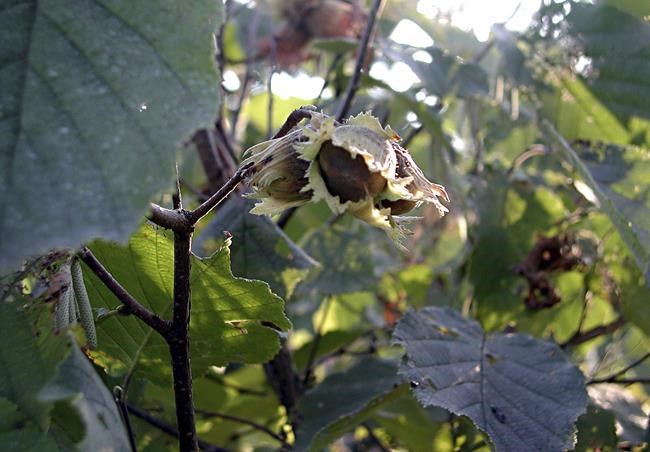
The plants, which grow as large, multi-stemmed shrubs or small trees, are attractive, especially in winter when their catkins (male flowers) dangle gracefully from the bare branches.
My first planting was of seedling shrubs of American hazelnuts (Corylus americana), a short hedge of them. The plants bore in three years, and each autumn their leaves lit up in fiery colors. Unfortunately, the nuts themselves weren’t worth eating; they were small and had poor flavor.
So a few years after that first planting, I planted more hazelnuts, but this time of named varieties — that is, clones selected or bred for bearing large and flavorful nutmeats. Such plants would be pure species or hybrids involving European hazelnut (C. avellana), a different species than American hazelnut.
These European hazels are commonly called filberts. These are the nuts you find in supermarkets, and they’re generally grown either in the Mediterranean region of Europe or in the Pacific Northwest here.
ENTER, A DISEASE
A disease called filbert blight is what has historically kept people from growing filberts in the eastern U.S. This indigenous disease has little effect on our native hazelnuts but can be devastating to the European ones.
The “blight” in the name says it all: collapse and death of branches, the shriveled leaves forlornly still clinging. A more telltale symptom is lines of raised, dark bumps running along the branches. The disease can go undetected for years because it has a long cycle and latent period; 10 years could go by before a tree is killed.
EASY WORKAROUND FOR DISEASE
Pruning and spraying are two ways to deal with the blight. But even better — to deal with most pest problems for any plants — is to plant resistant varieties.
Many years ago, blight found its way to the commercial filbert orchards of the Pacific Northwest, which had the positive effect of prompting the search for, and breeding of, high-quality filbert varieties that would not succumb to the disease.
Hall’s Giant and Willamette were, early on, identified for being somewhat resistant, and the former variety made it into my yard. After some time, along came Lewis, Clark, and Tonda di Giffoni, all three even more resistant to the blight. And all three have found their way into my yard. Most recently, the varieties Gamma, Delta, Epsilon and Zeta have been bred; they’ll be in my yard sometime soon.
But filbert blight is a capricious organism, and while a plant might show resistance to it in one part of the country, the plant might succumb elsewhere. Which most of mine did. (My garden is in New York’s Hudson Valley.)
Breeding new varieties has continued, and I’ve since planted what I hope are the best of the best for here, which are varieties born and bred east of the Rocky Mountains. The plants — varieties such as Truxton, Donald, Raritan, Somerset, Geneva and Monmouth — all look good, so far.
I keep my shrubs healthy by mulching and, if needed, fertilizing. To thwart diseases, and to promote a certain amount of new growth on which the following year’s nuts are born, I prune regularly to let all the branches bathe in light and air.
The combined effects of pruning and fertilizing coaxes 6 to 10 inches of new growth every year for consistently good nut production.
This week I am collecting the delectable, nutty morsels as they drop from the trees. I’m gathering them frequently because the squirrels have gotten in on this part of the “nutty” game too.
—-
Lee Reich writes regularly about gardening for The Associated Press. He has authored a number of books, including “Growing Figs in Cold Climates” and “The Pruning Book.” He blogs at http://www.leereich.com/blog. He can be reached at garden@leereich.com.