Prada focuses generational transition on artisans, expanding production and workforce in Italy

Advertisement

Advertise with us

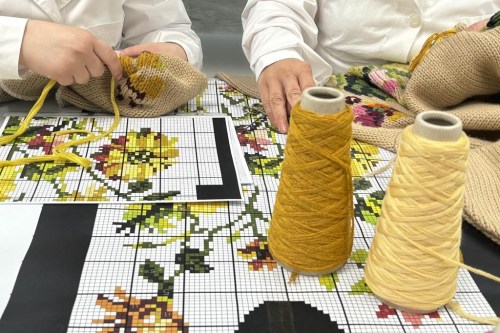
TORGIANO, Italy (AP) — The Prada Group is expanding its production footprint in Italy, including dozens of new jobs at its knitwear factory in Umbria, leaning into “Made in Italy” as integral to the brand’s ethos and developing new artisanal talent to ease the luxury group through a generational shift in its workforce.

Read this article for free:


or

Already have an account? Log in here »

To continue reading, please subscribe:

Subscribe and receive a limited-edition Free Press branded hat or tote.

Digital Subscription

One year of digital access for only $205*

  • Enjoy unlimited reading on winnipegfreepress.com
  • Read the E-Edition, our digital replica newspaper
  • Access News Break, our award-winning app
  • Play interactive puzzles

*First annual payment billed as $205.00 + GST for one year. This annual subscription will automatically renew at $233.00 + GST every 52 weeks (10% off the regular annual price of $259.35). Offer available to new and qualified returning subscribers only. Cancel any time.

To continue reading, please subscribe:

Add Free Press access to your Brandon Sun subscription for only an additional

$1 for the first 4 weeks*

  • Enjoy unlimited reading on winnipegfreepress.com
  • Read the E-Edition, our digital replica newspaper
  • Access News Break, our award-winning app
  • Play interactive puzzles
Start now

*Your next Brandon Sun subscription payment will increase by $1.00 and you will be charged $17.95 plus GST for four weeks. After four weeks, your payment will increase to $24.95 plus GST every four weeks.

Hey there, time traveller!
This article was published 08/05/2024 (861 days ago), so information in it may no longer be current.

TORGIANO, Italy (AP) — The Prada Group is expanding its production footprint in Italy, including dozens of new jobs at its knitwear factory in Umbria, leaning into “Made in Italy” as integral to the brand’s ethos and developing new artisanal talent to ease the luxury group through a generational shift in its workforce.

Prada CEO Andrea Guerra, who was brought in last year as part of the generational change in family-run Prada’s management, said at an unveiling of the expanded plant Tuesday that the company is investing 60 million euros ($65million) in production this year.

At Torgiano, Prada has added 30 new jobs this year, alongside 65 last year, bringing the workforce to some 220 employees, mostly women, to create knitwear for the Prada and Miu Miu brands, a key category for the group. The site had just 39 employees when Prada bought it in 2001.
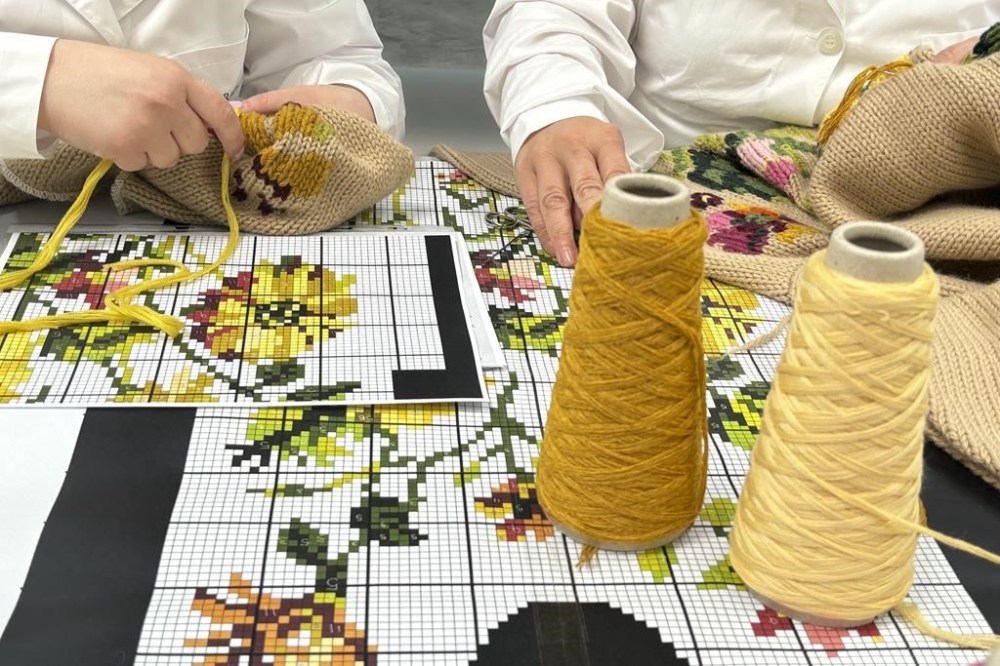
Italian artesans create knitwear for the Prada and Miu Miu brands at a recently expanded factory in the Perugia province of Italy Tuesday, May 7, 2024. The Prada Group is expanding its production footprint in Italy, including dozens of new jobs at brand's knitwear factory near Umbria, leaning into Made in Italy as integral to the brand's ethos as it develops new artisanal talent to ease the luxury group through a generational shift in its workforce, alongside the management and creative transitions already under way. (AP Photo/Colleen Barry)

“For many years, Torgiano was a small, important place, linked to the Umbrian knitwear tradition,’’ mostly dedicated to product research and development, Guerra said. “In the last six or seven years, with the extraordinary growth in knitwear, we decided to create an all-around industrial hub,” adding production to a reinforced R&D center.

The innocuous low-slung plant, identified by a simple, small Prada nameplate near the gate, is at the heart of a network that includes dozens of smaller companies that together create some 30,000 pieces of knitwear a month for the global luxury group. They include pretty, red crocheted Miu Miu culottes to soft gray Prada cardigans that have become a trademark.

Guerra described the Milan-based fashion group’s manufacturing footprint in central Italy as a “network of intelligent relationships and craftsmanship merged with a constant capacity to bring innovation to the market.”

Prada’s investments to exert greater control over its supply chain stand out against the backdrop of a recent investigation that revealed sweatshop conditions in Chinese-owned factories producing luxury goods for other Italian brands in the Lombardy region, where the Italian fashion capital Milan is located. The production arm of Giorgio Armani has been put under receivership as part of an ongoing supply chain probe.

Prada has focused on what it calls vertical integration of its supply chain — working with smaller companies, some with just a handful of craftspeople, that provide specific, sometimes unique, skills. For its knitwear operation, Prada works with some 60 smaller companies that it refers to as “partners” or “collaborators.”

“Contractors, subcontractors, that is not something tied to this world. There are production phases that are assigned to our collaborators, our partners,’’ Guerra said, adding: “The way I work inside, and the way I work outside needs to be the same.”

Lorenzo Bertelli, marketing director and head of corporate social responsibility who is slated to take over the company from his parents Patrizio Bertelli and Miuccia Prada, said a strong governance is the key to avoiding “such incidents.” He credited his father with starting Prada on the road to integrating its supply chain in the 1990s.

Audits of suppliers, which have so far been voluntary, will become mandatory in 2025 under the Corporate Sustainability Reporting legislation, aimed at controlling abuses, said Stefania Saviolo, a fashion and luxury expert at Milan’s Bocconi University. Publicly quoted companies like Prada, which are used to a level of transparency and reporting, will likely have an easier time than others, she said.

Integrating the supply chain doesn’t just mean that a major player buys up smaller companies, she said, but they may invest in specific machinery, or help them secure bank financing. “It is not ownership, it is a longer transaction along the model of partnership,’’ Saviolo said, adding that such relationships also provide a sense of security to the smaller companies more vulnerable to market crashes.
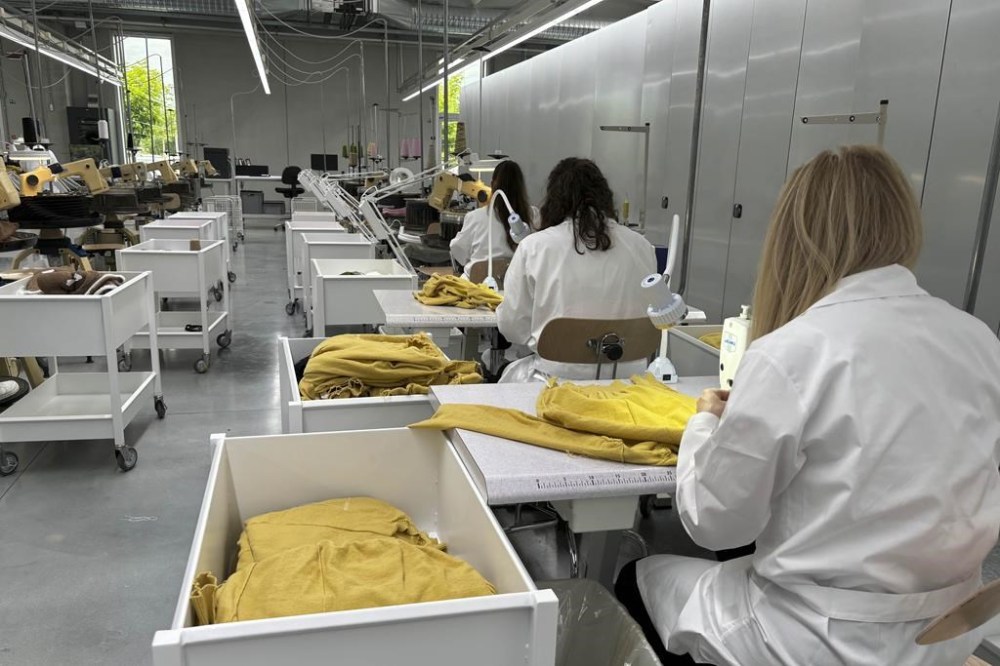
Italian artisans create knitwear for the Prada and Miu Miu brands at a recently expanded factory in the Perugia province of Italy Tuesday, May 7, 2024. The Prada Group is expanding its production footprint in Italy, including dozens of new jobs at brand's knitwear factory near Umbria, leaning into Made in Italy as integral to the brand's ethos as it develops new artisanal talent to ease the luxury group through a generational shift in its workforce, alongside the management and creative transitions already under way. (AP Photo/Colleen Barry)

Noting that the luxury and fashion industries have long relied on third-party manufacturing, Bernstein global luxury goods analyst Luca Solca said the kind of investments by Prada to integrate manufacturing processes in-house “is a sort of catch-up with best-in-class-players in the industry.”

A key part of Prada’s investments are aimed at securing know-how into the next generation, a transition the company has been preparing also in its management and creative roles.

Finding new workers with both experience and passion is difficult, even in a region where knitwear is part of the local tradition, said Lorenzo Teodori, who runs the Torgiano plant.

To fill that gap, Prada runs an internal academy as needed at its 23 Italian production sites to train young craftspeople. The next one in Torgiano starts in the fall, with experienced workers training the next generation.

“Through the Prada Academy, we have seen how this dialogue is still alive and successful,’’ Bertelli said. “We need it to train the future technicians of tomorrow, who in turn will be the teachers in the future. It is a fundamental cycle for our group.”
Report Error Submit a Tip

More Stories

Transit safety drives first mayoral debate

Morgan Modjeski 4 minute read Preview

Transit safety drives first mayoral debate

Morgan Modjeski 4 minute read 2:01 AM CDT

The safety of Winnipeg Transit drivers was front and centre Monday as the first mayoral debate of the 2026 election focused on public transit.

Kevin Klein, the most experienced of the 10 candidates at the Amalgamated Transit Union 1505-hosted debate, said the time for partial safety shields has passed.

“The partial shields have failed drivers. That’s why we need change,” the former PC MLA and city councillor said, adding driver safety is not a staffing issue, but a “protection failure.”

If elected, Klein said he will bring in full-shield implementation across the city within two years and start a nine-bus pilot project immediately.

Read
2:01 AM CDT

Winnipeg venues saying no to AI-made advertisements

Sheldon Birnie 8 minute read Preview

Winnipeg venues saying no to AI-made advertisements

Sheldon Birnie 8 minute read Updated: Yesterday at 10:22 AM CDT

Although the days when telephone poles and notice boards across the city were thick with gig posters, either slopped up with wheat paste or wrapped tight with packing tape, are behind us, the art of making an appealing visual ad for live music events is still a vital part of the local creative scene.

However, a widespread backlash against a new kind of slop — the use of generative AI images — has been building, especially among creatives when it comes to promoting live music.

“Live music is and always has been a DIY type of scene, especially locally,” says Evan Simpson, who has been working as a graphic designer for nearly a decade.

“For years people have been making their own flyers, or if they have the budget, hiring a designer or artist to come up with some artwork for their flyers. It’s a whole ecosystem, a scene supporting itself. If you take away the visual side of it, the spark, individuality and uniqueness of each gig poster is lost. What a sad world it would be if all art were made by AI.”

Read
Updated: Yesterday at 10:22 AM CDT

Menstruation, consent move up in sex-ed lesson plan

Maggie Macintosh 5 minute read Preview

Menstruation, consent move up in sex-ed lesson plan

Maggie Macintosh 5 minute read Yesterday at 6:00 AM CDT

Manitoba’s newest curriculum introduces the menstrual cycle earlier and repeatedly calls for explicit lessons on how students can give, seek, and decline to provide their consent.

The education department has released its sweeping proposal to overhaul how exercise, nutrition and sexuality are taught between kindergarten and Grade 12.

Grade 5 has long served as a key turning point for “the talk,” said J Fiedler, a sexual and reproductive health educator who provided input on the new curriculum.

“There’s no ‘the talk’ anymore. Now, there’s continuations of multiple ‘talks,’ which can hopefully reduce stress for students and stigma that people experience talking about sexuality.”

Read
Yesterday at 6:00 AM CDT

Prada focuses generational transition on artisans, expanding production and workforce in Italy

Colleen Barry, The Associated Press 6 minute read Preview

Prada focuses generational transition on artisans, expanding production and workforce in Italy

Colleen Barry, The Associated Press 6 minute read Wednesday, May. 8, 2024

TORGIANO, Italy (AP) — The Prada Group is expanding its production footprint in Italy, including dozens of new jobs at its knitwear factory in Umbria, leaning into “Made in Italy” as integral to the brand’s ethos and developing new artisanal talent to ease the luxury group through a generational shift in its workforce.

Prada CEO Andrea Guerra, who was brought in last year as part of the generational change in family-run Prada’s management, said at an unveiling of the expanded plant Tuesday that the company is investing 60 million euros ($65million) in production this year.

At Torgiano, Prada has added 30 new jobs this year, alongside 65 last year, bringing the workforce to some 220 employees, mostly women, to create knitwear for the Prada and Miu Miu brands, a key category for the group. The site had just 39 employees when Prada bought it in 2001.

“For many years, Torgiano was a small, important place, linked to the Umbrian knitwear tradition,’’ mostly dedicated to product research and development, Guerra said. “In the last six or seven years, with the extraordinary growth in knitwear, we decided to create an all-around industrial hub," adding production to a reinforced R&D center.

Read
Wednesday, May. 8, 2024

Subway owner becomes 14th candidate for mayor 

1 minute read Yesterday at 4:50 PM CDT

A franchise business owner is the 14th candidate to register in the race to become Winnipeg’s next mayor.

Gagandeep Bawa, 45, said he has owned a downtown Subway franchise for five years, and believes more work is needed to address safety concerns in the area.

Bawa said robberies and thefts have led some businesses to move out, showing more support is needed. If elected, he would push for a greater security presence, such as more Downtown Community Safety Partnership or Exchange District BIZ patrols.

Bawa said he would also attempt to create water bill rebates for seniors and single parents.

Health system would suffer during extended Dynacare strike, board told

Chris Kitching 5 minute read Preview

Health system would suffer during extended Dynacare strike, board told

Chris Kitching 5 minute read 6:50 PM CDT

A prolonged strike at Dynacare labs would lead to unsustainable pressure on the public health-care system alongside testing and treatment delays for some patients, the Manitoba Labour Board was told Tuesday.

Dr. AbdulRazaq Sokoro, chief operating officer of diagnostic services at Shared Health, outlined the potential effect on blood, urine and other tests if the provincial authority has to implement a strike contingency plan that would give priority to patients deemed more vulnerable.

“We know from evidence and we know from medical fact that any patient that has complaints will get a worsening of their disease if they’re unattended to,” Sokoro said during a labour board hearing to determine whether unionized employees of Dynacare — a private, American-owned company — provide an essential service.

“We also know that in order for physicians to attend to complaints, they need to be able to diagnose the patient’s disease.

Read
6:50 PM CDT