Why does purple dominate in lupin fields? Biology and the bees, says scientist
Advertisement
Read this article for free:
or
Already have an account? Log in here »
To continue reading, please subscribe:

Digital Subscription
One year of digital access for only $205*
- Enjoy unlimited reading on winnipegfreepress.com
- Read the E-Edition, our digital replica newspaper
- Access News Break, our award-winning app
- Play interactive puzzles
*First annual payment billed as $205.00 + GST for one year. This annual subscription will automatically renew at $233.00 + GST every 52 weeks (10% off the regular annual price of $259.35). Offer available to new and qualified returning subscribers only. Cancel any time.
To continue reading, please subscribe:
Add Free Press access to your Brandon Sun subscription for only an additional
$1 for the first 4 weeks*
- Enjoy unlimited reading on winnipegfreepress.com
- Read the E-Edition, our digital replica newspaper
- Access News Break, our award-winning app
- Play interactive puzzles
*Your next Brandon Sun subscription payment will increase by $1.00 and you will be charged $17.95 plus GST for four weeks. After four weeks, your payment will increase to $24.95 plus GST every four weeks.
Read unlimited articles for free today:
or
Already have an account? Log in here »
Hey there, time traveller!
This article was published 27/07/2024 (795 days ago), so information in it may no longer be current.
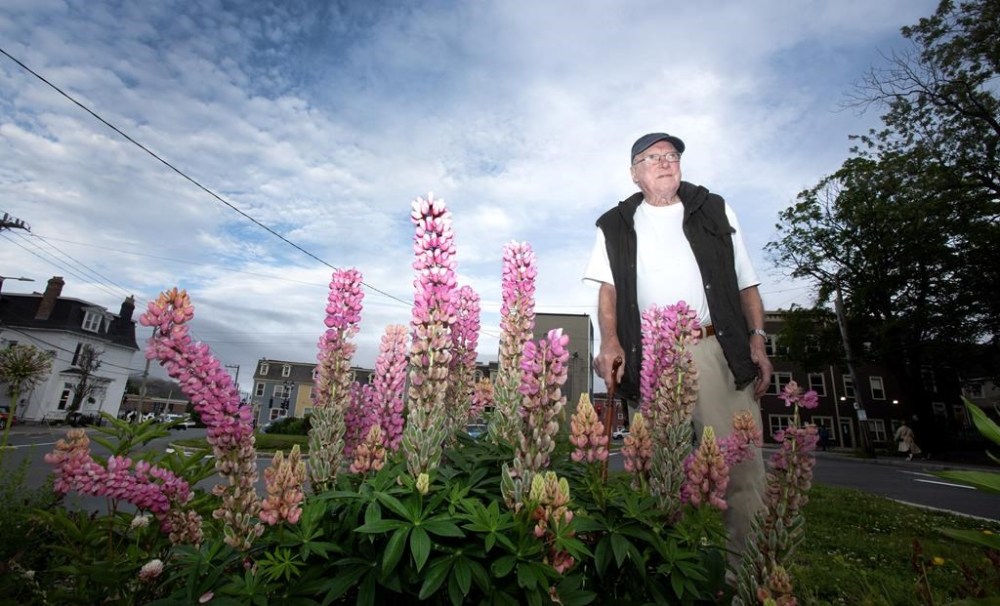
ST. JOHN’S, N.L. – In downtown St. John’s, N.L., this summer, motorists have been treated to a rare botanical sight — a plume of pink lupins growing at the heart of a hectic intersection.
Dense swirls of purple, pink and white are not uncommon along roadsides across Atlantic Canada as lupins come into bloom, but most of those fields are dominated by purple — and after a few summers, the colour seems to take over completely.
The careful cluster of pink in the St. John’s gardens tended by retired neurosurgeon William Pryse-Phillips may also succumb to purple over the years, the 86-year-old acknowledged in a recent interview. “Though I may not live to see it,” he added, laughing.
The type of lupin that spreads across fields and takes over roadside slopes each year is the large-leaf lupin, and they’re considered invasive, said Jason McCallum, a scientist with Agriculture and Agri-Food Canada.
They arrived in Atlantic Canada from western North America much like they arrived in the middle of St. John’s: gardeners were taken by their tall, bobbing clusters of pastel-coloured flowers and decided to plant some seeds, McCallum said in a recent interview. The flowers are part of the pea family, and they ultimately produce dozens of pods, each with its own row of seeds.
With so many seeds from just one flower, a small cluster of lupins can produce hundreds of seeds, which are then blown around by the wind. They take hold easily, even in poor-quality dirt, which explains their abundance in the dry, dusty soil along highways, McCallum said.
“You start out with a few plants, and then the next thing you know, hundreds and hundreds of metres of the roadside is just completely engulfed in lupins,” he said.
About 30 years ago, the Prince Edward Island government tried unsuccessfully to eradicate the flowers, McCallum said.
“They went out with, like, lawn mowers on the sides of tractors, and tried cutting them in the ditches,” he said. “But they’re perennial plants, they come back from their roots year after year once they’re established. So even if you stop them from flowering, the plants are still there.”
Now, lupin-covered fields and hillsides are a staple in tourism materials used to lure visitors to the region.
The sundial lupin, another species of the plant, is native to parts of Atlantic Canada, but “they’re almost endangered at this point,” McCallum said. Sundial lupins have the same foxtail-shaped flower heads, but their blooms are a pale, muted blue, and the plants are smaller, he said.
Claire Ferguson with the New Brunswick Invasive Species Council said she encourages anyone interested in planting lupins to seek out sundial lupin seeds, rather than the invasive large-leafed variety — even if they’re not as colourful.
Invasive lupins can crowd out native plants and the insects those plants support, although McCallum said they are a boon for bumblebees. And it is the bumblebees, he figures, that are at least partly responsible for turning multicoloured lupin patches into fields of monochrome purple.
“Honeybees and butterflies and things, they like red colours more,” he said. “But bumblebees definitely like purple.”
The genetic component for purple colour in lupins is dominant, he said. Bees are more likely to land on purple flowers and pick up their pollen. If they land on a white or a pink flower and cross-pollinate the colours, the flowers’ offspring has a much higher chance of being purple.
Pryse-Phillips’ patch of pink lupins — what McCallum called a “founder population” — will likely become overrun with purple in time, McCallum predicted, thanks to cross-pollinating from bees who’ve been nosing around in purple lupins and make a pit stop in the roadside pink.
Pryse-Phillips said he chose to plant the pink lupins this year because they went with the other early-summer flowers in his gardens in two medians at a St. John’s intersection known as Rawlins Cross. He became an official steward of the area in a city-run adopt-a-spot program about three decades ago, and his gardens are now cherished across the city.
After St. John’s spent much of the early summer under a thick covering of fog this year, many of Pryse-Phillips’ flowers were slow to bloom. His pink lupins were among the first to burst through the ground, their flowers all the more vibrant against June’s grey skies.
Though he likes the pink, he said it’s all right if they’re replaced with purple in time. “They’re still nice plants, whatever colour.”
This report by The Canadian Press was first published July 27, 2024.