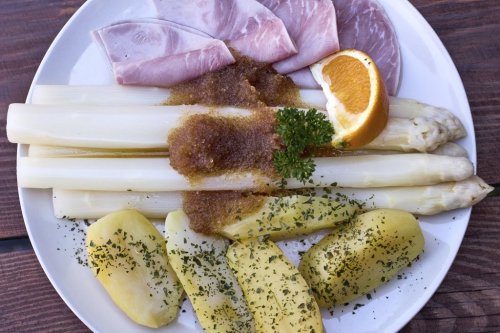
It’s springtime in Germany and people are obsessing about white asparagus

Advertisement

Advertise with us

BEELITZ, Germany (AP) — Asparagus season has arrived in Germany, signaling the unofficial beginning of springtime.

Read this article for free:


or

Already have an account? Log in here »

To continue reading, please subscribe:

Subscribe and receive a limited-edition Free Press branded hat or tote.

Digital Subscription

One year of digital access for only $205*

  • Enjoy unlimited reading on winnipegfreepress.com
  • Read the E-Edition, our digital replica newspaper
  • Access News Break, our award-winning app
  • Play interactive puzzles

*First annual payment billed as $205.00 + GST for one year. This annual subscription will automatically renew at $233.00 + GST every 52 weeks (10% off the regular annual price of $259.35). Offer available to new and qualified returning subscribers only. Cancel any time.

To continue reading, please subscribe:

Add Free Press access to your Brandon Sun subscription for only an additional

$1 for the first 4 weeks*

  • Enjoy unlimited reading on winnipegfreepress.com
  • Read the E-Edition, our digital replica newspaper
  • Access News Break, our award-winning app
  • Play interactive puzzles
Start now

*Your next Brandon Sun subscription payment will increase by $1.00 and you will be charged $17.95 plus GST for four weeks. After four weeks, your payment will increase to $24.95 plus GST every four weeks.

Hey there, time traveller!
This article was published 08/04/2025 (530 days ago), so information in it may no longer be current.

BEELITZ, Germany (AP) — Asparagus season has arrived in Germany, signaling the unofficial beginning of springtime.

There is no other vegetable that Germans obsess about as much as white asparagus. They can discuss for hours whether it should be eaten with melted butter or Hollandaise sauce, served with smoked ham or schnitzel, or should come with a side of potatoes boiled whole or peeled, cut into slices and fried with bacon and onion.

There’s also some debate over whether you can eat the shoots with your fingers or only with a fork and knife — though traditional etiquette clearly states that using your fingers is no violation of good manners as long as you dip and clean them in a little bowl of warm water.
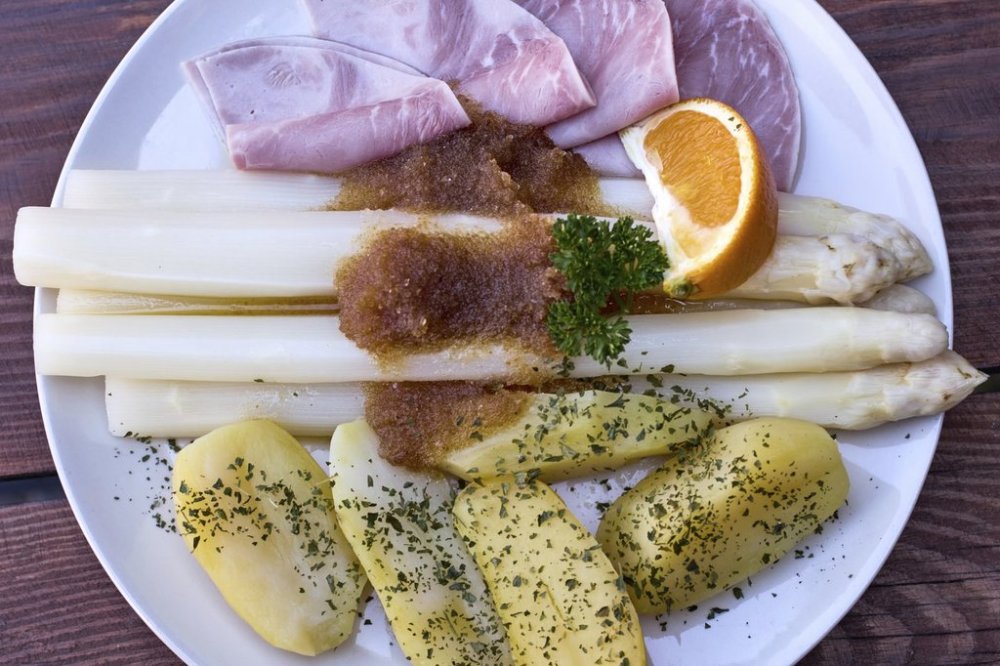
A plate with fresh white asparagus, ham, potatoes and melted butter is served at the Jakobs-Hof farm asparagus restaurant in Beelitz Germany, Thursday, April 3, 2025. (AP Photo/Markus Schreiber)

The only thing Germans can agree on when it comes to their favorite veggie is that green asparagus comes nowhere close to its white companion and may as well be snubbed or ignored.

“White asparagus is definitely more delicate in taste,” said Sven Sperling, 54, who was enjoying his first dish of the year at the Jakobs-Hof asparagus restaurant in Beelitz, just outside of Berlin. “It’s something very special. It’s not possible to compare it to green asparagus.”

Asparagus is known as ‘white gold’ in Germany

Beelitz is one of the most famous asparagus-growing regions in the country. The farmers in the town, which is located 50 kilometers (30 miles) southwest of the German capital, make a good living off the “white gold” as the vegetable is sometimes called — a nod not just to its color but also its steep price. At the beginning of the season in early April it sells for up to 20 euros per kilo ($22 for two pounds).

By the end of the season in June the price tag for asparagus can go down to 10 euros per kilo — but nonetheless Spargel, as it is called in German, will not lose its air of luxury throughout the entire season.

For Germans, white asparagus is much more than just food, it’s a way of life, says Jürgen Jakobs, who runs the Jakobs-Hof restaurant, a farmers store, and grows the vegetable on 25 hectares of land — about the size of 300 soccer fields.

“Eating asparagus is a celebration,” Jakobs said in a recent interview with The Associated Press as he looked over his seemingly endless fields where Romanian workers were cutting the shoots out of the ground manually.

“Asparagus is the first vegetable of spring. Asparagus is served on holidays: Easter, Mother’s Day, Whitsun,” he said. “Usually family or friends are called over and the table is set festively.”

The ancient Romans considered the veggie an aphrodisiac

The passion for the delicacy is legendary in Europe. The ancient Romans considered the vegetables an aphrodisiac and supposedly brought them to Central Europe. Here, the delicacy was initially only grown in monastery gardens and only the nobility was allowed to eat it in the Middle Ages.

It was only in the late 19th century that farmers started growing asparagus on fields and thus made it available to more people — nonetheless the vegetable still has a somewhat elitist reputation to this day.

The shoots like sandy ground, which gives them the unique sweet, almost nutty taste, said Jakobs, whose family has been cultivating the veggie for several generations.

White asparagus grows underground covered with plastic tarp — the moment it’s touched by sunlight it turns violet, then green, and changes its flavor to a fuller, more bitter aroma.

Germans are the world champions in eating white asparagus

Nobody eats more white asparagus than the Germans — each citizen devours about three pounds per year, which translated to a yearly harvest volume of 105,000 metric tons last year, according to the country’s Federal Statistical Office.

Germans don’t export white asparagus, they eat it all themselves, but they do import it from countries like Spain or Italy, which mainly grow it for export. The imported veggies are mostly sold in supermarkets and are less expensive than the homegrown ones — but also not as refined when it comes to the flavor, said Jakobs.

White asparagus is mostly steamed in water with one tablespoon of sugar and one tablespoon of salt and — unlike its green brother — it needs to be peeled before it’s cooked. Asparagus has a social component as well, because traditionally, the women of the house would sit together for hours peeling many kilos of shoots, chatting and enjoying each other’s company.

Nowadays, some high-end grocery stores sell the delicacies peeled already to shorten the preparation time. Health advocates praise the low amount of calories of the watery stalks that are normally a little longer and thicker than their green brethren.

The shoots are more than just a food; they convey a way of life

However, at the end of the day nothing compares to the real, old-school experience, Sperling said, while he finished his plate with the veggies that had been freshly cut just a few hours earlier by Jakobs’ team.

“Buying it fresh from the farm, peeling it yourself at home, and celebrating the preparation with the family at the weekend — it couldn’t be better,” he said, adding with a nostalgic smile that it simply tastes of “childhood memories.”


Report Error Submit a Tip

More Stories

Desperate Poilievre wants Canadians to believe the sky is falling when it’s just cloudy outside

Tom Brodbeck 5 minute read Preview

Desperate Poilievre wants Canadians to believe the sky is falling when it’s just cloudy outside

Tom Brodbeck 5 minute read Friday, Sep. 18, 2026

Pierre Poilievre has a problem.

Canadians just don’t seem to be paying much attention to him anymore.

So, naturally, the Conservative Opposition leader has decided to turn up the volume.

At a recent party caucus retreat in Penticton, B.C., Poilievre delivered the familiar message: Canada is in trouble, Canadians are hurting and the Liberal government is making everything worse.

Read
Friday, Sep. 18, 2026

Canada must not accept another Iranian autocracy

David Matas 5 minute read Yesterday at 2:01 AM CDT

Iran is a state run by a radical government victimizing its citizens and its neighbours. How do we change that? Any regime change that repeats the mistakes of the past is not a solution.

What went wrong in the past which led to the current regime? One answer is the U.K. and American aided coup which led to the ouster in 1953 of a democratically elected government headed at the time by Mohammad Mossadegh and its replacement with an American friendly autocrat, the Shah of Iran, Mohammad Reza Pahlavi.

The Shah imposed his rule through the Iranian National Intelligence and Security Organization — SAVAK, the acronym of its Persian name. SAVAK systematically inflicted torture, arbitrary killings and extra-judicial killings on perceived opponents of the regime. It was only a matter of time before repression of a regime directed to serving foreign interests would be overthrown.

What replaced the regime of the Shah, in 1979, the current regime of the mullahs, is a regime as intolerant and violent as the regime of the Shah and then some. That was not inevitable. But neither was it surprising. The vicious nature of the current regime, following the example set by the Shah, and its hatred for the United States, reacting to the U.S. aided imposition of the Shah, both echoes and reacts to the past. In 1979, the U.S. reaped what it sowed in 1953.

Near-future U.S. the setting for surreal dual-world storyline

Reviewed by Morley Walker 4 minute read Preview

Near-future U.S. the setting for surreal dual-world storyline

Reviewed by Morley Walker 4 minute read Yesterday at 2:01 AM CDT

It’s not every day you encounter a seriously intended literary novel that attempts to dramatize a mind-bending physics theory like quantum entanglement.

But then the B.C.-born-and-raised Emily St. John Mandel is not your everyday Canadian literary writer.

In her late 40s, she has lived in the U.S. for her entire writing career. She is best known for her 2014 dystopian novel Station Eleven, about a Shakespearean acting troupe navigating a pandemic-ravaged America.

Her new outing, her seventh, Exit Party, shares DNA with detective and sci-fi genres more than with conventional literary fiction.

Read
Yesterday at 2:01 AM CDT

It’s springtime in Germany and people are obsessing about white asparagus

Kirsten Grieshaber, The Associated Press 5 minute read Preview

It’s springtime in Germany and people are obsessing about white asparagus

Kirsten Grieshaber, The Associated Press 5 minute read Tuesday, Apr. 8, 2025

BEELITZ, Germany (AP) — Asparagus season has arrived in Germany, signaling the unofficial beginning of springtime.

There is no other vegetable that Germans obsess about as much as white asparagus. They can discuss for hours whether it should be eaten with melted butter or Hollandaise sauce, served with smoked ham or schnitzel, or should come with a side of potatoes boiled whole or peeled, cut into slices and fried with bacon and onion.

There's also some debate over whether you can eat the shoots with your fingers or only with a fork and knife — though traditional etiquette clearly states that using your fingers is no violation of good manners as long as you dip and clean them in a little bowl of warm water.

The only thing Germans can agree on when it comes to their favorite veggie is that green asparagus comes nowhere close to its white companion and may as well be snubbed or ignored.

Read
Tuesday, Apr. 8, 2025

Not falling back means time loop remains unclosed

Jen Zoratti 4 minute read Yesterday at 2:01 AM CDT

I demand restitution. Where’s my hour?

In the traditional fall-back, spring-forward time change set up — you know, ol’ trusty that’s been effect for lo these 63 years — we lost an hour in the spring that we got back in the fall.

That was the social contract: you commit to feeling like you’re on cold medication for a week in March because you know a glorious extra hour of sleep will be returned to you in November. (Unless, of course, you have little kids, but look: we all make our choices.)

Well, that transaction, flawed as it was, isn’t happening this year. That hour you sacrificed to the sun gods in the spring? Gone. Not coming back. We’ve sprung forward and we shan’t be falling back — not in November, and (possibly) not ever. The scale shall remain unbalanced and the loop shall remain unclosed as Manitoba has adopted permanent daylight time.

Cabernet Sauvignon star of wine festival

Ben Sigurdson 5 minute read Preview

Cabernet Sauvignon star of wine festival

Ben Sigurdson 5 minute read Yesterday at 3:00 AM CDT

The Winnipeg Wine Festival will celebrate the king of red wine grapes next weekend — the theme of this year’s festival, which takes place Sept. 25 and 26 at the RBC Convention Centre, is Cabernet Sauvignon.

Cab Sauv, as it’s also known, is the world’s most widely planted wine grape of any colour, first coming to prominence in the 1800s in France’s Bordeaux region, where the grape is still popular. Rather than single-variety wines, Bordeaux reds tend to be blends, with those coming from the left bank of the Gironde estuary being Cabernet-dominant, while right-bank wines are Merlot-dominant, with Cabernet Sauvignon playing a supporting role. Cabernet and Merlot work well together and many other countries have followed suit in blending the two.

A team at University of California Davis put Cabernet Sauvignon through a DNA test in 1996 and discovered its parent grapes are Cabernet Franc and Sauvignon Blanc — it’s likely that at some point the two varieties, planted next to each other in some vineyard, crossed and mutated and became the grape we know today. (Someone growing grapes in the 19th century must have had an inkling of what was up, as the grape has been called Cabernet Sauvignon since long before the DNA test.)

Flavour-wise, most Cabernet Sauvignon wines are big and bold, with a core of deep dark berry flavours, some graphite and spice notes and relatively bright acidity. It’s a grape that is well-suited to barrel aging, with most examples seeing at least some time in wood.

Read
Yesterday at 3:00 AM CDT