Misericordia chapel lives on

Advertisement
Read this article for free:
or
Already have an account? Log in here »
To continue reading, please subscribe:

Digital Subscription
One year of digital access for only $205*
- Enjoy unlimited reading on winnipegfreepress.com
- Read the E-Edition, our digital replica newspaper
- Access News Break, our award-winning app
- Play interactive puzzles
*First annual payment billed as $205.00 + GST for one year. This annual subscription will automatically renew at $233.00 + GST every 52 weeks (10% off the regular annual price of $259.35). Offer available to new and qualified returning subscribers only. Cancel any time.
To continue reading, please subscribe:
Add Free Press access to your Brandon Sun subscription for only an additional
$1 for the first 4 weeks*
- Enjoy unlimited reading on winnipegfreepress.com
- Read the E-Edition, our digital replica newspaper
- Access News Break, our award-winning app
- Play interactive puzzles
*Your next Brandon Sun subscription payment will increase by $1.00 and you will be charged $17.95 plus GST for four weeks. After four weeks, your payment will increase to $24.95 plus GST every four weeks.
Read unlimited articles for free today:
or
Already have an account? Log in here »
Hey there, time traveller!
This article was published 18/06/2011 (5573 days ago), so information in it may no longer be current.
Now boarded off and under demolition, parts of a century-old hospital chapel will rise again in the near future.
St. Luke’s Chapel at Misericordia Health Centre was officially closed last September to make room for a new building on that site, but demolition crews are salvaging the painted frescoes and leaded glass windows that have graced the chapel since it opened in 1916, says the centre’s spiritual care director.
Rev. Vince Herner says staff and residents are pleased the frescoes will be reused in the health centre’s new chapel and in a new Roman Catholic church in Morden.
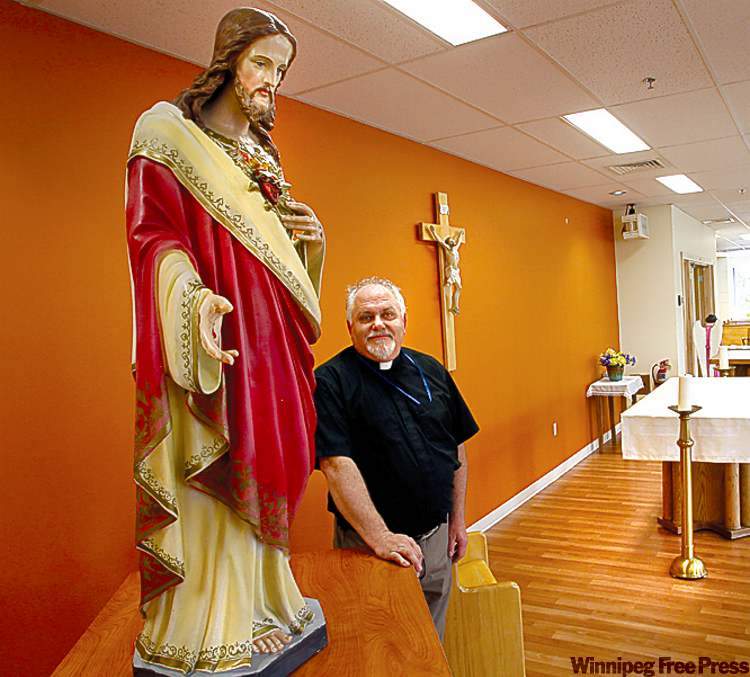
The chapel’s Art Deco-style leaded glass windows, which do not have religious symbols on them, will probably be reinstalled somewhere in the future buildings at Misericordia.
“The response is, ‘Oh, good, it’s (the chapel) going to live on,’ ” says Herner, who has worked in spiritual care at Misericordia for the last 15 years. “The comment (from staff) is that it would be a shame if it was just thrown in the garbage.”
Much of the interior plaster work from the high-ceilinged former chapel on the second floor of Misericordia’s Maryland building cannot be salvaged, but six 1.2-metre-high oval frescoes depicting scenes from the life of Jesus Christ will be removed. Two of them will find a home in the new chapel, which should be completed within three to five years, and the other four will be installed in the meeting room of St. John the Evangelist Roman Catholic Church in Morden.
“Apparently these (frescoes) were painted off-site by the artist, and they were plastered into the wall,” explains Derek Buttars, an interior designer with MMP Architects, the firm that designed the new building for St. John the Evangelist.
Constructed at a cost of $1.8 million, the new Catholic church in Morden is a modern building with layers of boxes, but it will also include older fittings and furniture from the congregation’s current wood frame building, as well as the nearly century-old frescoes, says Buttars.
The new, still unnamed chapel at Misericordia is part of the second phase of construction at the health centre, which involves demolishing the oldest buildings of the complex and replacing them with a health-care facility for seniors, an expanded eye-care centre and a new main entrance for the complex.
Until the new chapel is completed, patients, long-term care residents and staff will worship in a temporary chapel located in the former intensive care unit at the southwest corner of the complex, a floor above the current urgent care department.
That new space, featuring windows overlooking the Assiniboine River, includes furniture and several of the plaster statues from St. Luke’s. But after nine decades of looking down on worshippers from their second-storey niches, the statues are now placed on low pedestals, making them easier to view, says Herner. The statue of Mary holding Jesus, a gift from medical staff when St. Luke’s was dedicated in 1916, is now located just outside the entrance to the interim chapel.
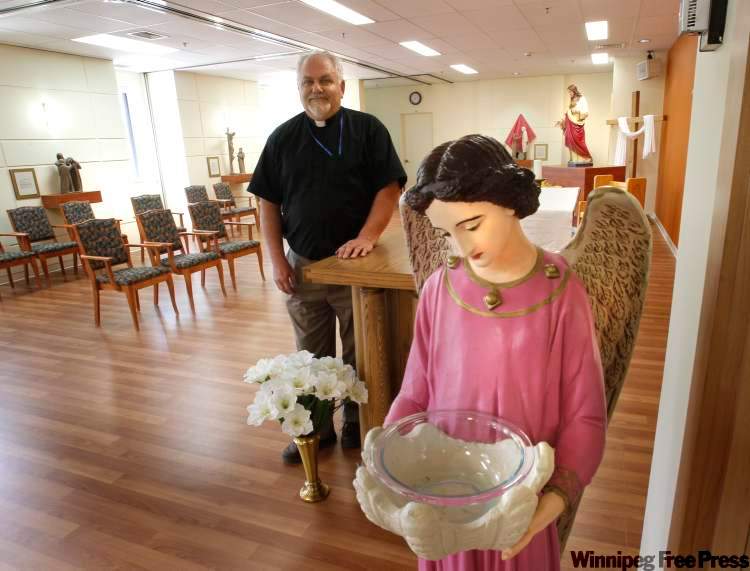

The one-level interim chapel is simple and spare, a stark contrast to the ornate St. Luke’s, but it offers lots of space for wheelchairs, as well as providing a comfortable and warm place for about 40 worshippers at the services held three times a week.
“(St. Luke’s) was cold and drafty, and we have a number of shawls and lap blankets we brought out to keep residents warm during the service,” explains Herner.
Unlike the former chapel, the doors to the interim chapel are kept locked, since its entrance is located off a hallway in the interim care facility, says Herner.
“For safety and the privacy of residents, we’ve had to restrict access.”
brenda@suderman.com
The Free Press is committed to covering faith in Manitoba through our Religion in the News project. This reporting continues because readers like you step forward to fund it.
Donate now to support our reporting on religion.
Your donation is eligible for a charitable tax receipt.
BECOME A FAITH JOURNALISM SUPPORTER
Brenda Suderman has been a columnist in the Saturday paper since 2000, first writing about family entertainment, and about faith and religion since 2006.
Our newsroom depends on a growing audience of readers to power our journalism. If you are not a paid reader, please consider becoming a subscriber.
Our newsroom depends on its audience of readers to power our journalism. Thank you for your support.
The Free Press is committed to covering faith in Manitoba through our Religion in the News project. This reporting continues because readers like you step forward to fund it.
Donate now to support our reporting on religion.
Your donation is eligible for a charitable tax receipt.
BECOME A FAITH JOURNALISM SUPPORTER
Brenda Suderman has been a columnist in the Saturday paper since 2000, first writing about family entertainment, and about faith and religion since 2006.
Our newsroom depends on a growing audience of readers to power our journalism. If you are not a paid reader, please consider becoming a subscriber.
Our newsroom depends on its audience of readers to power our journalism. Thank you for your support.
Advertisement Advertise With Us
Advertisement Advertise With Us
The Free Press acknowledges the financial support it receives from members of the city’s faith community, which makes our coverage of religion possible.