Reflections on covering historic Vatican event
Highlights of the Roman Catholic Church’s Synod on Synodality

Advertisement
Read this article for free:
or
Already have an account? Log in here »
To continue reading, please subscribe:

Digital Subscription
One year of digital access for only $205*
- Enjoy unlimited reading on winnipegfreepress.com
- Read the E-Edition, our digital replica newspaper
- Access News Break, our award-winning app
- Play interactive puzzles
*First annual payment billed as $205.00 + GST for one year. This annual subscription will automatically renew at $233.00 + GST every 52 weeks (10% off the regular annual price of $259.35). Offer available to new and qualified returning subscribers only. Cancel any time.
To continue reading, please subscribe:
Add Free Press access to your Brandon Sun subscription for only an additional
$1 for the first 4 weeks*
- Enjoy unlimited reading on winnipegfreepress.com
- Read the E-Edition, our digital replica newspaper
- Access News Break, our award-winning app
- Play interactive puzzles
*Your next Brandon Sun subscription payment will increase by $1.00 and you will be charged $17.95 plus GST for four weeks. After four weeks, your payment will increase to $24.95 plus GST every four weeks.
Read unlimited articles for free today:
or
Already have an account? Log in here »
Hey there, time traveller!
This article was published 02/11/2024 (684 days ago), so information in it may no longer be current.
A week ago, I was in Rome covering the end of the month-long assembly of the Roman Catholic Church’s Synod on Synodality.
It was quite a week, learning about the inner workings of the Roman Catholic Church, a church with 1.4 billion members spread around the world. I wrote 11 stories about it for this newspaper, catching what I hoped were the highlights. But there were many other things related to that historic event that didn’t make it into my articles. Here are a few of them.
● ● ●
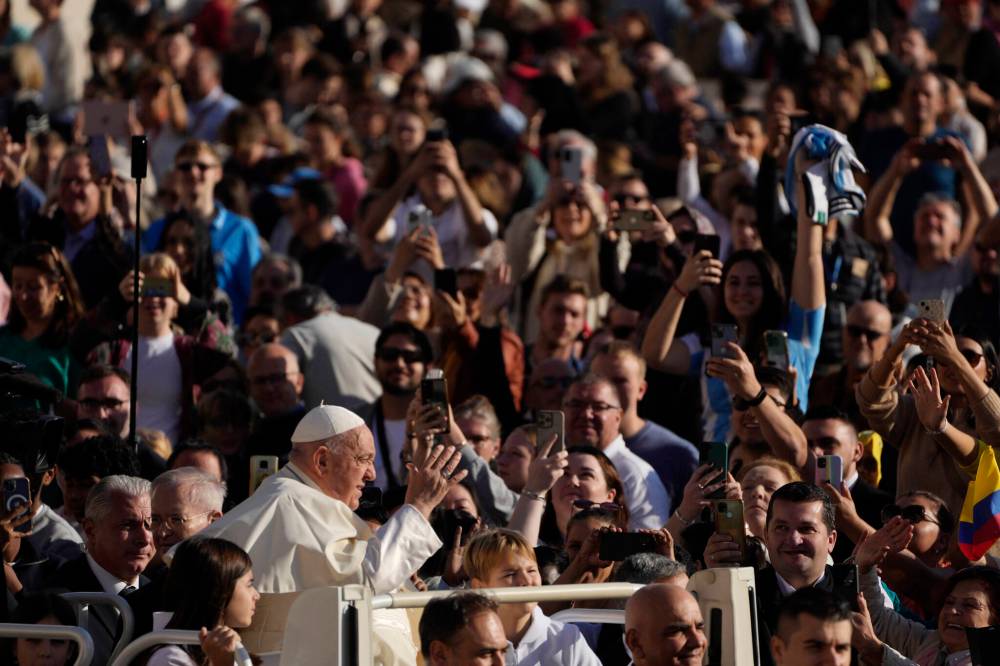
Gregorio Borgia / The Associated Press
Pope Francis arrives for his weekly general audience in St. Peter’s Square, at the Vatican, on Oct. 30.
One thing that stood out at the synod was how the discussions took place. Unlike other gatherings where speeches are delivered and then people respond, the synod featured what was called “Conversations in the Spirit.”
In that format, each delegate at the various tables of ten or 11 people had three uninterrupted minutes to share on a topic. After sharing, there was a period of silence, followed by a chance for each delegate to respond to what was heard—again, for three minutes. After that, a more general discussion ensued.
Delegates expressed deep appreciation for this approach to dealing with difficult challenges, saying it helped ensure every voice was heard — from cardinals to bishops to lay people.
As it turns out, Canada can take some credit for this approach. It was pioneered by Jesuits in Canada in the 1970s, and is known in the Roman Catholic Church as the “Canadian method” — a significant contribution from this country to the universal Church through the synod.
For Pope Francis, this “Canadian method” is a form of discussion and discernment he wants to see the Roman Catholic Church use worldwide at national, diocesan and parish levels, as a way to make sure everyone’s voice is heard, not just those at the top.
● ● ●
On the Sunday before the last week of the synod, the pope canonized 14 new saints including Canadian Marie-Leonie Paradis of Quebec. Just the third saint to have been born in Canada, Paradis was canonized for her life of service and sanctity through Petites sœurs de la Sainte-Famille de Sherbrooke (Little Sisters of the Holy Family of Sherbrooke), an order she founded in 1880 to serve the needs of priests.
While Catholics Canada were glad to see a Canadian mad into a saint, one long-time Vatican observer noted it was probably not lost on Canadian women advocating for greater leadership roles in the Church that Paradis was known for her devotion to doing domestic chores for priests — things like cooking, cleaning and laundry.
The observer wondered what kind of message that sent to Canadian Catholic women, coming as it did in the midst of a synod where they saw no progress on the topic of women’s ordination.
● ● ●
Another thing that marked the synod gathering in Rome was the presence of 16 fraternal delegates from other Christian denominations.
These delegates came from Orthodox, Anglican, Lutheran, Methodist, Reformed, Baptist, Pentecostal, Disciples of Christ and Mennonite churches. They were invited to participate fully in the discussions, but they could not vote.
Anne-Cathy Graber of France, a Mennonite pastor and secretary for ecumenical relations for the Mennonite World Conference, represented Mennonites at the synod.
“The invitation was amazing, considering how small the Mennonite world is,” said Graber, adding although Mennonites are a very small group — just about 1.5 million worldwide, compared to 1.4 billion Roman Catholics — her “voice and presence were welcomed just like everyone else’s. Everyone counted, even those of us from the smallest denominations.”
She noted the Roman Catholic Church didn’t need to invite such a small denomination to the synod. But the fact it did shows how committed that Church is to synodality — or “journeying together” — not just among Catholics, but with all Christians. “It showed that every voice matters, every voice is important,” Graber said.
During breaks at the synod, Graber was able to speak informally with Pope Francis. “I thanked him for the invitation,” she said, explaining she was a Mennonite. “He seemed to know who Mennonites were, telling me we must all walk together as Christians.”
● ● ●
On the question of women’s ordination, the synod indicated the answer is not yes — but it’s not no, either. But that isn’t of much comfort to Catholic women who had hoped for a breakthrough moment at this synod.
That includes the Women’s Ordination Conference (WOC), an international organization dedicated to seeing women become ordained deacons and priests in the Roman Catholic Church. Following the release of the final synod document, WOC issued a statement saying the proposal to continue studying the question was “disappointing.”
“Endless study on the subject of women is a patriarchal stalling tactic by ordained men to maintain the status quo,” the WOC stated. “Ordained men decide the parameters and pace of synodality, and when the time is ‘ripe’ for women’s ministries. And they do so at an incalculable cost. The church has lost generations of women who endured the pain and humiliation of having to prove the validity of their calling. How long must women wait? Or more consequentially: Will women wait?”
That’s a good question. It remains to be seen what answer Catholic women will give.
● ● ●
One topic that got almost no attention at the synod was how the Church might respond to LGBTTQ+ people; it was shunted off to a study group of “controversial” issues that will report to the pope next year. But it came into the synod agenda in an unexpected way when Cardinal Fridolin Ambongo of the Democratic Republic of Congo spoke about the need for the Church in Africa to have flexibility to address the subject of polygamy, which is traditional in some African cultures.
Polygamy has become one of the most contentious issues for the Catholic Church on that continent, since it contradicts Church teaching that marriage is to be between one man and one woman only. Ambongo said the Church in Africa intends to remain faithful to the Catholic doctrine on marriage. But he also said the Church needs to find a pastoral way to accompany Catholics in polygamous relationships.
And what does that have to do with LGBTTQ+? According to reports, a day after Ambongo made his comments, another delegate gave an almost identical version of his remarks on the floor of the synod. Only in place of the word “polygamy,” he said “LGBTTQ+.”
In his comments, the delegate used the same logic as Ambongo to argue that churches need the ability to adapt Church teaching to local contexts and cultures. In Africa, that would mean polygamy; in places like Europe, the U.S. and Canada, it would be for people in same-sex relationships.
That is a challenge for The Vatican, which strives to have unity in doctrine for the entire Roman Catholic Church around the world. It remains to be seen how this will play out with the report from the study group in 2025.
● ● ●
Pope Francis surprised everyone by immediately announcing that he had accepted the final text of the synod, releasing it to the public. As Dutch journalist and Vatican watcher Hendro Munsterman noted, this was revolutionary.

Until now, the Pope has always written a summary review — a post-synodal exhortation — in which he may or may not support the ideas of the synod. This ensures the pope always has the last word.
But just as Pope Francis turned the synod on its head by not sitting on the podium above the delegates, but rather sitting with them at round tables, he intends to invert the way the Church thinks about authority and power by letting the person in the pew speak the final word.
By releasing it immediately, Munsterman said, the pope was declaring “’what is here on paper is the result of three years of collective discernment. I don’t have to say whether I agree with it anymore. This is what the church as a whole thinks and so it is what I think. What is written here has therefore become a very official part of the Church.’”
As Munsterman said, that was revolutionary. Now it is up to the Church in Manitoba, in Canada and around the world to decide how it wants to participate in this revolution.
faith@freepress.mb.ca
The Free Press is committed to covering faith in Manitoba through our Religion in the News project. This reporting continues because readers like you step forward to fund it.
Donate now to support our reporting on religion.
Your donation is eligible for a charitable tax receipt.
BECOME A FAITH JOURNALISM SUPPORTER
Our newsroom depends on a growing audience of readers to power our journalism. If you are not a paid reader, please consider becoming a subscriber.
Our newsroom depends on its audience of readers to power our journalism. Thank you for your support.
The Free Press is committed to covering faith in Manitoba through our Religion in the News project. This reporting continues because readers like you step forward to fund it.
Donate now to support our reporting on religion.
Your donation is eligible for a charitable tax receipt.
BECOME A FAITH JOURNALISM SUPPORTER
Our newsroom depends on a growing audience of readers to power our journalism. If you are not a paid reader, please consider becoming a subscriber.
Our newsroom depends on its audience of readers to power our journalism. Thank you for your support.
Advertisement Advertise With Us
Advertisement Advertise With Us
History
Updated on Tuesday, November 5, 2024 9:07 AM CST: Corrects that Cardinal Fridolin Ambongo is from the Democratic Republic of Congo
The Free Press acknowledges the financial support it receives from members of the city’s faith community, which makes our coverage of religion possible.