Loss, worry and prayers for better days mark Ramadan’s start as fragile ceasefire holds in Gaza

Advertisement

Advertise with us

JABALIYA, Gaza Strip (AP) — Before the war, the Muslim holy month of Ramadan was a festive time of increased worship, social gatherings and cheer for Fatima Al-Absi. Together with her husband, the resident of Jabaliya in Gaza said she used to do Ramadan shopping, visit relatives and head to the mosque for prayers.

Read this article for free:


or

Already have an account? Log in here »

To continue reading, please subscribe:

Subscribe and receive a limited-edition Free Press branded hat or tote.

Digital Subscription

One year of digital access for only $205*

  • Enjoy unlimited reading on winnipegfreepress.com
  • Read the E-Edition, our digital replica newspaper
  • Access News Break, our award-winning app
  • Play interactive puzzles

*First annual payment billed as $205.00 + GST for one year. This annual subscription will automatically renew at $233.00 + GST every 52 weeks (10% off the regular annual price of $259.35). Offer available to new and qualified returning subscribers only. Cancel any time.

To continue reading, please subscribe:

Add Free Press access to your Brandon Sun subscription for only an additional

$1 for the first 4 weeks*

  • Enjoy unlimited reading on winnipegfreepress.com
  • Read the E-Edition, our digital replica newspaper
  • Access News Break, our award-winning app
  • Play interactive puzzles
Start now

*Your next Brandon Sun subscription payment will increase by $1.00 and you will be charged $17.95 plus GST for four weeks. After four weeks, your payment will increase to $24.95 plus GST every four weeks.

Hey there, time traveller!
This article was published 01/03/2025 (582 days ago), so information in it may no longer be current.

JABALIYA, Gaza Strip (AP) — Before the war, the Muslim holy month of Ramadan was a festive time of increased worship, social gatherings and cheer for Fatima Al-Absi. Together with her husband, the resident of Jabaliya in Gaza said she used to do Ramadan shopping, visit relatives and head to the mosque for prayers.

But the Israel-Hamas war has shredded many of the familiar and cherished threads of Ramadan as Al-Absi once knew it: her husband and a son-in-law have been killed, her home was damaged and burnt and the mosque she attended during Ramadan destroyed, she said.

“Everything has changed,” she said on Saturday as her family observed the first day of Ramadan. “There’s no husband, no home, no proper food and no proper life.”
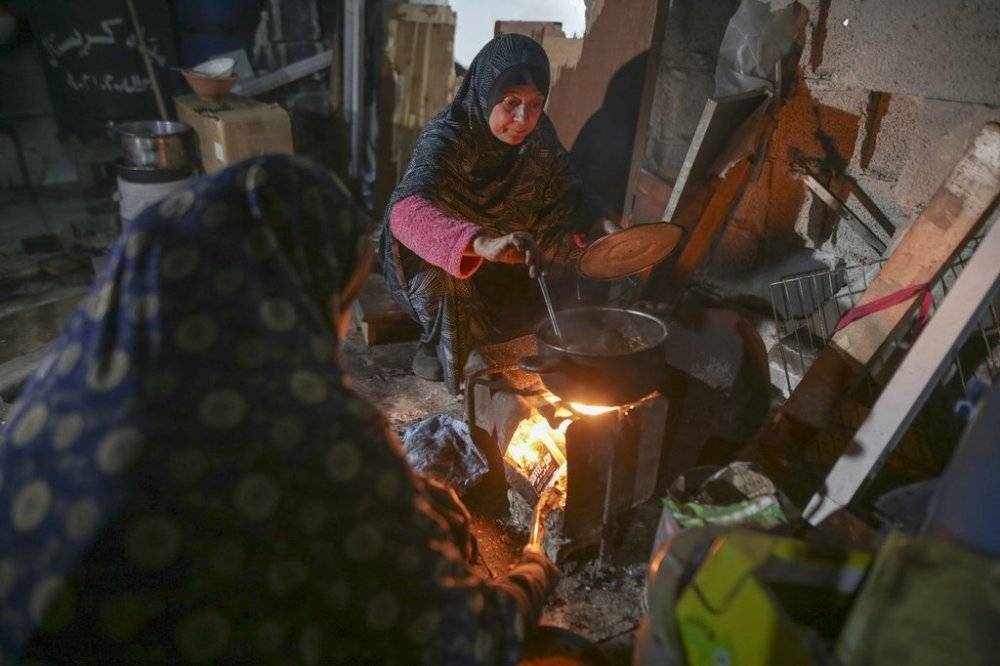
Fatima Al-Absi prepares food for her family's iftar, the fast-breaking meal, on the first day of Ramadan in their damaged apartment in Jabaliya, northern Gaza Strip, on Saturday, March 1, 2025. (AP Photo/Jehad Alshrafi)

For Al-Absi and other Gaza residents, Ramadan started this year under a fragile ceasefire agreement that paused more than 15 months of a war that has killed tens of thousands of Palestinians and devastated the Gaza Strip. Compared to last Ramadan, many found relief in the truce — but there’s also worry and fear about what’s next and grief over the personal and collective losses, the raw wounds and the numerous scars left behind.

“I’ve lost a lot,” said the 57-year-old grandmother, who’s been reduced to eking out an existence amid the wreckage. “Life is difficult. May God grant us patience and strength,” she added.

Israel cut off all aid and other supplies to Gaza on Sunday to pressure Hamas to accept a new proposal to extend the first phase of the ceasefire. Hamas accused Israel of trying to derail the existing ceasefire agreement, but both sides stopped short of declaring the truce over.

“We’re scared because there’s no stability,” Al-Absi said and added that she’s praying for the war to end and that she can’t bear any more losses. She spoke before Israel announced the new proposal and the aid cutoff on Sunday.

Though Ramadan is still far from normal, some in the Gaza Strip said that, in some ways, it feels better than last year’s.

“We can’t predict what will happen next,” Amal Abu Sariyah, in Gaza City, said before the month’s start. “Yes, the country is destroyed and the situation is very bad, but the feeling that the shelling and the killing … have stopped, makes you (feel) that this year is better than the last one.”

Overshadowed by war and displacement, last Ramadan was “very bad” for the Palestinian people, she said. The 2024 Ramadan in Gaza began with cease-fire talks then at a standstill, hunger worsening across the strip and no end in sight to the war.

The war was sparked by the Oct. 7, 2023 attack on Israel in which Hamas-led militants killed some 1,200 people and took about 250 hostages. Israel’s military offensive has killed over 48,000 Palestinians, according to Gaza’s Health Ministry, which does not distinguish between combatants and civilians. Vast areas of Gaza have been destroyed.

Under the ceasefire, hundreds of thousands of Palestinians flooded back into northern Gaza. After initial relief and joy at returning to their homes — even if damaged or destroyed — they’ve been grappling with living amid the wreckage.

As Palestinians in the Gaza Strip prepared for Ramadan, shopping for essential household goods and food, some lamented harsh living conditions and economic hardships, but also said they rely on their faith in God to provide for them.

“I used to help people. … Today, I can’t help myself,” said Nasser Shoueikh. “My situation, thank God, used to be better and I wasn’t in need for anything. … We ask God to stand by us.”

For observant Muslims the world over, Ramadan is a time for fasting daily from dawn to sunset, increased worship, religious reflection, charity and good deeds. It often brings families and friends together in festive gatherings around meals to break their fast.

Elsewhere in the Gaza Strip, Fatima Barbakh, from the southern city of Khan Younis, said her Ramadan shopping was limited to the essentials.

“We can’t buy lanterns or decorations like we do every Ramadan,” she said.

Back in Jabaliya, Al-Absi bitterly recalled how she used to break her fast with her husband, how much she misses him and how she remembers him when she prays.

“We don’t want war,” she said. “We want peace and safety.”

___

Shurafa reported from Deir al-Balah, Gaza Strip, and Fam from Cairo. Associated Press journalist Abdel Kareem Hana contributed from Gaza City.

___

Associated Press religion coverage receives support through the AP’s collaboration with The Conversation US, with funding from Lilly Endowment Inc. The AP is solely responsible for this content.

Report Error Submit a Tip

The Free Press acknowledges the financial support it receives from members of the city’s faith community, which makes our coverage of religion possible.


More Stories

Volunteer pop-up library axed from Manitoba Youth Centre

Matthew Frank 4 minute read Preview

Volunteer pop-up library axed from Manitoba Youth Centre

Matthew Frank 4 minute read Updated: Yesterday at 11:25 AM CDT

Manitoba Corrections has cancelled a pop-up library program at the Manitoba Youth Centre, leaving inmates without librarian services and fewer options to borrow certain books.

The Prison Libraries Committee, part of the non-profit Manitoba Library Association, operated and funded the volunteer program since 2024 before it was shut down by the province last month. The group previously partnered with the province to offer the service because the facility has no dedicated library of its own.

“It is concerning that community members who are incarcerated, especially youth, are losing out on meaningful programming, access to information and rehabilitation efforts, which are offered at no cost to (Manitoba) Corrections. We urge Manitoba Justice to promote more library services and programming, not less,” said a Sept. 24 letter from the non-profit addressed to the justice minister.

Ashley Huot, chair of the Prison Libraries Committee, said she was puzzled when she received an email last month from Manitoba Corrections stating that the pop-up library was no longer needed.

Read
Updated: Yesterday at 11:25 AM CDT

Creative powerhouse Perry Rosemond never lost Winnipeg roots

Ben Waldman 7 minute read Preview

Creative powerhouse Perry Rosemond never lost Winnipeg roots

Ben Waldman 7 minute read Yesterday at 6:00 AM CDT

He created King of Kensington, directed the troops in the Royal Canadian Air Farce, and his creative eye was behind the lens for television shows starring Johnny Cash, Tom Jones, Mr. Dress-Up and the Friendly Giant.

He also wrote and developed the Canadian version of Sesame Street during his time as the head of school and preschool programming for CBC in Toronto, and directed a televised special in 2002 for Winnipeg sketch comedy troupe Royal Liechtenstein Theatre Company.

But before his name featured in the credits of some of the most iconic and influential pieces of the Cancon canon, Perry Rosemond was an only child living in a crammed, multi-generational home in Winnipeg’s North End, racing each day to beat the morning bell next door at William Whyte School.

In memoirs that have yet to be published, the late television producer recalled his childhood. “(T)here were 14 of us in the house at 193 Andrews St., and it wasn’t that big of a house,” he writes.

Read
Yesterday at 6:00 AM CDT

Brandonmeat packer thriving on its own

Abiola Odutola 3 minute read Preview

Brandonmeat packer thriving on its own

Abiola Odutola 3 minute read Yesterday at 2:01 AM CDT

BRANDON — Canada Packers has strengthened its business and laid the foundation for future growth during its first year as an independent company, its president says.

The Brandon-based pork producer, separated from Maple Leaf Foods in October 2025, established its own leadership, strategy, systems, culture and identity while continuing operations across its hog production farms and regional hog barns in southern and eastern Manitoba.

The company’s first year was focused on building a successful standalone business while continuing to serve customers, communities and shareholders, president Dennis Organ said.

“Market conditions over the past year have been more challenging than we anticipated when we became a separate entity,” he said in an email. “Despite that, we continued to execute against our priorities, including increasing processing volumes, maintaining disciplined operations and strengthening the business.”

Read
Yesterday at 2:01 AM CDT

Winnipeggers witness unveiling of Japanese Canadian monument in B.C.

Morgan Modjeski 6 minute read Preview

Winnipeggers witness unveiling of Japanese Canadian monument in B.C.

Morgan Modjeski 6 minute read Yesterday at 8:39 PM CDT

As Miki Stewart gathered with her family at the Japanese Cultural Association of Manitoba on Saturday afternoon, she was thinking of her parents, Yoshimaru and Yoshi Abe.

Both Stewart, 80, and her sister Yumi Falk, 81, alongside an older brother, were born in the Tashme internment camp in British Columbia. They were among more than 2,600 Japanese Canadians who were forcefully removed and interned at the camp following the bombing of Pearl Harbour and Canada’s declaration of war on Japan in 1941.

“They didn’t talk much about how they suffered,” Stewart said of her parents. “But they did.”

She was amongst a group of more than 150 people who gathered at the association’s McPhillips headquarters on Saturday afternoon to watch the unveiling of the Japanese Canadian Monument in Victoria B.C.

Read
Yesterday at 8:39 PM CDT

Broadening prediction-market gambling a bad idea

Editorial 4 minute read Preview

Broadening prediction-market gambling a bad idea

Editorial 4 minute read Yesterday at 2:01 AM CDT

Let’s make a prediction: sooner or later, when Canadian governments find a way to take their own cut of the action, prediction-contract gambling on everything from sports to entertainment to political decisions is going to come to Canada.

And that’s a horrible, dangerous, pernicious idea.

Unless you have particular access to information — either inside information or strategic information based on skills or education — you’re not likely to make money at it. In fact, structurally, you’re likely to lose. In prediction markets, you basically pay an amount, plus fees from the company involved, to bet on whether something will or will not happen within a certain time frame. The amount you pay for your contract depends on how other people are also betting.

As Wealthsimple describes it, “You buy whichever side you think is right. Prices move with demand, so if the market leans towards one outcome, the more that side costs. If a lot of people are backing the TSX to finish above 38,000, yes gets more expensive and no gets cheaper.”

Read
Yesterday at 2:01 AM CDT

Khan should’ve taken high road: Goertzen

Carol Sanders 5 minute read Preview

Khan should’ve taken high road: Goertzen

Carol Sanders 5 minute read Friday, Oct. 2, 2026

The veteran Progressive Conservative who championed Obby Khan’s leadership bid says the former Blue Bomber dropped the ball by dissing his Tory teammates before he stepped down.

“I wouldn’t recommend it, and I didn’t recommend it,” Kelvin Goertzen (Steinbach) said in an interview Friday.

Khan resigned as PC leader and quit the caucus Monday saying some members were secretly plotting his ouster, even after he won a confidence vote on Sept. 25.

On Tuesday, Khan lashed out in a CJOB interview, naming the alleged plotters, saying constituents deserved to know which of their elected representatives “lacked moral integrity.” Khan told the Free Press he was “deeply emotionally hurt,” and felt stabbed in the back.

Read
Friday, Oct. 2, 2026