Good design in everyday products is focus of MoMA exhibit

Advertisement

Advertise with us

NEW YORK - From early Tupperware containers to Chemex coffee makers to sleek midcentury modern furniture, a new show at the Museum of Modern Art explores the democratizing and uplifting potential of design in everyday life.

Read this article for free:


or

Already have an account? Log in here »

To continue reading, please subscribe:

Subscribe and receive a limited-edition Free Press branded hat or tote.

Digital Subscription

One year of digital access for only $205*

  • Enjoy unlimited reading on winnipegfreepress.com
  • Read the E-Edition, our digital replica newspaper
  • Access News Break, our award-winning app
  • Play interactive puzzles

*First annual payment billed as $205.00 + GST for one year. This annual subscription will automatically renew at $233.00 + GST every 52 weeks (10% off the regular annual price of $259.35). Offer available to new and qualified returning subscribers only. Cancel any time.

To continue reading, please subscribe:

Add Free Press access to your Brandon Sun subscription for only an additional

$1 for the first 4 weeks*

  • Enjoy unlimited reading on winnipegfreepress.com
  • Read the E-Edition, our digital replica newspaper
  • Access News Break, our award-winning app
  • Play interactive puzzles
Start now

*Your next Brandon Sun subscription payment will increase by $1.00 and you will be charged $17.95 plus GST for four weeks. After four weeks, your payment will increase to $24.95 plus GST every four weeks.

Hey there, time traveller!
This article was published 19/02/2019 (2736 days ago), so information in it may no longer be current.

NEW YORK – From early Tupperware containers to Chemex coffee makers to sleek midcentury modern furniture, a new show at the Museum of Modern Art explores the democratizing and uplifting potential of design in everyday life.

“The Value of Good Design” opened Feb. 10 and runs through June 15 at the museum, which is preparing to close its doors temporarily this summer before opening a newly expanded campus later in the year.

The exhibit takes a fresh look at everything from domestic furnishings and appliances to ceramics, glass, electronics, transport design, sporting goods, toys and graphics. It focuses on household goods designed in the ’40s and ’50s as part of MoMA’s Good Design initiatives, which included competitions, exhibits, TV shows, educational programs and even three fully furnished houses built in the Museum Garden.
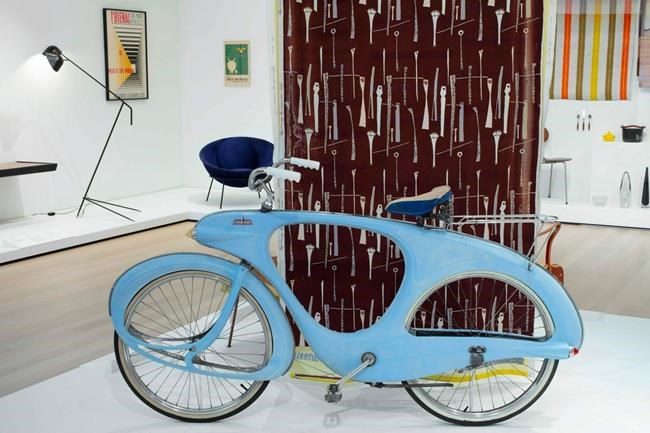
This Feb. 6, 2019 photo shows an installation view of the exhibit
This Feb. 6, 2019 photo shows an installation view of the exhibit "The Value of Good Design," at The Museum of Modern Art in New York. The exhibit runs Feb. 10 to June 15, 2019. (John Wronn/The Museum of Modern Art via AP)

Selections of good design were toured by MoMA nationally — to schools, libraries, colleges — and internationally.

MoMA’s initiatives championed well-designed, affordable, contemporary products. They gave young designers a platform, and helped launch the careers of Eero Saarinen, Charles and Ray Eames and other famous designers.

Winning designs of the competitions, which also were held by other major art museums such as the Walker Art Center in Minneapolis and the Detroit Institute of Arts, were then promoted in department stores, featured in magazines and strategically placed in television shows.

“To me good design is simply art applied to living,” the show quotes Dorothy Shaver, president of the Lord and Taylor department store, as saying at the 1950 launch of Good Design, a five-year collaboration between MoMA and the Chicago Merchandise Mart that entailed annual exhibits in New York and Chicago.

Designs for a huge range of home goods were evaluated on appearance, function, construction and price.

The show reveals the way household design was embraced not only by museums and stores, but also by governments during the Cold War as a tool of social and economic reconstruction and technological advancement. At one point, MoMA collaborated with the State Department to circulate American designs for everyday household products; there was a vibrant international exchange of ideas, with designs from other countries being shown in the U.S. while American designs were promoted overseas, according to the exhibit.

As you walk through the expansive gallery space, the neutrals and browns of the 1940s give way to the brightly colored chairs and textiles of the ’50s. Many of the objects were so well-designed that they continue to feel contemporary today, and can still be found in many homes.

The exhibit begins with a simple broomstick, for example, hung on the wall as a work of art. Nearby is a large glass case including, among other objects, an axe, with its carefully designed balance between the heavy blade and the gently curved wooden handle. Also featured are bath mitts and a whisk.

“People smile as they encounter things they’ve handled and used,” says Juliet Kinchin, curator in the museum’s department of architecture and design, who organized the exhibit with curatorial assistant Andrew Gardner.

“I love the axe. It was absolutely part of the agenda. It wasn’t about fads or fashion, it was about asking people to take a second look at things that are consistently pleasant to use and to look at,” she explains.

The show is divided into two parts: what was happening in design in the U.S. as it rose to become a superpower, and what was happening elsewhere in the world.

Included are promotional videos for some of the items featured, an ad for a tiny Fiat Cinquecento car that is on display, and a video of Eames products shown in a State Department-sponsored exhibit in Moscow in 1959.

“The idea of good design was an important form of soft power at the time, and continues to resonate today,” Kinchin says.

“Good design is much more than just appearance and it doesn’t happen in a vacuum,” she says. “It doesn’t have to be expensive. And what was good design in the ’50s might not necessarily be good design today. Now, for example, sustainability really would have to be key. Any notion of good design should reflect the values of the age.”

In one section of the exhibit, visitors are invited to judge designs for themselves by trying out a few Good Design classics still in production, such as a Slinky toy and various styles of desk lamp. They also can evaluate whether new products, such as portable solar-powered lanterns, pass muster as good design.

Report Error Submit a Tip

More Stories

Good design in everyday products is focus of MoMA exhibit

Katherine Roth, The Associated Press 4 minute read Preview

Good design in everyday products is focus of MoMA exhibit

Katherine Roth, The Associated Press 4 minute read Tuesday, Feb. 19, 2019

NEW YORK - From early Tupperware containers to Chemex coffee makers to sleek midcentury modern furniture, a new show at the Museum of Modern Art explores the democratizing and uplifting potential of design in everyday life.

"The Value of Good Design" opened Feb. 10 and runs through June 15 at the museum, which is preparing to close its doors temporarily this summer before opening a newly expanded campus later in the year.

The exhibit takes a fresh look at everything from domestic furnishings and appliances to ceramics, glass, electronics, transport design, sporting goods, toys and graphics. It focuses on household goods designed in the '40s and '50s as part of MoMA's Good Design initiatives, which included competitions, exhibits, TV shows, educational programs and even three fully furnished houses built in the Museum Garden.

Selections of good design were toured by MoMA nationally — to schools, libraries, colleges — and internationally.

Read
Tuesday, Feb. 19, 2019

Could renewed interest in strategically critical rare earth elements finally make sub-sector profitable?

Joel Schlesinger 6 minute read Preview

Could renewed interest in strategically critical rare earth elements finally make sub-sector profitable?

Joel Schlesinger 6 minute read Yesterday at 3:00 AM CDT

Rare earth elements are among the most critical of mined resources for modern economies.

They’re essential in manufacturing specialized magnets used in a host of technologies from wind turbines and electric vehicles to hard drives, smartphones, television screens, and fibre optics. Most notably, however, rare earth minerals are increasingly vital to the defence industry.

These 17 elements — closely related chemically and usually found all together in mineral deposits — have indeed been growing in geopolitical importance as the United States, Canada and other Western nations recognize their dependence on production from China.

It is the world’s largest producer and processor of rare earths, including the most in-demand elements neodymium and praseodymium used to manufacture very light and powerful magnets for an array of technologies, including the most advanced weapons of modern warfare.

Read
Yesterday at 3:00 AM CDT

HSC weapons scanners effective, needed at other hospitals: nurses union

Carol Sanders 5 minute read Preview

HSC weapons scanners effective, needed at other hospitals: nurses union

Carol Sanders 5 minute read Yesterday at 9:57 AM CDT

The AI weapons scanners at Health Sciences Centre have detected close to 2,000 items since they were installed at Manitoba’s largest hospital.

From March 6, 2025 to the beginning of this month, a total of 1,973 items had been flagged by the scanners and identified for further review, Shared Health said this week.

Knives, Swiss army knives and other multi-tools, drugs, alcohol, box cutters, syringes and other injection devices were detected, it said. The technology set up at entrances to the adult and children’s emergency rooms and the crisis response centre is designed to identify a wide range of objects that may require review under site safety protocols.

But Manitoba Nurses Union president Darlene Jackson said the technology isn’t available everywhere at HSC, and a sawed-off rifle was discovered in the adult ER earlier this month.

Read
Yesterday at 9:57 AM CDT

Men’s recovery home dedicated to ‘homeless hero’ Faron Hall’s memory

Scott Billeck 14 minute read Preview

Men’s recovery home dedicated to ‘homeless hero’ Faron Hall’s memory

Scott Billeck 14 minute read Friday, Aug. 14, 2026

Faron Hall never got the chance to begin recovery. Once heralded as Winnipeg’s “homeless hero” after twice plunging into the Red River to save strangers from drowning, Hall told St. Boniface Street Links executive director Marion Willis shortly before his death in 2014 that he wanted help for his alcoholism.

Read
Friday, Aug. 14, 2026

Manitoba family finalist for cattle producers environmental award

Aaron Epp 4 minute read Preview

Manitoba family finalist for cattle producers environmental award

Aaron Epp 4 minute read Yesterday at 2:00 AM CDT

A family in western Manitoba is one of seven finalists for a national environmental award honouring beef cattle producers.

Connor and Kyla English, alongside Connor’s parents, Brian and Leanne English, are nominated for the Canadian Cattle Association’s Environmental Stewardship Award. The 30-year-old award is presented to beef farmers and ranchers who explore innovative ways to protect, preserve and enhance their operations and the environment simultaneously.

This year’s recipient will be announced on Wednesday during a banquet at the Canadian Beef Industry Conference in Winnipeg.

The English family’s roots near Bradwardine — about 265 kilometres west of Winnipeg — date back to 1898. Today, Connor, Kyla, Brian and Leanne manage a herd of about 320 breeding cows on nearly 445 hectares (1,100 acres) of owned and rented pasture and forage land.

Read
Yesterday at 2:00 AM CDT

Firefighter’s death fuels cancer fight

Zoe Pierce 5 minute read Preview

Firefighter’s death fuels cancer fight

Zoe Pierce 5 minute read Yesterday at 2:01 AM CDT

The United Fire Fighters of Winnipeg is mourning the loss of Winnipeg firefighter Darrel Maynard while continuing its work to raise awareness of occupational cancer and improve health protections for firefighters.

Maynard, a senior firefighter II and acting lieutenant with the Winnipeg Fire Paramedic Service, died Aug. 5 at age 41 after a three-year battle with occupational cancer.

He served Winnipeg for nearly two decades and leaves behind his wife Francine and sons Colin and Christian.

“Darrel was an incredible, incredible person, an incredible firefighter, and really, really special to all of us,” said Nick Kasper, president of UFFW.

Read
Yesterday at 2:01 AM CDT