A tall-grass prairie companion
Habitat management really is for the birds (and every other species, too)
Advertisement
Read this article for free:
or
Already have an account? Log in here »
To continue reading, please subscribe:

Digital Subscription
One year of digital access for only $205*
- Enjoy unlimited reading on winnipegfreepress.com
- Read the E-Edition, our digital replica newspaper
- Access News Break, our award-winning app
- Play interactive puzzles
*First annual payment billed as $205.00 + GST for one year. This annual subscription will automatically renew at $233.00 + GST every 52 weeks (10% off the regular annual price of $259.35). Offer available to new and qualified returning subscribers only. Cancel any time.
To continue reading, please subscribe:
Add Free Press access to your Brandon Sun subscription for only an additional
$1 for the first 4 weeks*
- Enjoy unlimited reading on winnipegfreepress.com
- Read the E-Edition, our digital replica newspaper
- Access News Break, our award-winning app
- Play interactive puzzles
*Your next Brandon Sun subscription payment will increase by $1.00 and you will be charged $17.95 plus GST for four weeks. After four weeks, your payment will increase to $24.95 plus GST every four weeks.
Read unlimited articles for free today:
or
Already have an account? Log in here »
Hey there, time traveller!
This article was published 16/04/2016 (3792 days ago), so information in it may no longer be current.
University of Manitoba Prof. Nicola Koper has a broad background — landscape ecology, prairie and wetland ecology, multi-species management, surrogate species and ecological statistics.
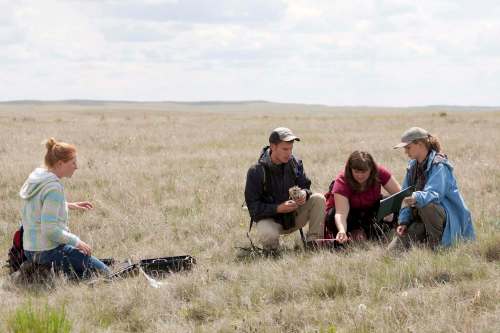
Her current projects explore conservation and habitat management for songbirds in mixed-grass and tall-grass prairies in Saskatchewan and Manitoba.
Over the past few years, she has also been working on conservation and ecotourism projects in the Caribbean country of Grenada.

Koper, who holds a faculty position in terrestrial ecology at the University of Manitoba’s Natural Resources Institute, sat down in early March to discuss her work.
Free Press: You are exploring conservation and habitat management for songbirds in mixed-grass and tall-grass prairies in Saskatchewan and Manitoba. What sort of practical applications have you done in that regard? How successful have they been?
Nicola Koper: I’ve worked a lot with federal and provincial governments, and with non-governmental organizations such as the Nature Conservancy of Canada, to develop species-recovery plans and habitat-management programs. Our research has helped us to make management recommendations about cattle grazing and to allow us to better understand how and where to conserve remaining fragments of native grasslands.
It’s clear that habitat fragmentation created by introducing roads and other human developments affects a much bigger area than just the area where habitat was lost. This has been important in helping us understand the conservation needs of species at risk that strongly avoid habitat edges, such as chestnut-collared longspurs and Sprague’s pipits.
FP: What led you to focus on conservation biology as a career?
NK: Like most people in this field, I find natural areas beautiful and fascinating, and I wanted to help protect them. Ultimately though, this led me to work mostly in human-altered landscapes. But I’ve learned to enjoy the wildlife that live around us and to appreciate that sometimes, conservation and economic development can both be achieved.
I also wanted to work on conservation of species that are often overlooked. We pay a lot of attention to conserving big, fluffy species like bears and pandas, and species with economic value, like game species, but in general our society spends a lot less time considering the conservation needs of plants and the little brownish birds we see around us all the time. The problem is they are affected by human activities as well, and they play important ecological roles within their ecosystems, so we need to conserve them.
FP: What are some of the other projects you’re working on?

NK: My students and I have been studying the effects of oil and gas development on grassland birds, such as Sprague’s pipits, Baird’s sparrows and chestnut-collared longspurs, in the prairies of southern Alberta for about six years now. It’s been fascinating, as it has allowed me to integrate research on habitat fragmentation, avoidance of habitat edges and roads, effects of cattle grazing and understanding how we can mitigate effects of human activities.
A particularly interesting component has been our research on effects of industrial noise. Noise is really important from a management perspective because we can actually do something about it by using quieter infrastructure, mufflers or other existing and commercially available technology. It’s also important from a theoretical perspective, because understanding effects of noise helps us understand communication among birds.
When we started this research, I really wanted to be able to distinguish the effects of noise from effects of the presence of infrastructure. To allow us to do this, my students and technicians and I developed unique, solar-powered infrastructure that allows us to play the noise from oil wells and oil drilling activities in sites where oil wells are absent. This has enabled us to study what effects there are from noise, specifically, and thus whether reducing noise would reduce the negative ecological impacts of wells. Our results are preliminary, so I can’t describe them in much detail, but we do see some effects of noise on behaviour and productivity.
FP: What is adaptive management? Where is this approach being applied?
NK: Adaptive management is sometimes thought of as “learning by doing.” We first have to acknowledge that we don’t know all the answers. Maybe we have some good ideas of what might happen to wildlife if we, say, build a road through a wetland, but we probably don’t know for sure. Will some species be displaced? Will some avoid the whole wetland because of noise and pollution? Ecology is an imprecise science. We can make educated guesses, but we still have a lot to learn.
In ecology, when we use the term adaptive management, we mean that we design a management action that is intended to help conserve species in such a way that we can measure the effects of that management tool and compare it with other management alternatives. The management tool is implemented following a rigorous study design protocol, and ecological consequences are strictly monitored.
For about 10 years, I’ve been working with Grasslands National Park of Canada in southern Saskatchewan to figure out how to reintroduce livestock grazing to the park in such a way that ecological integrity is enhanced, not harmed, by cattle. We’ve applied adaptive management to achieve this goal. North American prairies evolved in the presence of two important natural disturbances — grazing by wild ungulates, such as bison, and fire. We’ve virtually eliminated those disturbances from the landscape, making grasslands ecosystems very different from what they were like before Europeans colonized this region. In some parts of Grasslands National Park we’ve been able to reintroduce bison, but some areas of the park are too small to sustain a herd of bison, and there we’ve designed an adaptive-management experiment comparing ecological effects of a wide range of cattle-stocking rates, from very low to very high, to figure out what the optimal grazing intensity might be. We’ve also studied what happens to the ecosystem once you remove cattle after grazing it for several years.

Many people are surprised to learn that livestock can actually be good for conservation, but some species, such as the threatened chestnut-collared longspur, are dependent on these heavily grazed ecosystems. Our study in Grasslands National Park is helping us learn how to conserve these species while balancing the needs of other species that do better in undisturbed landscapes.
FP: What does the future hold for conservation of natural habitats, particularly on the prairies?
NK: That depends most on what our society decides are its priorities. We can create the future we want. We just need to decide what that is. But without active management, prairies, in particular, are going to continue to degenerate, and we’re going to lose a lot more species.