U.S. downs new ‘object’ off Alaskan coast, not far from Canadian border: White House
Advertisement
Read this article for free:
or
Already have an account? Log in here »
To continue reading, please subscribe:

Digital Subscription
One year of digital access for only $205*
- Enjoy unlimited reading on winnipegfreepress.com
- Read the E-Edition, our digital replica newspaper
- Access News Break, our award-winning app
- Play interactive puzzles
*First annual payment billed as $205.00 + GST for one year. This annual subscription will automatically renew at $233.00 + GST every 52 weeks (10% off the regular annual price of $259.35). Offer available to new and qualified returning subscribers only. Cancel any time.
To continue reading, please subscribe:
Add Free Press access to your Brandon Sun subscription for only an additional
$1 for the first 4 weeks*
- Enjoy unlimited reading on winnipegfreepress.com
- Read the E-Edition, our digital replica newspaper
- Access News Break, our award-winning app
- Play interactive puzzles
*Your next Brandon Sun subscription payment will increase by $1.00 and you will be charged $17.95 plus GST for four weeks. After four weeks, your payment will increase to $24.95 plus GST every four weeks.
Read unlimited articles for free today:
or
Already have an account? Log in here »
Hey there, time traveller!
This article was published 10/02/2023 (1318 days ago), so information in it may no longer be current.
WASHINGTON – A U.S. fighter jet shot an unknown object out of the sky Friday off the coast of Alaska not far from the Canadian border, White House officials confirmed, just hours after Canada’s defence minister met with her American counterpart at the Pentagon.
National Security Council co-ordinator John Kirby confirmed the latest encounter and its location during Friday’s press briefing at the White House, and said the order to shoot it down came directly from President Joe Biden.
Kirby said the object, first detected Thursday night, was not far from the Canada-U.S. border when it was shot down off the north Alaska coast over the frozen Arctic Ocean. Pentagon spokesman Brig.-Gen. Pat Ryder said it was travelling in a “northeasterly direction” at the time.
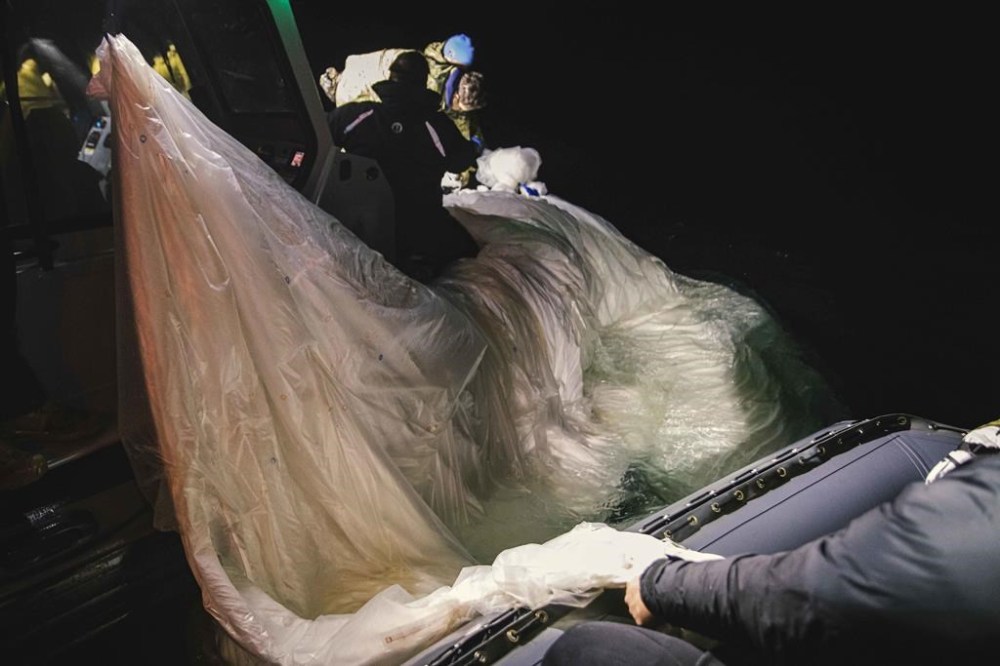
Kirby described the object as “the size of a small car,” but had few other details, such as where it might have come from or its capabilities.
“I can tell you it was an object that was at 40,000 feet” that did not appear to have the ability to manoeuvre, Kirby said, adding it was deemed a threat to civilian aircraft at that altitude.
“I’m not ruling anything in or out,” he said.
Prime Minister Justin Trudeau was briefed on the situation “and supported the decision to take action,” he tweeted. “Our military and intelligence services will always work together, including through (Norad), to keep people safe.”
Defence Minister Anita Anand said in a statement that she had learned about the object at the Pentagon, where she met earlier Friday with U.S. Defense Secretary Lloyd Austin.
She said in the statement that there, she and Austin participated in a call with Norad commander Gen. Glen VanHerck “regarding a high-altitude object detected over Alaska.”
The object did not fly into Canadian airspace, Anand confirmed, and she “conveyed Canada’s support” for taking it down. She added that Canada would continue to “work closely with our American allies” to protect North American airspace.
Earlier Friday, the U.S. Federal Aviation Administration restricted flights over an area about 26 square kilometres off Bullen Point, the site of a disused U.S. Air Force radar station on the Beaufort Sea about 160 kilometres from the Canada-U.S. border, The Associated Press reported.
“Any time we detect anything, we’re going to first of all observe it, and then make a decision and take appropriate action,” Ryder said.
“Given the fact that it was operating at an altitude that posed a reasonable threat to civilian air traffic, the determination was made and the president gave the order to take it down.”
At an earlier meeting on Friday, Austin thanked Canada for its help in tracking the Chinese surveillance balloon that traversed North America last week.
It’s still not clear what U.S. or Canadian intelligence that balloon managed to collect before it was shot out of the sky — an option Canada rejected because it posed no threat to public safety, Anand said earlier in the day.
The U.S. has the lead on analyzing the balloon, which was downed Sunday off the South Carolina coast, and Canada is not directly involved, Anand said.
Through Norad, the jointly commanded continental defence system, both the U.S. and Canada monitored the balloon’s weeklong journey from the Aleutian Islands off Alaska to its violent demise over the Atlantic Ocean at the hands of an F-22 Raptor fighter pilot.
But the minister offered no further details about where exactly the balloon was when Canada first learned of the incursion.
“We were … examining the trajectory and analyzing the balloon, including the height of the balloon and the contents of the balloon, and determined that it posed no imminent risk to Canadians at all,” Anand said.
“The analysis of the balloon and its contents … is what the United States is undertaking on its own. We’re not part of that.”
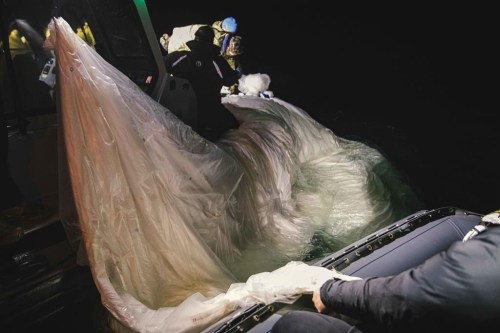
In the Pentagon briefing, Ryder said recovery teams have mapped the debris field on the ocean floor and are gathering it for analysis as weather conditions permit.
“While I won’t go into specifics due to classification reasons, I can say that we have located a significant amount of debris so far that will prove helpful to our further understanding of this balloon and its surveillance capabilities.”
In his meeting with Anand, Austin made specific mention of last week’s balloon as he cited the value of Norad and the importance of the ongoing binational effort to upgrade a system that experts say is desperately out of date.
“The United States and Canada recently worked together through Norad to track (China’s) high-altitude surveillance balloon that violated the sovereignty of both of our countries,” Austin said.

“That co-ordination underscored the importance of our efforts and the need for continued investment in Norad modernization on both sides.”
VanHerck acknowledged earlier this week that the balloon wasn’t the first of its kind to enter U.S. airspace, and that previous events went undetected, exposing a “domain awareness gap” that needs closing.
Anand has said there’s no evidence any of those prior episodes involved Canadian airspace.
“I think we’re going to continue to learn a lot about how these things are or can be detected,” Kirby said. “We expect to learn a lot about our own systems, our own processes, for detection and tracking.”
This report by The Canadian Press was first published Feb. 10, 2023.
Related Articles
Canada helping U.S. recover Lake Huron UFO debris
Advertisement Advertise With Us
Advertisement Advertise With Us