Disaster fatigue
Parliamentary defence committee explores ways to ease mounting pressure on the Canadian Forces who are often called upon as responder of first resort for an increasing number of extreme weather events
Advertisement
Read this article for free:
or
Already have an account? Log in here »
To continue reading, please subscribe:

Digital Subscription
One year of digital access for only $205*
- Enjoy unlimited reading on winnipegfreepress.com
- Read the E-Edition, our digital replica newspaper
- Access News Break, our award-winning app
- Play interactive puzzles
*First annual payment billed as $205.00 + GST for one year. This annual subscription will automatically renew at $233.00 + GST every 52 weeks (10% off the regular annual price of $259.35). Offer available to new and qualified returning subscribers only. Cancel any time.
To continue reading, please subscribe:
Add Free Press access to your Brandon Sun subscription for only an additional
$1 for the first 4 weeks*
- Enjoy unlimited reading on winnipegfreepress.com
- Read the E-Edition, our digital replica newspaper
- Access News Break, our award-winning app
- Play interactive puzzles
*Your next Brandon Sun subscription payment will increase by $1.00 and you will be charged $17.95 plus GST for four weeks. After four weeks, your payment will increase to $24.95 plus GST every four weeks.
Read unlimited articles for free today:
or
Already have an account? Log in here »
Hey there, time traveller!
This article was published 25/03/2023 (1299 days ago), so information in it may no longer be current.
John Savage remembers the 2017 floods in Gatineau, Que., which forced the region to call in military assistance, as a “slow motion disaster.”
“You could see the water rising and it just kept raining and raining and raining,” Savage said of the record-breaking weather that started in early April and continued all month. “I remember being at a staff lunch at a restaurant and it just kept raining. I just thought, this is actually kind of funny in a way, because just when you think it couldn’t get worse, it just kept coming.”
The deluge pouring from the sky outside the restaurant window would soon show up in the basement of his home. Quebec called in the highest level of support as the flood waters continued to rise in 261 municipalities: 2,200 members of the Canadian Armed Forces arrived with military boats, helicopters, armoured vehicles and engineering equipment.
Savage told The Narwhal he welcomed the friendly troops, but he couldn’t help but wonder why they had come. In the end he was largely on his own to manage — though soldiers filled sandbags, they left them kilometres away from his home, so he and his neighbours borrowed canoes from a tourist outfitter, then paddled over to get them. Meanwhile, he felt like his soggy street became a background for press conferences by local politicians. In his mind, the sight of green fatigues was a symbol of their failure to prepare.
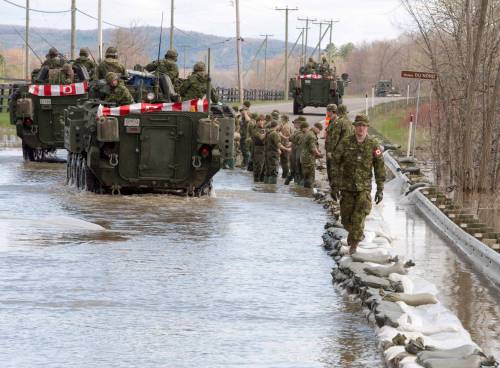
RYAN REMIORZ / CANADIAN PRESS FILES Canadian Forces soldiers lay down sandbags to reinforce a highway in Saint-Andre-d’Argenteuil, Que., in 2017. The military is feeling the strain of responding to a rising number of natural disasters every year.
“These people didn’t join the army to do sandbagging,” he explains, thinking back to the flood. He feels the current situation in Ukraine makes military priorities even clearer: “we need them for standing off against the Russians now.”
Since spring 2022, a House of Commons defence committee has been quizzing expert witnesses on how to manage the needs of Canadians struck by disaster. It has heard that the pressure on the military is increasing. Between 2010 and 2016, there were about two requests to the federal government from provinces and territories for the military to assist with disaster relief every year. That doubled from 2017 to 2021, when the average was four. In 2021, the military responded to seven requests in one year, including assisting in the forest fire fight in eastern Manitoba.
The committee hasn’t made any recommendations for future best practices yet, as the study remains open and will continue in 2023. But one solution keeps bubbling to the top, as officials figure out how to spend less military time and dollars on extreme weather response: everyday citizens, trained to help their neighbours cope with a rising number of storms and floods.
It’s a solution that intrigues Savage, who dealt with another flood in 2019 and pre-emptively rigged pumps last year after a flood warning that thankfully didn’t pan out. He’s also spent massive amounts of energy on recovery, petitioning local governments for improvements, and documenting and advocating for other victims. That energy could have been put to better use if the situation had unfolded in a more co-operative way.
“If they engaged us, we could do a better job of coming up with a plan,” he said. And along with saving Canadians money, teaching citizens disaster-response skills might help them feel more empowered to deal with an uncertain climate future.
The Canadian Armed Forces has eight core missions, one of which is responding to disasters and emergencies. Since 2020, high-ranking officials have warned that domestic obligations could soon impact readiness for other missions, a warning they’ve reiterated to the current committee.
“Although the Canadian Armed Forces will stand ready to respond to domestic crises, the increased frequency will have implications on human, material and financial resources,” Maj.-Gen. Paul Prévost told the defence committee on Sept. 27.
In 2017, Quebec’s provincial government waited until a month of rain — and 800 evacuations — had passed before making an official request to Public Safety for federal backup. Since the military is supposed to be a last resort, such requests must be approved by the ministers of Public Safety and National Defence. Approval didn’t take long: two days after the May 5 request, 400 troops arrived in the province, along with a fresh rainfall warning.
Moving hundreds of trained people quickly is what makes the Canadian Armed Forces so useful, explained Peter Kikkert, a public policy professor at St. Francis Xavier University in Antigonish, N.S., who spoke to the committee last May.
RYAN REMIORZ / CANADIAN PRESS FILES Federal officials are exploring ways to expend less military time and resources on extreme weather response.
“It’s hard to replicate the hundreds of boots on the ground that the CAF can put on in very quick order,” he told the committee. But, he said, the armed forces have become the “force of first — or only resort.”
The increasing pressure on the military is why Kikkert and others shared other ideas for future response. These included military responses, such as adding a branch for natural disasters and specializing the reserves, but non-military solutions as well, such as better funding for non-governmental organizations.
Kikkert also suggested the creation of a civil volunteer “resilience corps” that would be trained to respond to emergencies. Such a force would operate under Public Safety Canada much like the military reserve, but be focused on disaster response. Volunteers would be organized into regional units, with equipment stores and standardized training, but able to deploy to other provinces and territories.
“There’s only more disasters or emergencies and severe weather coming down the pipes. Moving on this quickly is important,” Kikkert said.
Almost all of the committee’s witnesses told MPs that citizens already step forward regularly when their neighbours are in need. This usually happens out of necessity — William Sutherland of Peguis First Nation in Manitoba took his first step into emergency management in 2009, when he was a flood evacuee sheltering with his family at a Holiday Inn. Sutherland, a trained security guard, helped identify members of the community who were elderly, disabled or in need of medical support.
TREVOR HAGAN / FREE PRESS FILES William Sutherland is emergency manager for Peguis First Nation. The community 200 kilometres north of Winnipeg has experienced five major flood evacuations since 2006. 
That was 14 years ago. Sutherland is now emergency manager for the First Nation, whose main reserve is 200 kilometres north of Winnipeg. The community has learned a lot of lessons, having experienced five major flood evacuations since 2006. Sutherland now spends every winter preparing and every spring watching water levels rise.
“(The flooding) is a combination of man-made land improvements and global warming, with weather patterns changing. It’s almost as if spring is coming two weeks earlier than the year before. It starts warming up really fast,” he told The Narwhal.
The extreme freeze-thaw cycles are a menace to those trying to protect their homes — especially without adequate assistance. Peguis asked the federal government for additional flood preparation funds in 2022 but was turned down after official forecasts showed a low flood risk.
The forecast was wrong. Last April’s flood was the worst yet, damaging 300 homes and forcing 2,000 people to evacuate.
The cyclical flooding has exacerbated a housing crisis and displaced hundreds. It has also made experts out of the First Nation’s emergency management team, which has also coped with recent fires and COVID-19, which was a crash course in disaster response for so many organizations.
JOHN WOODS / CANADIAN PRESS FILES Last April’s flood on Peguis First Nation was the worst yet, damaging 300 homes and forcing 2,000 people to evacuate.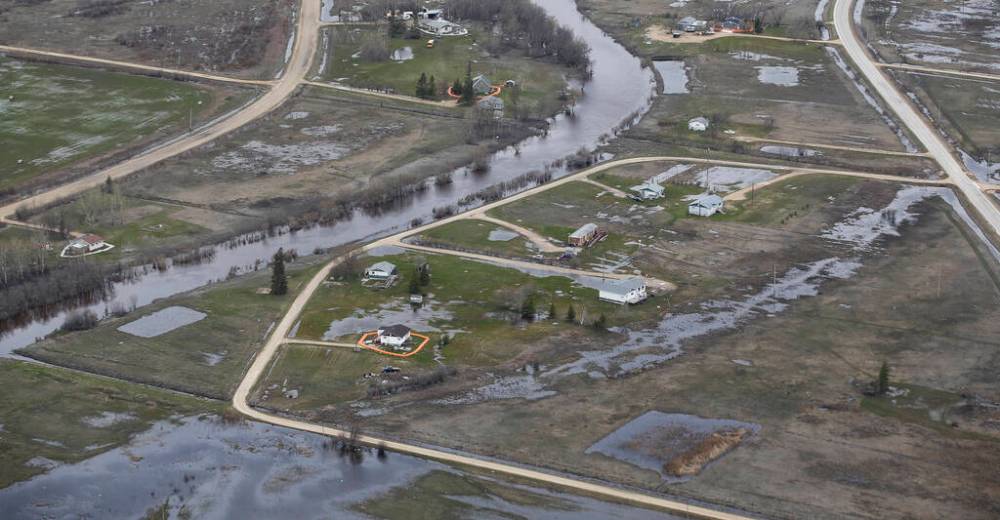
“A lot of the findings from 2009 were put into our emergency plan. For example, now, before any event occurs, we make a list of everybody,” Sutherland said. Such registered lists, with information about household sizes, pets and people with disabilities or other special needs, make it easier to work with partners like Indigenous Services Canada and the Red Cross. But knowing how to make one takes experience and preparation.
“That’s the good thing about Peguis. We’ve been through it so many times,” said Sutherland.
The experience of Peguis First Nation also shows that building up local capacity — whether by necessity or preplanning — can aid an entire province. The community was identified as a potential hub of emergency response for Manitoba’s entire Interlake region in 2011, and put its expertise to use a year later, when the rural municipality of Grahamdale flooded.
“It was our Peguis staff that were the first to get in the water,” said Sutherland. “They were working in waist-high water, trying to protect the properties up in that area.”
“We did what we had to do to get the job done,” he said. “After a while, with the proper people in key positions, you can keep that chaos level controlled.” The First Nation has since shared its expertise with the City of Brandon, Sandy Bay First Nation and Grahamdale.
Communities across Canada are full of willing volunteers — including people who would never consider joining the military — that could step forward in a crisis, but lack training, MPs heard.
From clearing debris after a storm to filling sandbags in a flood, volunteers, non-governmental organizations and private-sector resources tend to provide better value for disaster response labour than soldiers, who are, as committee chair and MP for Toronto’s Scarborough-Guildwood riding John McKay quipped, “the most expensive sandbaggers and woodcutters.”
Canada once had its own Canadian Emergency Management College that offered standardized training courses in prevention and mitigation, preparedness, response and recovery for municipal officials and employees. It was founded in the 1950s, when nuclear warfare was a bigger threat than global warming, but closed in 2012. Various emergency management courses are offered at a number of universities and colleges in Canada, but those are aimed at people interested in becoming professionals.
Without training, volunteers can be a liability, even when intentions are good. However, models already exist for the creation of a volunteer civil protection force or resilience corps that could operate under Public Safety Canada. Much like the military reserve, volunteers would be organized into regional units, with equipment stores and standardized training.
Both Germany and Australia have organizations, also founded during the nuclear fears of the 1950s. The German Federal Agency for Technical Relief (Bundesanstalt Technisches Hilfswerk) has 80,000 trained citizen volunteers in 700 local detachments that work alongside non-governmental organizations, first responders and the German military during emergencies — local and international. Its annual budget in 2021 was around CDN$657 million.
“Instead of armoured vehicles, we need excavators, cranes, high-capacity pumps and other equipment — and the people trained to use them — to clear debris, provide emergency power and water, and repair damaged infrastructure.”–Eva Cohen
Eva Cohen, a witness at the committee, was a Technisches Hilfswerk volunteer before she immigrated to Canada. She is now president of the advocacy group Civil Protection Youth Canada, which is pushing to bring the German model here. Like others, she pointed out that military response is expensive and often unnecessary.
“Instead of armoured vehicles, we need excavators, cranes, high-capacity pumps and other equipment — and the people trained to use them — to clear debris, provide emergency power and water, and repair damaged infrastructure,” she told the defence committee. And many of these skills, she pointed out, already exist in the private sector.
Cohen said being part of a volunteer response can give residents a sense of agency. A 2023 study in the Journal of Climate Change and Health found that 56 per cent of young people in Canada describe themselves feeling “helpless” about climate change. The committee heard this anxiety can lead people of all ages to think the military is the only solution: faced with a crisis, citizens unfamiliar with emergency response systems can be quick to demand the army via social media.
A volunteer force that involves people across the country, Cohen said, “enables everybody, from youth to veteran to senior, to be part of the answer to the problem.” She spoke with enthusiasm of regional exercises that prepared her for actual emergency scenarios.
“The exercises felt so real, I wasn’t even aware sometimes that we weren’t rescuing people in the rubble. It was so exciting. It was so well done,” she told MPs.
Cohen explained that whether those stepping forward already have skills from their day jobs or are “just looking for an exciting hobby,” a civil organization would provide the opportunity for training and certification that could be valuable outside of their own regions.
“If everyone is trained the same way, to the same standards and with the same equipment … all these people can then be rotated so that nobody has to leave for a long period of time,” she said.
“At the Red Cross, we believe the time has come to stop treating these large-scale events as exceptional, and we must do more now to prepare ourselves for a new normal.”–Conrad Sauvé
The government has already begun to spend more money on disaster relief by non-governmental organizations: In 2020, in response to the pandemic, $170-million was announced to scale up the Red Cross, St. John Ambulance, Salvation Army and the Search and Rescue Volunteer Association, and the federal fall economic statement that year promised an additional $150 million over two years.
Canadian Red Cross CEO Conrad Sauvé appeared before the committee as a witness in October. He said that while the organization can help relieve pressure on the armed forces, it is best suited to the “people” side of disasters — support in finding health care, shelter and funding — not with jobs requiring the labour and heavy machinery that the military has access to.
He said that when he started with the organization 24 years ago, almost all emergency operations were international. Today, 90 per cent of assistance goes to Canadians at home.
“At the Red Cross, we believe the time has come to stop treating these large-scale events as exceptional, and we must do more now to prepare ourselves for a new normal,” Sauvé said. “I’m not saying that in every case you don’t need the military — in some exceptional cases you do — but it seems to be the only tool in the tool box. We’re looking at the fire after the fire starts. We’re not spending a lot of money building the fire station in the civil protection area.”
The defence committee’s work is not done — Public Safety minister Bill Blair has yet to appear — but while some witnesses suggested the provinces and territories were relying on the Canadian Armed Forces too much and neglecting their own preparedness, Deryck Trehearne, Director General of Public Safety Canada’s Government Operations Centre, noted that plenty of extreme weather events happened in 2022 that did not require federal assistance.
“People, I think, have really woken up to the fact of the challenge and have resourced it adequately,” he said.
In Gatineau, those people include Savage, which is why he thinks formalizing residents, and training them properly, would pay off.
“It’s a really smart idea, I think,” said Savage. “In every neighbourhood, there’s people like me that are on top of the issues, who know their neighbours and would be invaluable to have those people doing that sort of thing.”
Haley Ritchie is a freelance writer.