Survival clock ticks for trapped B.C. orca calf, as gear arrives for complex rescue

Advertisement

Advertise with us

ZEBALLOS, B.C. - Equipment for the rescue of a killer whale calf stranded in a Vancouver Island lagoon has started arriving in the remote community of Zeballos, ahead of a complex operation that could happen as early as next week.

Read this article for free:


or

Already have an account? Log in here »

To continue reading, please subscribe:

Subscribe and receive a limited-edition Free Press branded hat or tote.

Digital Subscription

One year of digital access for only $205*

  • Enjoy unlimited reading on winnipegfreepress.com
  • Read the E-Edition, our digital replica newspaper
  • Access News Break, our award-winning app
  • Play interactive puzzles

*First annual payment billed as $205.00 + GST for one year. This annual subscription will automatically renew at $233.00 + GST every 52 weeks (10% off the regular annual price of $259.35). Offer available to new and qualified returning subscribers only. Cancel any time.

To continue reading, please subscribe:

Add Free Press access to your Brandon Sun subscription for only an additional

$1 for the first 4 weeks*

  • Enjoy unlimited reading on winnipegfreepress.com
  • Read the E-Edition, our digital replica newspaper
  • Access News Break, our award-winning app
  • Play interactive puzzles
Start now

*Your next Brandon Sun subscription payment will increase by $1.00 and you will be charged $17.95 plus GST for four weeks. After four weeks, your payment will increase to $24.95 plus GST every four weeks.

Hey there, time traveller!
This article was published 04/04/2024 (913 days ago), so information in it may no longer be current.

ZEBALLOS, B.C. – Equipment for the rescue of a killer whale calf stranded in a Vancouver Island lagoon has started arriving in the remote community of Zeballos, ahead of a complex operation that could happen as early as next week.

The timer has been set to save the young orca’s life, First Nations leaders and a federal Fisheries Department marine mammal expert said Thursday.

A seine net more than 270 metres long was delivered Thursday to the Ehattesaht First Nation to help corral the calf into shallow water, where it will be placed in a sling, taken out of the lagoon and transported to an ocean net pen, similar to those used by salmon farms.
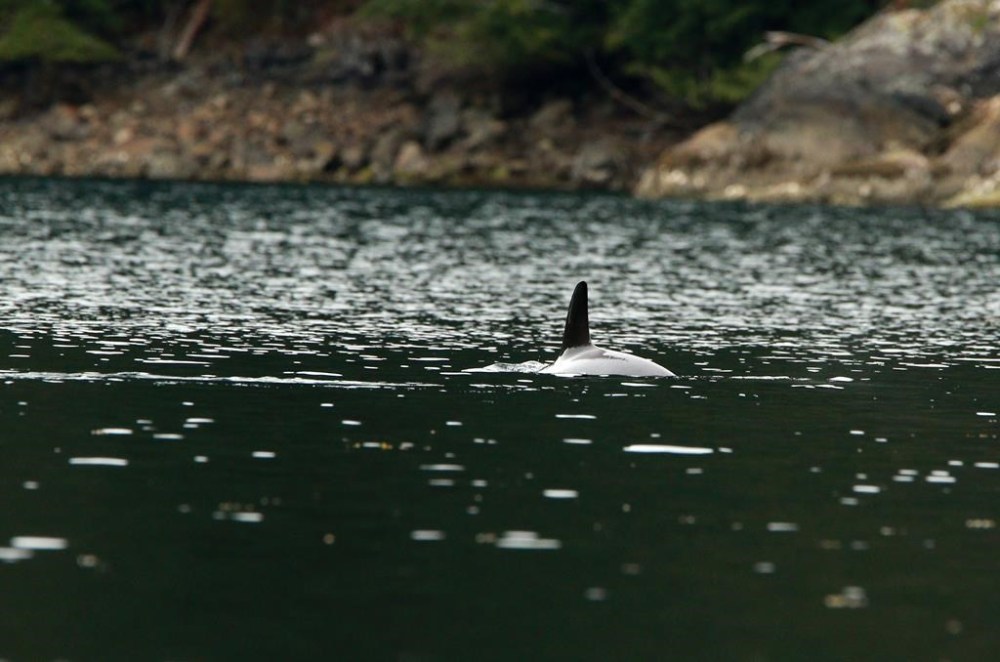
The orphaned orca calf who has been stranded after its pregnant mother died after being caught when the tide went out more than a week ago is spotted in a lagoon near Zeballos, B.C., on Monday April 1, 2024. THE CANADIAN PRESS/Chad Hipolito

The complicated move could involve a crane, a specially outfitted truck and a landing craft or boat. A previous plan to airlift the whale with a helicopter is now taking a back seat, although it remains an option, said Paul Cottrell, a marine mammal co-ordinator with the Fisheries Department.

The net pen is expected to arrive in Zeballos on Sunday. Once the whale is in the pen, it will be kept at a location its extended family is known to frequent, in hopes of a reunion when it is finally freed.

“I think it’s probably going to be within the week because of the health of the killer whale,” Ehattesaht First Nation Chief Simon John said of the operation. “There’s going to be three or four stages related to capturing it. There’s several barriers that will be deployed.”

The distance of the move can’t be worked out until the location of capture and release into the pen are decided.

Cottrell said there is still much to organize before the rescue team tries to capture the calf and transport it out of the lagoon.

“You can appreciate the complications on the logistics,” he said. “We want to do this as safe as possible for the whale, but also for the people involved. We’re piecing all this together in quite a short amount of time. We’re going to undertake the rescue when it’s safe to do so but also taking into consideration how the animal’s doing.”

John said helicopters were available to the nation, but the airlift that had been discussed on Wednesday was “not the optimum opportunity currently.”

Cottrell said a helicopter airlift was “a tool in our tool box and it’s an option we can look at, but we’re looking at other options as well in terms of using a sling onto a vehicle then moving the animal that way to either a landing craft or a vessel that can move the animal to a net pen.”

He said numerous variables could affect the rescue attempt, including the weather.

“We’re moving to this next phase of capture and transport and reunification with its pod,” Cottrell said. “We’re doing a great amount of work to make that happen. Time is of the essence for this calf, we know that, and the planning is well along, but we do have a little bit more planning, equipment and logistics to work out.”

The calf has been stranded near Little Espinosa Inlet since March 23, when its pregnant mother became trapped on a rocky beach at low tide and died.

The drama is unfolding near the tiny village of Zeballos, population 200, about 450 kilometres northwest of Victoria.

Fisheries Department officials, the Ehattesaht First Nation and marine mammal rescue experts have been meeting daily about the orca calf. They are convinced the only way to save it is to capture and transport it from the three-kilometre-long tidal lagoon to the ocean.

The timer has been set to save a young killer whale calf's life, say First Nations leaders and a federal Fisheries Department marine mammal expert. The orphaned orca calf who was stranded after it's pregnant mother died after being caught on a gravel bed when the tide went out more than 12 days ago is spotted in a lagoon near Zeballos, B.C., Thursday, April 4, 2024. THE CANADIAN PRESS/Chad Hipolito

John said attempts to entice the young whale to leave the lagoon on its own via a shallow and swiftly running channel to the ocean have not been successful and the nation wants to take every opportunity available to save its life.

“The whole plan, through the whole process, has been to reunite it with its pod,” he said. “It needs assistance. It’s so young.”

Officials aren’t sure if the whale has been feeding and set out the remains of a harbour seal this week. While the seal meat disappeared, they aren’t sure if the calf ate it.

Rescue team members were out in boats again Thursday, hoping to feed seal remains to the calf, which has been seen with a bird in its mouth. There were indications the calf, thought to be about two years old, had been supplementing its diet with its mother’s milk before it died.

Bigg’s killer whales, like this calf, are mammal eaters, unlike the resident orcas of B.C.’s coast which eat fish.

The calf appears in good health, spending much of its time in a midsection of the lagoon, surfacing every five to 10 minutes, said Fisheries Department officials who have been monitoring the orca with drones and boats.

The First Nation said a wide range of equipment and technology has been made available for the rescue effort, including helicopters, drones, trucks, excavators, boats and advanced equipment to provide remote sensing and land surveying.

The last time members of the calf’s pod were spotted was Sunday near Ucluelet, which is also on Vancouver Island’s west coast but about 150 kilometres south of Zeballos.

Cedar boughs placed by the First Nations residents, who have named the orca calf kwiisahi?is, or Little Brave Hunter, hang from a bridge that the young orca must swim under, while a bouquet of flowers rests at the roadside where locals and visitors are keeping vigil.

This report by The Canadian Press was first published April 4, 2024.

Report Error Submit a Tip

More Stories

Winnipeggers witness unveiling of Japanese Canadian monument in B.C.

Morgan Modjeski 6 minute read Preview

Winnipeggers witness unveiling of Japanese Canadian monument in B.C.

Morgan Modjeski 6 minute read Yesterday at 8:39 PM CDT

As Miki Stewart gathered with her family at the Japanese Cultural Association of Manitoba on Saturday afternoon, she was thinking of her parents, Yoshimaru and Yoshi Abe.

Both Stewart, 80, and her sister Yumi Falk, 81, alongside an older brother, were born in the Tashme internment camp in British Columbia. They were among more than 2,600 Japanese Canadians who were forcefully removed and interred at the camp following the bombing of Pearl Harbour and Canada’s declaration of war on Japan in 1941.

“They didn’t talk much about how they suffered,” Stewart said of her parents. “But they did.”

She was amongst a group of more than 150 people who gathered at the association’s McPhillips headquarters on Saturday afternoon to watch the unveiling of the Japanese Canadian Monument in Victoria B.C.

Read
Yesterday at 8:39 PM CDT

Living the dream

Ken Wiebe 7 minute read Preview

Living the dream

Ken Wiebe 7 minute read Yesterday at 4:48 PM CDT

DETROIT – As Tyrel Bauer took a left turn out of the tunnel from the Winnipeg Jets dressing room and into the stands, he was met with a hearty round of applause from the 25 friends and family members who had made the trek from various points around North America.

Bauer had just realized a childhood dream and the significance of the moment was not lost on some of his biggest supporters.

“It was a special walk, for sure. A special walk,” Bauer said on Saturday afternoon before the Jets departed for a two-game road trip that begins on Sunday in Detroit against the Red Wings. “Those people who came – and many more that weren’t there and were cheering on from afar – they’ve always been there.

“I wanted that for my family, maybe even more than I wanted it for me. They’ve been through thick and thin. I’ve stressed mom out quite a bit over the years doing my job. That meant a lot for them and I’m really happy they could be there for it.”

Read
Yesterday at 4:48 PM CDT

Broadening prediction-market gambling a bad idea

Editorial 4 minute read Preview

Broadening prediction-market gambling a bad idea

Editorial 4 minute read Yesterday at 2:01 AM CDT

Let’s make a prediction: sooner or later, when Canadian governments find a way to take their own cut of the action, prediction-contract gambling on everything from sports to entertainment to political decisions is going to come to Canada.

And that’s a horrible, dangerous, pernicious idea.

Unless you have particular access to information — either inside information or strategic information based on skills or education — you’re not likely to make money at it. In fact, structurally, you’re likely to lose. In prediction markets, you basically pay an amount, plus fees from the company involved, to bet on whether something will or will not happen within a certain time frame. The amount you pay for your contract depends on how other people are also betting.

As Wealthsimple describes it, “You buy whichever side you think is right. Prices move with demand, so if the market leans towards one outcome, the more that side costs. If a lot of people are backing the TSX to finish above 38,000, yes gets more expensive and no gets cheaper.”

Read
Yesterday at 2:01 AM CDT

May be whiff of truth to ex’s odour ardour

Maureen Scurfield 5 minute read Yesterday at 2:01 AM CDT

DEAR MISS LONELYHEARTS: I ran into an old boyfriend I used to curl on a team with, and we went for drinks. We’ve been almost eight years apart, and I couldn’t remember why we broke up, as we always had such a great time together.

It wasn’t until the second date — this time on a weekend — that it came back to me, with a jolt. Pee-yew! I remembered he doesn’t use deodorant on weekends. Why? He enjoys his own body odour. I recalled that a bit too late, and it was just as awful as ever! I went home early.

Tonight, he called and I refused him another date. I said, “Think back. You remember why we broke up?” Then he said, “Oh yeah, you hated my no-deodorant weekend policy. Well, guess what? Some women don’t mind!” I said I really doubted that, and that ended the conversation. Miss L., wouldn’t any women find stinky underarms offensive?

— Sensitive Nose, Fort Richmond

Manitoba’s own Summer Howell takes on biggest role yet as Stephen King’s telekinetic teen Carrie

Randall King 7 minute read Preview

Manitoba’s own Summer Howell takes on biggest role yet as Stephen King’s telekinetic teen Carrie

Randall King 7 minute read Friday, Oct. 2, 2026

From the tender age of eight, actress Summer Howell has made her presence known in a series of horror films shot in her home province of Manitoba.

Her first film was Curse of Chucky (2013), director Don Mancini’s continuation of the venerable killer doll series he started (as a screenwriter) in 1988 with Child’s Play.

“Even then, it was obvious she was very talented, intelligent and delightful,” Mancini said of Howell.

Though she has worked in other genres, Howell gravitated to horror repeatedly, with credits in Shawn Linden’s harrowing Hunter Hunter (2020) and the 2023 possession thriller All Fun and Games. Earlier this year, she shot the horror film Sundown in Winnipeg with director Rebekah McKendry, which premièred last week at Beyond Fest in Los Angeles and is headed for a streaming berth on Shudder.

Read
Friday, Oct. 2, 2026

Volunteer pop-up library axed from Manitoba Youth Centre

Matthew Frank 4 minute read Preview

Volunteer pop-up library axed from Manitoba Youth Centre

Matthew Frank 4 minute read Updated: Yesterday at 11:25 AM CDT

Manitoba Corrections has cancelled a pop-up library program at the Manitoba Youth Centre, leaving inmates without librarian services and fewer options to borrow certain books.

The Prison Libraries Committee, part of the non-profit Manitoba Library Association, operated and funded the volunteer program since 2024 before it was shut down by the province last month. The group previously partnered with the province to offer the service because the facility has no dedicated library of its own.

“It is concerning that community members who are incarcerated, especially youth, are losing out on meaningful programming, access to information and rehabilitation efforts, which are offered at no cost to (Manitoba) Corrections. We urge Manitoba Justice to promote more library services and programming, not less,” said a Sept. 24 letter from the non-profit addressed to the justice minister.

Ashley Huot, chair of the Prison Libraries Committee, said she was puzzled when she received an email last month from Manitoba Corrections stating that the pop-up library was no longer needed.

Read
Updated: Yesterday at 11:25 AM CDT