Thai officials seize over 200 tons of electronic waste illegally imported from the US

Advertisement

Advertise with us

BANGKOK (AP) — Thai officials said Wednesday they seized 238 tons of illegally imported electronic waste from the United States at the port of Bangkok, one of the biggest lots they've found this year.

Read this article for free:


or

Already have an account? Log in here »

To continue reading, please subscribe:

Subscribe and receive a limited-edition Free Press branded hat or tote.

Digital Subscription

One year of digital access for only $205*

  • Enjoy unlimited reading on winnipegfreepress.com
  • Read the E-Edition, our digital replica newspaper
  • Access News Break, our award-winning app
  • Play interactive puzzles

*First annual payment billed as $205.00 + GST for one year. This annual subscription will automatically renew at $233.00 + GST every 52 weeks (10% off the regular annual price of $259.35). Offer available to new and qualified returning subscribers only. Cancel any time.

To continue reading, please subscribe:

Add Free Press access to your Brandon Sun subscription for only an additional

$1 for the first 4 weeks*

  • Enjoy unlimited reading on winnipegfreepress.com
  • Read the E-Edition, our digital replica newspaper
  • Access News Break, our award-winning app
  • Play interactive puzzles
Start now

*Your next Brandon Sun subscription payment will increase by $1.00 and you will be charged $17.95 plus GST for four weeks. After four weeks, your payment will increase to $24.95 plus GST every four weeks.

Hey there, time traveller!
This article was published 14/05/2025 (508 days ago), so information in it may no longer be current.

BANGKOK (AP) — Thai officials said Wednesday they seized 238 tons of illegally imported electronic waste from the United States at the port of Bangkok, one of the biggest lots they’ve found this year.

The waste, which came in 10 large containers, was declared as mixed metal scrap but turned out to be circuit boards mixed in a huge pile of metal scrap, said Theeraj Athanavanich, director-general of the Customs Department. It was found Tuesday in a random inspection.

A U.N. report last year said electronic waste is piling up worldwide. Some 62 million tons of electronic waste was generated in 2022 and that figure is on track to reach 82 million tons by 2030, the report said. It said only 22% of the waste was properly collected and recycled in 2022 and that quantity is expected to fall to 20% by the end of the decade due to higher consumption, limited repair options, shorter product life cycles, and inadequate management infrastructure.
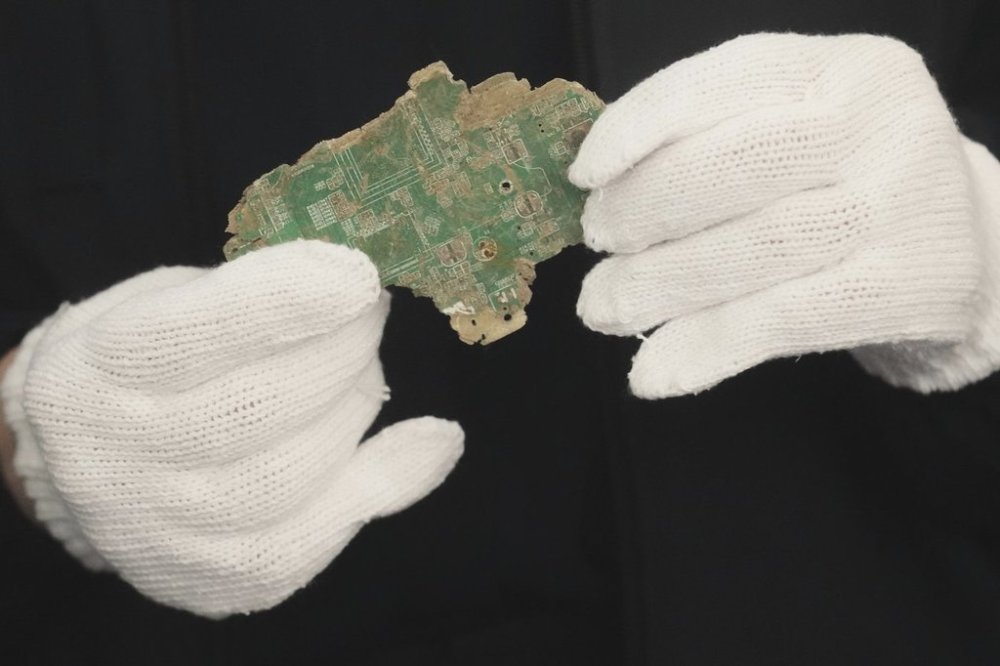
A Thai official shows a sample of illegally imported electronic waste from the United States which they said they seized at Bangkok Port during a press conference in Bangkok, Thailand, Wednesday, May 14, 2025. (AP Photo/Sakchai Lalit)

Theeraj said Thai authorities are looking to press charges including falsely declaring imported goods, illegally importing electronic waste and planning to return the waste to its country of origin.

“It’s important that we take action on this kind of goods,” he said. “There are environmental impacts that are dangerous to the people, especially communities around factories that might import these things for processing, then recycling.”

Electronic waste creates huge health hazards. Many components are laden with lead and mercury, cadmium and other toxins. Recyclers are after gold, silver, palladium and copper, mainly from printed circuit boards, but lax controls mean that facilities often burn plastics to release encased copper and use unsafe methods to extract precious metals.

Thailand passed a ban on the import of a range of electronic waste products in 2020. The Cabinet in February approved an expanded list of the banned waste.

Sunthron Kewsawang, deputy director-general of the Department of Industrial Works, said officials suspected at least two factories in Samut Sakhon province, which borders Bangkok, are involved in importing the waste.

In January, the Customs Department said it seized 256 tons of illegally imported electronic waste from Japan and Hong Kong at a port in eastern Thailand.

Report Error Submit a Tip

More Stories

Thai officials seize over 200 tons of electronic waste illegally imported from the US

The Associated Press 3 minute read Preview

Thai officials seize over 200 tons of electronic waste illegally imported from the US

The Associated Press 3 minute read Wednesday, May. 14, 2025

BANGKOK (AP) — Thai officials said Wednesday they seized 238 tons of illegally imported electronic waste from the United States at the port of Bangkok, one of the biggest lots they've found this year.

The waste, which came in 10 large containers, was declared as mixed metal scrap but turned out to be circuit boards mixed in a huge pile of metal scrap, said Theeraj Athanavanich, director-general of the Customs Department. It was found Tuesday in a random inspection.

A U.N. report last year said electronic waste is piling up worldwide. Some 62 million tons of electronic waste was generated in 2022 and that figure is on track to reach 82 million tons by 2030, the report said. It said only 22% of the waste was properly collected and recycled in 2022 and that quantity is expected to fall to 20% by the end of the decade due to higher consumption, limited repair options, shorter product life cycles, and inadequate management infrastructure.

Theeraj said Thai authorities are looking to press charges including falsely declaring imported goods, illegally importing electronic waste and planning to return the waste to its country of origin.

Read
Wednesday, May. 14, 2025

’Disgusting’ posters being investigated by police

Morgan Modjeski 4 minute read Yesterday at 2:22 PM CDT

The Winnipeg Police Service major crimes unit is investigating what some have labelled offensive and hateful posters on full-display at a Winnipeg home.

One of the people irked by the display is Gracie Garrett. She’s has lived on Ashburn Street in Winnipeg’s Minto neighbourhood for almost ten years. She’s never felt unsafe in the neighbourhood before, but now, a set of posters plastered on a nearby house are making her feel uneasy.

The five signs, posted facing the street prominently on a front window, contain a slur, refer to Nazis as “heroes” and call Muslims, Christians and other groups “evil.”

Learning of the signs Friday, Garrett said she’ll be reporting the posters to police, as she worries they incite and promote violence.

Province looks to seize notorious drug den

Erik Pindera 5 minute read Preview

Province looks to seize notorious drug den

Erik Pindera 5 minute read Yesterday at 12:00 PM CDT

Provincial justice officials are trying to seize a Dominion Street drug den that has been the source of trouble in the West End for years.

The owner of 982 Dominion St., 45-year-old Robert Edward Johnson, was most recently arrested in June along with several others after a lengthy Winnipeg Police investigation into thefts and illicit drug sales connected to the house.

“The residence has a reputation within the neighbourhood as being a location where individuals habitually attend for the purpose of purchasing and/or consuming controlled substances,” reads a statement of claim filed by the province’s director of civil forfeiture in the Court of King’s Bench last week.

“For several years, the residence has been associated with criminal activity, violence, and disorder, resulting in numerous police attendances and complaints from members of the surrounding community.”

Read
Yesterday at 12:00 PM CDT

Letters, Oct. 3

7 minute read Yesterday at 2:01 AM CDT

A morning in the life …

My very first lesson does not start when I walk into that lecture hall, oh no — it starts long before. It begins when I walk to my car, check the estimated arrival time to the University of Manitoba and hope that Winnipeg traffic agrees with it.

A drive that appears completely manageable changes almost immediately when I’m greeted by a tsunami of orange pylons and a line of cars that appears to go on forever. Traffic moves by the inch, lanes magically disappear and the detour I took yesterday now has a detour of its own. These factors make me do a calculation that I have become all too familiar with. How late can I arrive and still find parking, run to my class across campus and get to class with enough time left to make it worth it?

I have grown used to people saying, “Why not just leave earlier?” I do. But when I’m already leaving for my 8:30 a.m. class at 7 a.m., there’s only so much I can do. This drive that some would think is relaxing is one that feels like an assignment that I didn’t know I had to complete and is due at 8:30 a.m.

Broadening prediction-market gambling a bad idea

Editorial 4 minute read Preview

Broadening prediction-market gambling a bad idea

Editorial 4 minute read Yesterday at 2:01 AM CDT

Let’s make a prediction: sooner or later, when Canadian governments find a way to take their own cut of the action, prediction-contract gambling on everything from sports to entertainment to political decisions is going to come to Canada.

And that’s a horrible, dangerous, pernicious idea.

Unless you have particular access to information — either inside information or strategic information based on skills or education — you’re not likely to make money at it. In fact, structurally, you’re likely to lose. In prediction markets, you basically pay an amount, plus fees from the company involved, to bet on whether something will or will not happen within a certain time frame. The amount you pay for your contract depends on how other people are also betting.

As Wealthsimple describes it, “You buy whichever side you think is right. Prices move with demand, so if the market leans towards one outcome, the more that side costs. If a lot of people are backing the TSX to finish above 38,000, yes gets more expensive and no gets cheaper.”

Read
Yesterday at 2:01 AM CDT

Creative powerhouse Perry Rosemond never lost Winnipeg roots

Ben Waldman 7 minute read Preview

Creative powerhouse Perry Rosemond never lost Winnipeg roots

Ben Waldman 7 minute read Yesterday at 6:00 AM CDT

He created King of Kensington, directed the troops in the Royal Canadian Air Farce, and his creative eye was behind the lens for television shows starring Johnny Cash, Tom Jones, Mr. Dress-Up and the Friendly Giant.

He also wrote and developed the Canadian version of Sesame Street during his time as the head of school and preschool programming for CBC in Toronto, and directed a televised special in 2002 for Winnipeg sketch comedy troupe Royal Liechtenstein Theatre Company.

But before his name featured in the credits of some of the most iconic and influential pieces of the Cancon canon, Perry Rosemond was an only child living in a crammed, multi-generational home in Winnipeg’s North End, racing each day to beat the morning bell next door at William Whyte School.

In memoirs that have yet to be published, the late television producer recalled his childhood. “(T)here were 14 of us in the house at 193 Andrews St., and it wasn’t that big of a house,” he writes.

Read
Yesterday at 6:00 AM CDT