As Iran war shakes energy system, some see powerful argument for renewable energy
Advertisement
Read this article for free:
or
Already have an account? Log in here »
To continue reading, please subscribe:

Digital Subscription
One year of digital access for only $205*
- Enjoy unlimited reading on winnipegfreepress.com
- Read the E-Edition, our digital replica newspaper
- Access News Break, our award-winning app
- Play interactive puzzles
*First annual payment billed as $205.00 + GST for one year. This annual subscription will automatically renew at $233.00 + GST every 52 weeks (10% off the regular annual price of $259.35). Offer available to new and qualified returning subscribers only. Cancel any time.
To continue reading, please subscribe:
Add Free Press access to your Brandon Sun subscription for only an additional
$1 for the first 4 weeks*
- Enjoy unlimited reading on winnipegfreepress.com
- Read the E-Edition, our digital replica newspaper
- Access News Break, our award-winning app
- Play interactive puzzles
*Your next Brandon Sun subscription payment will increase by $1.00 and you will be charged $17.95 plus GST for four weeks. After four weeks, your payment will increase to $24.95 plus GST every four weeks.
Read unlimited articles for free today:
or
Already have an account? Log in here »
Hey there, time traveller!
This article was published 09/03/2026 (193 days ago), so information in it may no longer be current.
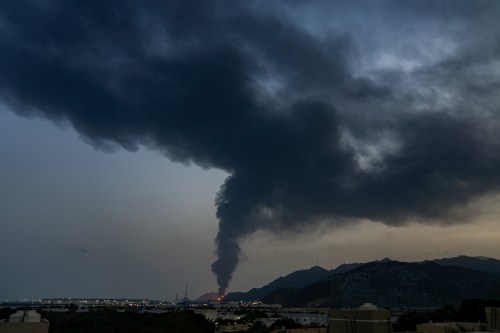
World leaders have tried and failed to curb climate change by appealing to nations to act for the common good. Now, the Iran war and its costly energy crunch have some experts wondering if selfishness and nationalism may be a more likely way to save the planet, by boosting support for homegrown renewables over imported fossil fuels.
Bombed refineries, disrupted shipping channels for oil and liquefied natural gas and skyrocketing fuel prices should point even the most reluctant leaders to a cleaner fossil free future, hope some experts.
But others are dismissive, noting the same speculation emerged, and then quickly flopped, as recently as Russia’s invasion of Ukraine. That prompted some European nations to replace gas with even dirtier coal.

“Just wishful thinking,” said Stanford University climate scientist Rob Jackson, who tracks global emissions of carbon dioxide.
The head of the United Nations will argue otherwise on Monday.
“The turmoil we are witnessing today in the Middle East makes it evident that we are facing a global energy system largely tied to fossil fuels — where supply is concentrated in a few regions and every conflict risks sending shock waves through the global economy,” U.N. Secretary-General António Guterres said in an email to The Associated Press. “In past oil shocks, countries had little choice but to absorb the pain. Now they have an exit ramp.
“Homegrown renewable energy has never been cheaper, more accessible, or more scalable,” Guterres said. “The resources of the clean energy era cannot be blockaded or weaponized.”
Going alone versus together
Annual U.N. climate conferences aimed at global cooperation have accomplished little. The most recent meeting in Brazil, known as COP30, ended with a statement that didn’t even mention the words “fossil fuels,” much less include a timeline to reduce their use. Guterres said then that he “cannot pretend that COP30 has delivered everything that is needed.” Under President Donald Trump, whose attack on Iran has sparked new energy concerns, the U.S. didn’t even participate in the Brazil meeting.
Even though renewable energy use and new installations are soaring globally, outpacing fossil fuel growth, the world continues to increase its fossil fuel use every year with emissions of heat-trapping carbon dioxide and methane rising to new highs year after. That’s driving atmospheric warming that increases costly and deadly extreme weather, including dangerous heat, around the world.
“The bottom line is that for at least another five years and maybe longer, emissions reduction will in fact be dealt with largely unilaterally,” said Michael Oppenheimer, a Princeton climate and international affairs professor. “If countries see the Israel-U.S.-Iran war as a further reason to head for the exits on fossil fuels by loosening domestic opposition to the necessary policies, that will be accomplished unilaterally at the domestic level.”
A moment of opportunity may be here
Caroline Baxter, director of the Converging Risks Lab at the Council on Strategic Risks in Washington, said there has already been a “dramatic slowdown” in the movement of fossil fuels to various ports due to the conflict. And for countries like Japan or South Korea that depend on tankers arriving in their ports to deliver energy, this is a really big deal, she said.
Baxter said she “wouldn’t be surprised” if some shift to green energy because of the conflict, if only because renewable energy offers more stability than fossil fuels do.
“I think there is an opportunity, rightly or wrongly, for countries to really turn inward and try to power themselves in a way that cuts off their dependence on other nations for that source,” said Baxter, who was U.S. deputy assistant secretary of defense for force education and training from 2021 to 2024 under the Biden administration.
Baxter said if she’s right and if “everyone does it in their backyard,” it will limit future climate change “without the thorny diplomatic negotiations and the glad-handing and the machinations behind closed doors” of international climate conferences.
The war will lead to more solar panels and heat pumps installed in coming months, said energy analyst Ana Maria Jaller-Makarewicz, of IEEFA Europe.
A reality check from Ukraine: ‘Exactly the wrong lesson’
More skeptical analysts point to the Russian invasion of Ukraine a few years ago, which put a massive kink in Europe’s natural gas supply, yet didn’t change the world’s fossil fuel dependence. Politicians often pivot to other fossil fuels to address war-oriented energy insecurity, such as coal, which releases even higher amounts of heat-trapping gases.
“We have seen this at the European level where actors post-2022 slowly wanted to move away from the energy transition which is exactly the wrong lesson,” said war studies lecturer Pauline Heinrichs at King’s College in the United Kingdom.
Just as Europe did then, many countries, like China and India — already the world’s No. 1 and No. 3 carbon-emitting countries — could turn to more coal use, said Ohio University’s Geoff Dabelko, an expert on climate and conflict, and University of St. Andrews’ Neta Crawford, author of “The Pentagon, Climate Change, and War: Charting the Rise and Fall of U.S. Military Emissions.”
War and militaries pollute the air
Whatever happens with nations’ energy choices, the war itself will spike emissions.
Even before it began, reports showed that the world’s militaries are responsible for 5.5% of Earth’s heat-trapping emissions each year, more than any country except China, the United States and India.
Crawford, co-founder of the Costs of War project at Brown University’s Watson Institute for International and Public Affairs, said fighter jets consuming vast quantities of fuel, releasing carbon dioxide and other pollutants, is just one example.

“The consequences of war on emissions will far exceed any incremental offset in emissions due to increased enthusiasm for a green transition,” she said.
___
Borenstein reported from Washington and McDermott from Providence, Rhode Island.
___
The Associated Press’ climate and environmental coverage receives financial support from multiple private foundations. AP is solely responsible for all content. Find AP’s standards for working with philanthropies, a list of supporters and funded coverage areas at AP.org.