Pacific island nations seek to turn geopolitics into funding to offset climate change harm
Advertisement
Read this article for free:
or
Already have an account? Log in here »
To continue reading, please subscribe:

Digital Subscription
One year of digital access for only $205*
- Enjoy unlimited reading on winnipegfreepress.com
- Read the E-Edition, our digital replica newspaper
- Access News Break, our award-winning app
- Play interactive puzzles
*First annual payment billed as $205.00 + GST for one year. This annual subscription will automatically renew at $233.00 + GST every 52 weeks (10% off the regular annual price of $259.35). Offer available to new and qualified returning subscribers only. Cancel any time.
To continue reading, please subscribe:
Add Free Press access to your Brandon Sun subscription for only an additional
$1 for the first 4 weeks*
- Enjoy unlimited reading on winnipegfreepress.com
- Read the E-Edition, our digital replica newspaper
- Access News Break, our award-winning app
- Play interactive puzzles
*Your next Brandon Sun subscription payment will increase by $1.00 and you will be charged $17.95 plus GST for four weeks. After four weeks, your payment will increase to $24.95 plus GST every four weeks.
Read unlimited articles for free today:
or
Already have an account? Log in here »
KOROR, Palau (AP) — When stormy seas batter Melekeok state on Palau’s biggest island, the Pacific Ocean floods right into people’s homes.
“We keep telling the legislature we need to move inward,” said Bol Sebalt, 43, who was born and raised on the low-lying beachfront. “But because of a shortage of funding we cannot.”
The fate of Melekeok, a chiefdom of 300 people, is echoed by stories from many island nations in remote parts of the vast Pacific Ocean. Their leaders, gathered for a summit in Palau this week, are wrestling once more with the question of how tiny countries with little global power can use major polluters’ geopolitical interest in their region to secure a chance of survival.
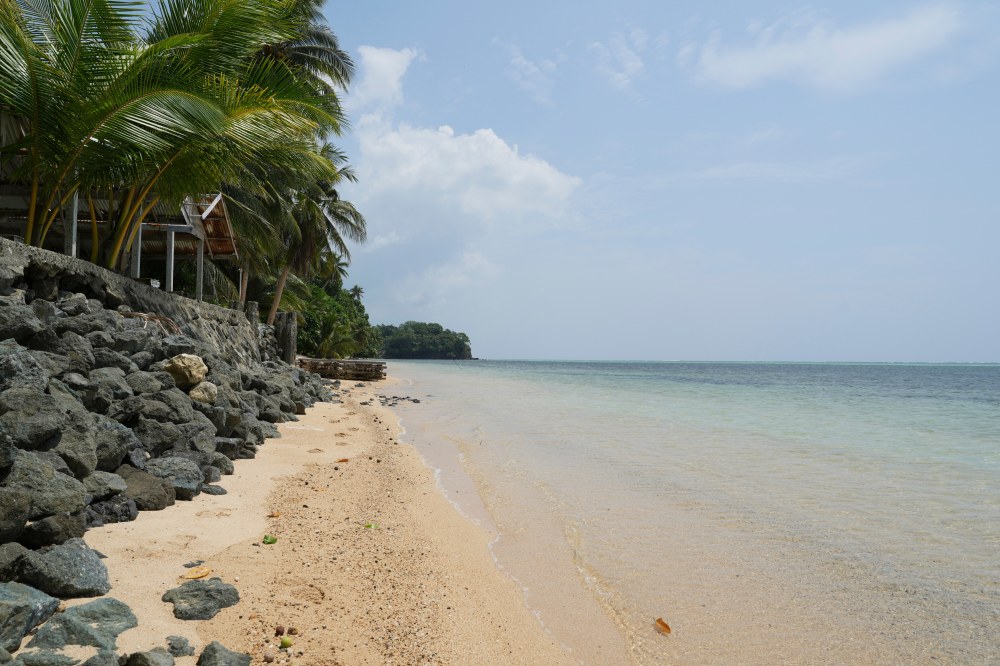
Some hope for funding to help them adapt to changes they can’t reverse. Sebalt, a legislative clerk, is also a trained volunteer for her local disaster readiness team, making her one of 200 people across the western Pacific country now prepared to shepherd their communities through events such as catastrophic typhoons that have struck before.
Almost a year ago, Sebalt moved to a subdivision being prepared inland for Melekeok’s people, where she’s the only resident so far. Sebalt said funding for plumbing, sewage and enough street light poles for others to move in was sourced in small chunks and much too slowly.
“We cannot move faster than climate change,” she said.
Pacific officials warn of no way out but curbing emissions
About 32 kilometers (20 miles) across the volcanic island, down winding roads fringed by tropical jungle, leaders from some of the small Pacific nations most imperiled by rising seas renewed dire warnings Wednesday about their expected fate.
The officials standing in sweltering, wet heat outside the annual Pacific Islands Forum summit were responding to a bleak first-of-its-kind report issued by the United Nations, which said Earth would soon exceed the safe temperature threshold agreed upon in the 2015 Paris climate accord because of warming from the burning of coal, oil and gas.
“Loss and damage is a reality that currently exists in my country,” Vanuatu Climate Adaptation Minister Ralph Regenvanu said.
“It will only accelerate with any overshoot, encompassing economic and non-economic losses that no finance can fully restore,” he said, adding that the loss encompassed “our ancestral lands, our heritage, our identity.”
For years, Regenvanu and other Pacific leaders have urged action from major polluters that would limit global warming to an accepted goal of 1.5 Celsius (2.7 Fahrenheit) above mid-19th century temperatures, which scientists said could avoid the dramatic impacts on people and the planet expected at 2 C.
Wednesday’s report finally admitted that the world would cross the 1.5 threshold “in the next few years,” while recommending efforts to bring down the temperature. The leaders gathered in Palau said that would be too late.
Warmer seas would devastate the Pacific’s tuna fisheries, which produce 30% of the world’s catch, and the mangroves where fish hatch, according to the regional scientific organization SPC. This year’s El Nino chaos has left parts of the Pacific in drought while others flooded, and such events would only intensify, the body added.
“There is no other way out,” said Maina Talia, Tuvalu’s minister for climate change. “The only way out for us is to ensure that we continue to push for 1.5, to stay alive, to stay in our countries.”
The summit’s host urged climate funding instead of geopolitics squabbles
Ahead of each year’s Pacific leaders summit, many of the 18 member states and territories cite climate change as the most pressing discussion topic.
But it’s often swept aside by geopolitical jostling from major powers on the sidelines of the event as they seek to shore up more influence in the strategically important region than their rivals. Palau’s President Surangel Whipps Jr., suggested this week that countries who sought involvement in the region could instead do so by funding climate projects, including his push to see the sunny region become the first in the world powered entirely by renewable energy.
A geopolitical sideshow between China and Taiwan promptly erupted, however, when envoys from Beijing and Taipei were seated in the same row at the summit’s opening ceremony. But there are other obstacles to the leaders’ ambitions.
A Pacific-managed fund created by the summit’s members and intended to finance grassroots adaptation projects across the region has so far faltered because major donors haven’t pledged the hoped-for amounts. While some have cited governance concerns with the Pacific Resilience Facility, due to be headquartered in Tonga, the model is also new for an aid-dependent region where donors are used to controlling where money goes.
“International financial institutions have very lengthy, long processes to deliver the direct access funding that we require in the Pacific,” Tonga’s Prime Minister Fatafehi Fakafanua told The Associated Press.
“The PRF was purposefully designed to work immediately for the urgent needs of the Pacific Island people,” he added. “That is something that differentiates the PRF from the existing financial models that we are using here in the Pacific.”
Small island states are questioning larger forum members’ commitment
Then there are the tensions between small island nations who make up the majority of the Forum and its two largest powers and biggest donors, Australia and New Zealand, about their climate efforts.
Australia’s Prime Minister Anthony Albanese told reporters in Palau on Wednesday that Pacific leaders understood his country’s transition away from fossil fuels couldn’t “happen overnight,” and required greater capacity for renewable power generation.
“Australia is highly regarded when it comes to climate change and the talking down of Australia doesn’t happen from outside Australia, I make that point,” he said.
An hour later, Regenvanu of Vanuatu told reporters that Australia was not doing enough.
“Australia is a major producer of fossil fuels,” he said. “The very least a country like Australia should be doing is stopping future expansion and it’s not doing that.”
___
Associated Press writer Rod McGuirk in Melbourne, Australia, contributed to this report.