Thousands march in Toronto for Grassy Narrows, seeking justice for mercury poisoning

Advertisement

Advertise with us

TORONTO - The smell of burning tobacco and the sounds of banging drums hung in the air in Toronto's downtown core as thousands of supporters of the Grassy Narrows First Nation marched to Queen’s Park on Wednesday.

Read this article for free:


or

Already have an account? Log in here »

To continue reading, please subscribe:

Subscribe and receive a limited-edition Free Press branded hat or tote.

Digital Subscription

One year of digital access for only $205*

  • Enjoy unlimited reading on winnipegfreepress.com
  • Read the E-Edition, our digital replica newspaper
  • Access News Break, our award-winning app
  • Play interactive puzzles

*First annual payment billed as $205.00 + GST for one year. This annual subscription will automatically renew at $233.00 + GST every 52 weeks (10% off the regular annual price of $259.35). Offer available to new and qualified returning subscribers only. Cancel any time.

To continue reading, please subscribe:

Add Free Press access to your Brandon Sun subscription for only an additional

$1 for the first 4 weeks*

  • Enjoy unlimited reading on winnipegfreepress.com
  • Read the E-Edition, our digital replica newspaper
  • Access News Break, our award-winning app
  • Play interactive puzzles
Start now

*Your next Brandon Sun subscription payment will increase by $1.00 and you will be charged $17.95 plus GST for four weeks. After four weeks, your payment will increase to $24.95 plus GST every four weeks.

TORONTO – The smell of burning tobacco and the sounds of banging drums hung in the air in Toronto’s downtown core as thousands of supporters of the Grassy Narrows First Nation marched to Queen’s Park on Wednesday.

Members of Grassy Narrows, alongside labour unions, environmental groups, and faith-based organizations, took to the streets to call for justice for the Ojibwe community in northwestern Ontario, which has for decades suffered from the aftershocks of thousands of kilograms of mercury being dumped in their river system in the 1960s and 1970s.

Grassy Narrows Chief Sherry Ackabee said the First Nation has lost untold members to the effects of mercury poisoning. 
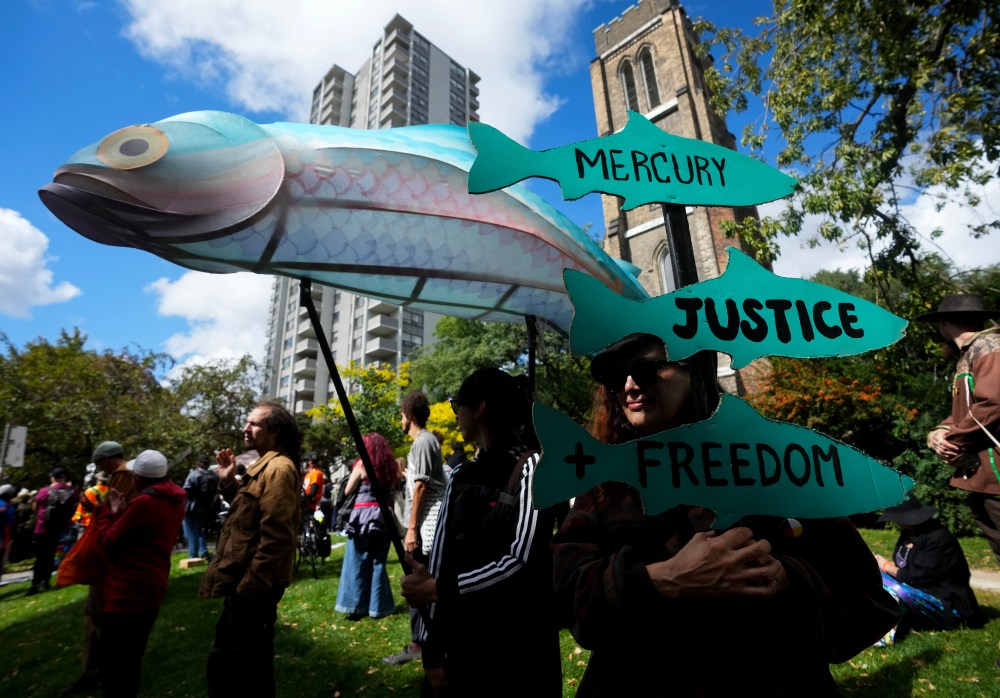
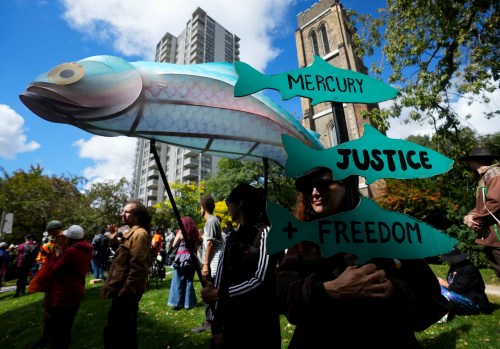
People protest seeking justice for mercury poisoning in Grassy Narrows First Nation, in Toronto, on Wednesday, Sept. 23, 2026. THE CANADIAN PRESS/Nathan Denette

“Everybody’s lost somebody,” she said. “I myself have a child who was born with one functioning kidney … And my other children have been sick as well.”

One study estimated that 90 per cent of the Grassy Narrows population suffers from some degree of mercury poisoning. The heavy metal can be passed from mothers to babies they carry, making it a problem that spans generations.

The protesters are calling for Premier Doug Ford and Prime Minister Mark Carney to close the Dryden Paper Mill responsible for the mercury contamination, and to provide compensation for the community’s hardship.

The mill, which operates upstream from Grassy Narrows on the English-Wabigoon River, stopped using mercury in its industrial process in the 1970s, but mercury levels downstream from the plant haven’t decreased significantly since the 1980s. 

A 2024 study from Western University found emissions from the mill, including sulphate, continue to wreak havoc on the community by generating methylmercury — the most toxic form of mercury. 

“We need cleanup. We need justice. We need compensation, and we need our people to try and live a healthy life again. But how can you do that when Dryden’s still operating their mill?” Ackabee questioned.

Children from Grassy Narrows led the protesters to the Indigenous Services Canada office on Bay Street, where a moment of silence was observed to honour those who had died, before the rally continued to Queen’s Park.

Some held photos of Grassy Narrows members who had died prematurely. Ackabee said portraits of her nieces and nephews were among them, as well as a photo of Simon Fobister, a former Grassy Narrows chief who died at age 63.

Toronto police estimated that about 2,000 people marched in the rally, though organizers put the number much higher. Police spokesperson Nadine Ramadan said the force uses drones to estimate crowd sizes but pinning down an accurate number can be difficult because crowds are fluid and people come and go during protests. 

Among the supporters was Donna Mergler, a professor emeritus at the University of Quebec in Montreal, who authored a 2020 Lancet study that first demonstrated a link between premature mortality and long-term mercury exposure from freshwater fish consumption in Grassy Narrows.

Among the study’s findings was that Grassy Narrows members who died before the age of 60 had higher mercury levels than those who died after 60. Mergler said that in Canada, a person who dies before the age of 75 is considered to have died prematurely, but there weren’t enough people in the nation over the age of 75 to do an adequate statistical analysis using that benchmark. 

“All of the studies that I’ve done with Grassy for the past 10 years have shown that mercury is having devastating effects on this community. And I think as a scientist, one needs to take a stand,” she said. “I can’t tell you how many funerals I have been to of people 20, 30, 40 years of age.”

Chrissy Isaacs, a member of Grassy Narrows, said she drove more than 1,800 kilometres from the northwestern Ontario community to Toronto to participate in the march.

She said she faces mental and physical health issues due to five generations of mercury poisoning in her family.

“Sometimes I’m in a wheelchair … I get tremors from time to time and I lose co-ordination when I’m walking,” she said. “There’s days where I just lay in bed because of nerve pain.”

Isaacs drew headlines earlier this year after she protested outside a Toronto press conference held by Carney and Ford. The prime minister said “I can outlast her” as the voices of protesters could be heard shouting in the background.

She says she has yet to receive an apology from the prime minister and invited him to visit Grassy Narrows First Nation to “see our people that are suffering.”

The Prime Minister’s Office said at the time that Carney could not hear what protesters were saying and that members of staff met with them after the event to understand their concerns.

This report by The Canadian Press was first published Sept. 23, 2026.

— With files from Alessia Passafiume
Report Error Submit a Tip

More Stories

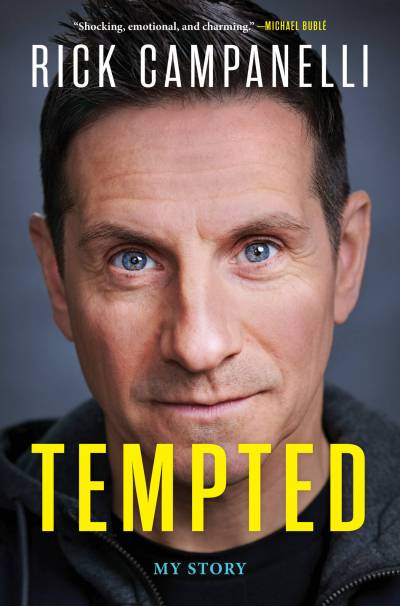
Former host/VJ Rick Campanelli revisits his gambling addiction in new memoir

Jen Zoratti 7 minute read Preview

Former host/VJ Rick Campanelli revisits his gambling addiction in new memoir

Jen Zoratti 7 minute read 6:00 AM CDT

To many Canadians, veteran media personality Rick Campanelli is better known as Rick the Temp, the energetic, baby-faced intern-turned-VJ on MuchMusic in the 1990s and early 2000s.

But behind that winning smile was a much darker reality.

In his new memoir, Tempted: My Story, released last month via HarperCollins Canada and co-written with John Meyer, Campanelli, 56, opens up for the first time about his struggles with a serious — and secret — gambling addiction, which reached its nadir in 2008 when the then-host of Entertainment Tonight Canada was detained by U.S. Homeland Security for unpaid casino debts on a flight back from Las Vegas.

The Free Press caught up with Campanelli in advance of his Winnipeg launch Monday evening at McNally Robinson Grant Park. This interview has been lightly edited for length and clarity.

Read
6:00 AM CDT

‘Amazing honour’: Winnipeg distribution centre continues award-winning ways for McKesson Canada

Aaron Epp 5 minute read Preview

‘Amazing honour’: Winnipeg distribution centre continues award-winning ways for McKesson Canada

Aaron Epp 5 minute read 6:00 AM CDT

After a three-year absence, the trophy is back in Winnipeg.

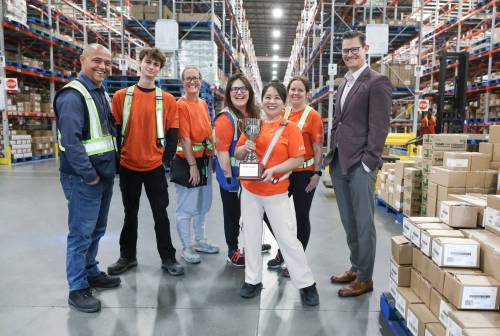
Last week, McKesson Canada named its 120,000-square-foot pharmaceutical distribution centre in the northwest part of the Manitoba capital its Distribution Centre of the Year. The award recognizes the facility’s role in helping essential medications reach communities across the province and some of Canada’s remote regions.

This is the fourth time the Winnipeg facility has earned the company-wide award since it opened five years ago. McKesson previously honoured the centre in 2021, 2022 and 2023. The recognition comes with a trophy, as well as a banner that was hung from the rafters on Thursday.

More than 100 employees work across the centre’s day-and-night operations, processing between 80,000 and 100,000 medication units daily. Last year, the centre distributed more than 21 million medication units while maintaining more than 99 per cent accuracy.

Read
6:00 AM CDT

Mayoral hopefuls trade accusations

Maggie Macintosh 4 minute read Preview

Mayoral hopefuls trade accusations

Maggie Macintosh 4 minute read Yesterday at 7:51 PM CDT

Two mayoral hopefuls traded accusations about meddling in each other’s campaigns as the incumbent rallied supporters for his re-election bid on the eve of advanced polls opening across Winnipeg.

A social media post made by Mike Vogiatzakis, one of 12 nominees in the Oct. 28 race for the top job at city hall, caught the attention of rivals Sunday.

The funeral director took to Facebook midday to criticize Kevin Klein — a competitor he said he thought of “as a friend” until the former Tory cabinet minister made a U-turn after pledging to back the Vogiatzakis campaign.

“Good speaker? Yes. Good looking guy? Sure. Someone I trust now? Absolutely not,” he wrote in a lengthy post.

Read
Yesterday at 7:51 PM CDT

Broadening prediction-market gambling a bad idea

Editorial 4 minute read Preview

Broadening prediction-market gambling a bad idea

Editorial 4 minute read Saturday, Oct. 3, 2026

Let’s make a prediction: sooner or later, when Canadian governments find a way to take their own cut of the action, prediction-contract gambling on everything from sports to entertainment to political decisions is going to come to Canada.

And that’s a horrible, dangerous, pernicious idea.

Unless you have particular access to information — either inside information or strategic information based on skills or education — you’re not likely to make money at it. In fact, structurally, you’re likely to lose. In prediction markets, you basically pay an amount, plus fees from the company involved, to bet on whether something will or will not happen within a certain time frame. The amount you pay for your contract depends on how other people are also betting.

As Wealthsimple describes it, “You buy whichever side you think is right. Prices move with demand, so if the market leans towards one outcome, the more that side costs. If a lot of people are backing the TSX to finish above 38,000, yes gets more expensive and no gets cheaper.”

Read
Saturday, Oct. 3, 2026

Stevenson set for first Jets start against Penguins

Ken Wiebe 5 minute read Preview

Stevenson set for first Jets start against Penguins

Ken Wiebe 5 minute read Yesterday at 6:55 PM CDT

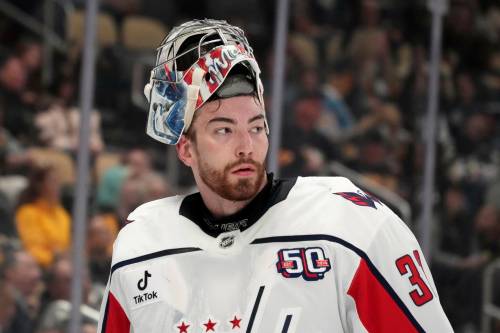
DETROIT — Clay Stevenson, the stage is yours.

As the Winnipeg Jets wrap up a two-game road trip on Monday against the Pittsburgh Penguins, the newest member of the team will be between the pipes after Stuart Skinner got the call in the first two outings of the campaign.

There will be an element of familiarity for Stevenson, as PPG Paints Arena is where he made his first NHL appearance with the Washington Capitals on April 17, 2025.

“There is some comfortability in that building,” said Stevenson, who made 33 saves in a 5-2 loss to the Penguins in that NHL debut. “It’s always a great challenge to play against (Sidney) Crosby and (Evgeni) Malkin and those guys. It’s an honour to get into the crease anytime.”

Read
Yesterday at 6:55 PM CDT

Thousands march in Toronto for Grassy Narrows, seeking justice for mercury poisoning

Kathryn Mannie, The Canadian Press 5 minute read Preview

Thousands march in Toronto for Grassy Narrows, seeking justice for mercury poisoning

Kathryn Mannie, The Canadian Press 5 minute read Wednesday, Sep. 23, 2026

TORONTO - The smell of burning tobacco and the sounds of banging drums hung in the air in Toronto's downtown core as thousands of supporters of the Grassy Narrows First Nation marched to Queen’s Park on Wednesday.

Members of Grassy Narrows, alongside labour unions, environmental groups, and faith-based organizations, took to the streets to call for justice for the Ojibwe community in northwestern Ontario, which has for decades suffered from the aftershocks of thousands of kilograms of mercury being dumped in their river system in the 1960s and 1970s.

Grassy Narrows Chief Sherry Ackabee said the First Nation has lost untold members to the effects of mercury poisoning. 

“Everybody’s lost somebody,” she said. “I myself have a child who was born with one functioning kidney … And my other children have been sick as well.”

Read
Wednesday, Sep. 23, 2026