Japan’s leader welcomes investment, exchanges to strengthen computer chip supply chain
Advertisement
Read this article for free:
or
Already have an account? Log in here »
To continue reading, please subscribe:

Digital Subscription
One year of digital access for only $205*
- Enjoy unlimited reading on winnipegfreepress.com
- Read the E-Edition, our digital replica newspaper
- Access News Break, our award-winning app
- Play interactive puzzles
*First annual payment billed as $205.00 + GST for one year. This annual subscription will automatically renew at $233.00 + GST every 52 weeks (10% off the regular annual price of $259.35). Offer available to new and qualified returning subscribers only. Cancel any time.
To continue reading, please subscribe:
Add Free Press access to your Brandon Sun subscription for only an additional
$1 for the first 4 weeks*
- Enjoy unlimited reading on winnipegfreepress.com
- Read the E-Edition, our digital replica newspaper
- Access News Break, our award-winning app
- Play interactive puzzles
*Your next Brandon Sun subscription payment will increase by $1.00 and you will be charged $17.95 plus GST for four weeks. After four weeks, your payment will increase to $24.95 plus GST every four weeks.
Read unlimited articles for free today:
or
Already have an account? Log in here »
Hey there, time traveller!
This article was published 17/05/2023 (1221 days ago), so information in it may no longer be current.
TOKYO (AP) — Japanese Prime Minister Fumio Kishida stressed that investment and international exchanges to strengthen the computer chip supply chain were welcome, as he met with the leaders of top computer chips makers Thursday.
A recent shortage of chips was a sore point for Japan’s manufacturing powerhouses like Toyota Motor Corp., when social restrictions related to the coronavirus pandemic crimped supplies, serving as a wake-up call that solid access to production must be ensured.
Computer chips are used in vehicles, mobile phones and an array of other products, and next-generation chips are going to be crucial for artificial intelligence, automated driving systems and other advanced technology.
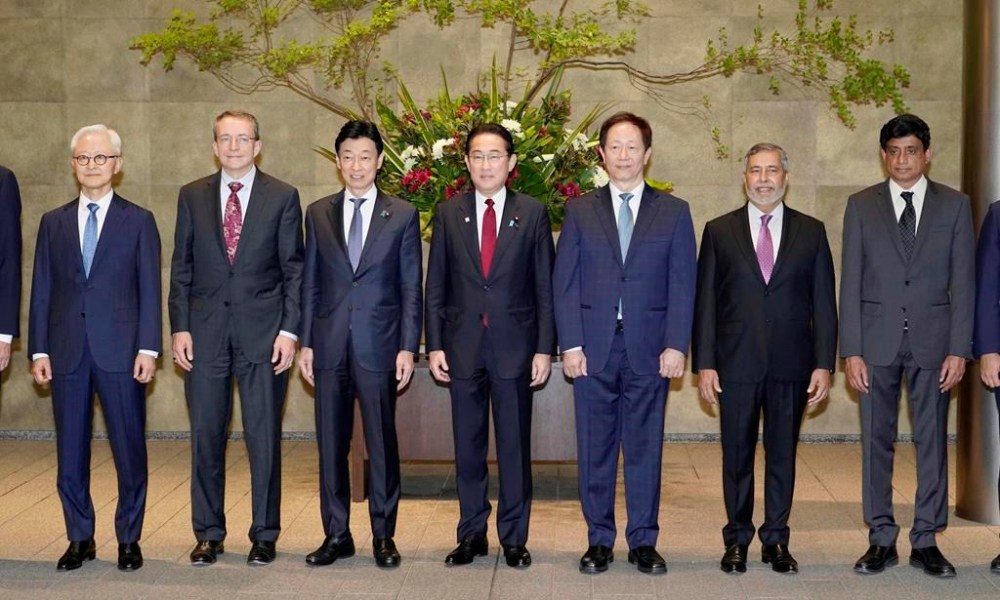
Japan is eager to strengthen its domestic chip production and remain a technological leader. Analysts say the uncertain future of U.S.-China relations also could put supplies from China at risk.
Intel Chief Executive Pat Gelsinger, TSMC Chair Mark Liu and Kye Hyun Kyung, a top executive at Samsung Electronics, were among the executives meeting at the prime minister’s official residence in Tokyo.
Yasutoshi Nishimura, the economy and trade minister, who was also at the meeting, said many of the executives had a positive response to Japan’s request.
The meeting centered around exchanging views on the policies needed to attract more investment, personnel and funding to Japan to strengthen the critical chips sector, according to the Japanese government.
“The government of Japan plans to take this into serious consideration and offer cooperative aid to fully tackle this issue,” Nishimura told reporters after the meeting.
Other chips makers represented at the meeting included Micron Technology Chief Executive Sanjay Mehrotra and IBM Senior Vice President Darío Gil.
The officials were on their way to the meeting of the Group of Seven nations in Hiroshima.
The strengthening of the chips supply chain is expected to be one of the topics discussed at the summit being attended by President Joe Biden and the leaders of Germany, Italy and other major industrial nations.
“I plan to lead the discussion intended to address the stabilization of the supply network and stress the importance of international cooperation,” Kishida told reporters before departing to Hiroshima.
The Japanese government has already announced funding for TSMC and Micron plants in Japan. It’s also giving money to a new domestic company called Rapidus, which means “quick” in Latin, to developing next-generation, or “post-5G,” semiconductors.
Those taking part in Rapidus are automaker Toyota Motor Corp., electronics makers Sony Group Corp. and NEC Corp., along with SoftBank Corp., Nippon Telegraph and Telephone Corp., Denso Corp. and Kioxia.
___
Yuri Kageyama is on Twitter https://twitter.com/yurikageyama