With ‘God’s-eye view,’ secretive surveillance flights keep close watch on Russia and Ukraine

Advertisement

Advertise with us

ABOARD A FRENCH AIR FORCE AWACS (AP) — Off in the distance, Ukraine, fighting for its survival. Seen from up here, in the cockpit of a French air force surveillance plane flying over neighboring Romania, the snow-dusted landscapes look deceptively peaceful.

Read this article for free:


or

Already have an account? Log in here »

To continue reading, please subscribe:

Subscribe and receive a limited-edition Free Press branded hat or tote.

Digital Subscription

One year of digital access for only $205*

  • Enjoy unlimited reading on winnipegfreepress.com
  • Read the E-Edition, our digital replica newspaper
  • Access News Break, our award-winning app
  • Play interactive puzzles

*First annual payment billed as $205.00 + GST for one year. This annual subscription will automatically renew at $233.00 + GST every 52 weeks (10% off the regular annual price of $259.35). Offer available to new and qualified returning subscribers only. Cancel any time.

To continue reading, please subscribe:

Add Free Press access to your Brandon Sun subscription for only an additional

$1 for the first 4 weeks*

  • Enjoy unlimited reading on winnipegfreepress.com
  • Read the E-Edition, our digital replica newspaper
  • Access News Break, our award-winning app
  • Play interactive puzzles
Start now

*Your next Brandon Sun subscription payment will increase by $1.00 and you will be charged $17.95 plus GST for four weeks. After four weeks, your payment will increase to $24.95 plus GST every four weeks.

Hey there, time traveller!
This article was published 15/01/2024 (993 days ago), so information in it may no longer be current.

ABOARD A FRENCH AIR FORCE AWACS (AP) — Off in the distance, Ukraine, fighting for its survival. Seen from up here, in the cockpit of a French air force surveillance plane flying over neighboring Romania, the snow-dusted landscapes look deceptively peaceful.

The dead from Russia’s war, the shattered Ukrainian towns and mangled battlefields, aren’t visible to the naked eye through the clouds.

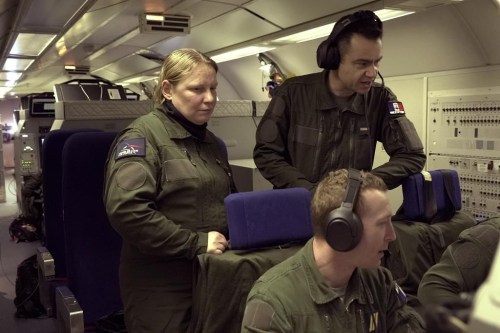
But French military technicians riding farther back in the aircraft, monitoring screens that display the word “secret” when idle, have a far more penetrating view. With a powerful radar that rotates six times every minute on the fuselage and a bellyful of surveillance gear, the plane can spot missile launches, airborne bombing runs and other military activity in the conflict.
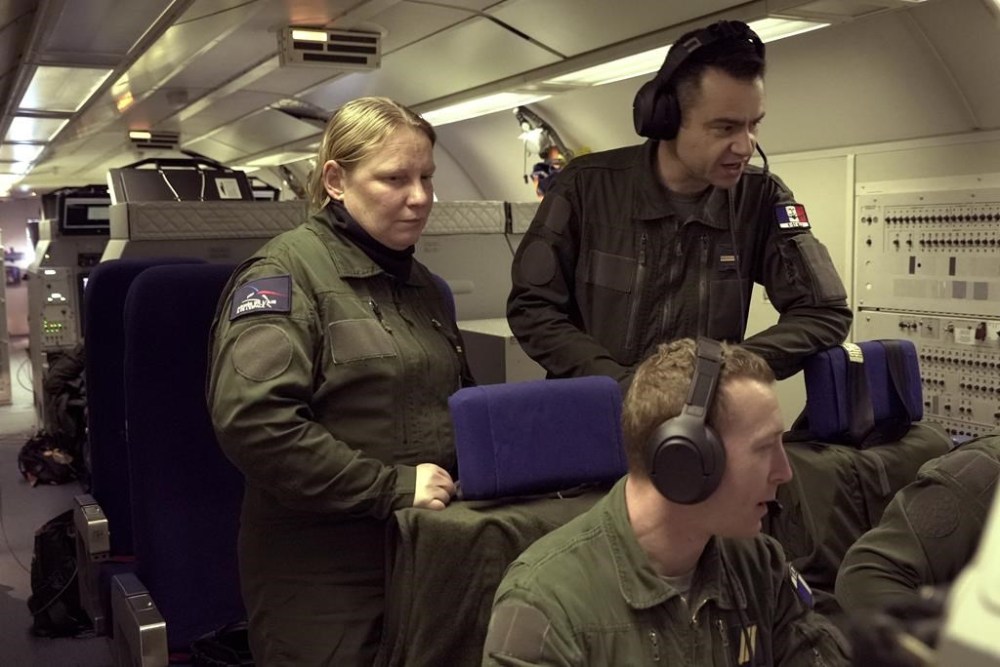
Crew members analyze data on monitors aboard a French military AWACS surveillance plane as it flies a 10-hour mission Tuesday, Jan. 9, 2024, to eastern Romania for the NATO military alliance. With a powerful radar that rotates six times a minute on top of the planes, AWACS can detect targets over hundreds of kilometers (miles). One AWACS can surveil an area the size of Poland; three can cover all of central Europe, NATO says. (AP Photo/John Leicester)

As the second anniversary of Russia’s Feb. 24, 2022, invasion of Ukraine nears, The Associated Press obtained rare and exclusive access aboard the giant Airborne Warning and Control System, or AWACS, aircraft. With 26 military personnel and an AP journalist aboard, it flew a 10-hour reconnaissance mission from central France to Romanian airspace and back, peering with electronic eyes across southern Ukraine and the Black Sea to Russian-occupied Crimea and beyond.

Circling on auto-pilot at 34,000 feet (10 kilometers), the plane with a proud cockerel painted on its tail fed intelligence in real time to ground-based commanders.

Its mission for NATO on the eastern flank of the 31-nation military alliance also, in effect, drew a do-not-cross line in European skies.

The plane’s sustained presence high above eastern Romania — seeing and also being seen by Russian forces — signaled how intensely NATO is watching its borders and Russia, ready if necessary to act should Russian aggression threaten to extend beyond Ukraine.

SHIELDS FOR NATO, PIECES OF AVIATION HISTORY

Regular surveillance flights, together with fighter patrols, ground-based radar, missile batteries and other hardware at NATO’s disposal, form what the commander of France’s AWACS squadron described as “a shield” against any potential spill-over.

The “ultimate goal is, of course, no conflict and deterrence,” said the commander, a lieutenant colonel named Richard. Because of French security concerns, the AP was only able to identify him and other military personnel by their ranks and first names.

“We need to show that we have the shield, show to the other countries that NATO is collective defense,” he continued. “We have the ability to detect everywhere. And we are not here for a conflict. We are here to show that we are present and ready.”

France’s four AWACS are among a variety of surveillance aircraft, including unmanned UAV drones, that gather intelligence for NATO and its member nations. Lt. Col. Richard said the French E-3F-type AWACS see for hundreds of kilometers (miles) with their distinctive black-and-white rooftop radar domes, although he wouldn’t be precise.

E-3s are modified Boeing 707s. The 707 first flew in 1957 but stopped carrying passengers commercially in 2013, so E-3s are also flying examples of aviation history.

“We can detect aircraft, we can detect UAVs, we can detect missiles and we can detect ships. That’s true, for sure, in Ukraine, especially when we are at the border,” Lt. Col. Richard said.

As the plane loitered and scanned, the crew detected a distant Russian AWACS above the Sea of Azov, many hundreds of kilometers away on the Crimean Peninsula’s eastern side. The Russian aircraft also seemingly spotted the French AWACS: Sensors along the fuselage picked up Russian radar signals.

“We know that they see us, they know that we see them. Let’s say that it’s some kind of a dialogue between them and us,” the French co-pilot, Major Romain, said.

HAWK-EYED AWACS ON CALL TO SAFEGUARD THE OLYMPICS

NATO also has its own fleet of 14 AWACS, also E-3s. They can detect low-flying targets within 400 kilometers (250 miles) and higher-flying targets another 120 kilometers (75 miles) beyond that, the alliance says. It says one AWACS can surveil an area the size of Poland; three can cover all of central Europe.

Able to fly for 12 hours without refueling, French AWACS aren’t limited to surveillance, communications and air-traffic control missions for NATO. They expect to be deployed as part of the massive security operation for the Paris Olympics, providing additional radar surveillance with what Lt. Col. Richard called their “God’s-eye view.”
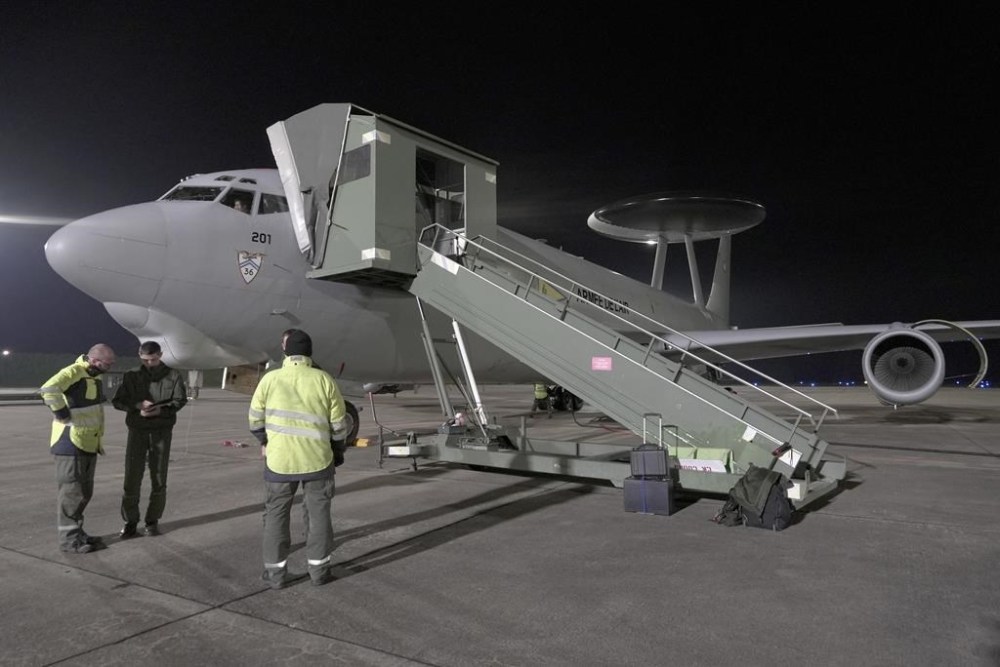
Crew members debrief ground staff after a 10-hour mission Tuesday, Jan. 9, 2024, aboard a French Air Force AWACS surveillance plane that flew from the 702 Air Base in Avord, central France, to eastern Romania and back again. Circling around and around for hours on auto-pilot high in the skies of eastern Europe, secretive surveillance flights for NATO closely watch Russian activity along the military alliance's eastern flank. (AP Photo/John Leicester)

Russian pilots have at times made clear that they don’t like being watched.

In 2022, a Russian fighter jet released a missile near a British air force RC-135 Rivet Joint surveillance aircraft that was flying in international airspace over the Black Sea, Britain’s government said. The U.S. government released video in March 2023 of a Russian fighter jet dumping fuel on a U.S. Air Force surveillance drone. The drone crashed into the Black Sea.

Rivet Joints are particularly capable spy planes, and Russian authorities “really hate” their ability to snoop on the Ukraine war, said Justin Bronk, a researcher at the Royal United Services Institute defense think tank in London.

As well as gathering “real-time intelligence that theoretically could be shared with Ukrainian partners,” the planes also furnish “fantastic” insight about “how Russian forces actually operate in a real war,” Bronk said in a phone interview.

“So of course, the Russians are furious,” he said.

IN THE SKIES, REGULAR ENCOUNTERS

NATO also scrambles fighter jets to scope Russian flights. It says allied aircraft took to the skies more than 500 times in 2022 to intercept Russian aircraft that ventured close to NATO airspace. The number of such encounters dropped to more than 300 in 2023, according to the Brussels-headquartered alliance.

The strengthening of Ukrainian air defenses with Western weaponry may partly explain the decrease, with shoot-downs seemingly making Russian pilots warier. NATO observed reduced activity by manned Russian flights over the western Black Sea last year. NATO says “the vast majority of aerial encounters between NATO and Russian jets were safe and professional” and that Russian incursions into NATO airspace were rare and generally short.

Aboard the French flight, the co-pilot, Major Romain, said Russian planes haven’t intercepted a French AWACS “for a long time” and that if they did, French pilots would try to defuse any tension.

“Our orders are to be, let’s say, passive,” he said. “For a civilian, let’s say ‘polite.’”

___

Find more of AP’s coverage of Russia and Ukraine at https://apnews.com/hub/russia-ukraine

Report Error Submit a Tip

More Stories

Creative powerhouse Perry Rosemond never lost Winnipeg roots

Ben Waldman 7 minute read Preview

Creative powerhouse Perry Rosemond never lost Winnipeg roots

Ben Waldman 7 minute read Yesterday at 6:00 AM CDT

He created King of Kensington, directed the troops in the Royal Canadian Air Farce, and his creative eye was behind the lens for television shows starring Johnny Cash, Tom Jones, Mr. Dress-Up and the Friendly Giant.

He also wrote and developed the Canadian version of Sesame Street during his time as the head of school and preschool programming for CBC in Toronto, and directed a televised special in 2002 for Winnipeg sketch comedy troupe Royal Liechtenstein Theatre Company.

But before his name featured in the credits of some of the most iconic and influential pieces of the Cancon canon, Perry Rosemond was an only child living in a crammed, multi-generational home in Winnipeg’s North End, racing each day to beat the morning bell next door at William Whyte School.

In memoirs that have yet to be published, the late television producer recalled his childhood. “(T)here were 14 of us in the house at 193 Andrews St., and it wasn’t that big of a house,” he writes.

Read
Yesterday at 6:00 AM CDT

With ‘God’s-eye view,’ secretive surveillance flights keep close watch on Russia and Ukraine

John Leicester, The Associated Press 7 minute read Preview

With ‘God’s-eye view,’ secretive surveillance flights keep close watch on Russia and Ukraine

John Leicester, The Associated Press 7 minute read Tuesday, Jan. 16, 2024

ABOARD A FRENCH AIR FORCE AWACS (AP) — Off in the distance, Ukraine, fighting for its survival. Seen from up here, in the cockpit of a French air force surveillance plane flying over neighboring Romania, the snow-dusted landscapes look deceptively peaceful.

The dead from Russia's war, the shattered Ukrainian towns and mangled battlefields, aren't visible to the naked eye through the clouds.

But French military technicians riding farther back in the aircraft, monitoring screens that display the word "secret" when idle, have a far more penetrating view. With a powerful radar that rotates six times every minute on the fuselage and a bellyful of surveillance gear, the plane can spot missile launches, airborne bombing runs and other military activity in the conflict.

As the second anniversary of Russia's Feb. 24, 2022, invasion of Ukraine nears, The Associated Press obtained rare and exclusive access aboard the giant Airborne Warning and Control System, or AWACS, aircraft. With 26 military personnel and an AP journalist aboard, it flew a 10-hour reconnaissance mission from central France to Romanian airspace and back, peering with electronic eyes across southern Ukraine and the Black Sea to Russian-occupied Crimea and beyond.

Read
Tuesday, Jan. 16, 2024

Winnipeggers witness unveiling of Japanese Canadian monument in B.C.

Morgan Modjeski 6 minute read Preview

Winnipeggers witness unveiling of Japanese Canadian monument in B.C.

Morgan Modjeski 6 minute read Yesterday at 8:39 PM CDT

As Miki Stewart gathered with her family at the Japanese Cultural Association of Manitoba on Saturday afternoon, she was thinking of her parents, Yoshimaru and Yoshi Abe.

Both Stewart, 80, and her sister Yumi Falk, 81, alongside an older brother, were born in the Tashme internment camp in British Columbia. They were among more than 2,600 Japanese Canadians who were forcefully removed and interred at the camp following the bombing of Pearl Harbour and Canada’s declaration of war on Japan in 1941.

“They didn’t talk much about how they suffered,” Stewart said of her parents. “But they did.”

She was amongst a group of more than 150 people who gathered at the association’s McPhillips headquarters on Saturday afternoon to watch the unveiling of the Japanese Canadian Monument in Victoria B.C.

Read
Yesterday at 8:39 PM CDT

Letters, Oct. 3

7 minute read Yesterday at 2:01 AM CDT

A morning in the life …

My very first lesson does not start when I walk into that lecture hall, oh no — it starts long before. It begins when I walk to my car, check the estimated arrival time to the University of Manitoba and hope that Winnipeg traffic agrees with it.

A drive that appears completely manageable changes almost immediately when I’m greeted by a tsunami of orange pylons and a line of cars that appears to go on forever. Traffic moves by the inch, lanes magically disappear and the detour I took yesterday now has a detour of its own. These factors make me do a calculation that I have become all too familiar with. How late can I arrive and still find parking, run to my class across campus and get to class with enough time left to make it worth it?

I have grown used to people saying, “Why not just leave earlier?” I do. But when I’m already leaving for my 8:30 a.m. class at 7 a.m., there’s only so much I can do. This drive that some would think is relaxing is one that feels like an assignment that I didn’t know I had to complete and is due at 8:30 a.m.

Mayoral candidate Vogiatzakis criticized for living outside Winnipeg

Malak Abas 4 minute read Preview

Mayoral candidate Vogiatzakis criticized for living outside Winnipeg

Malak Abas 4 minute read Friday, Oct. 2, 2026

A mayoral hopeful took heat from other candidates Friday for living outside Winnipeg while running in the civic election.

Mike Vogiatzakis’s primary residence is in the Rural Municipality of St. Andrews, about 25 kilometres north of Winnipeg — a community with its own mayor and councillors.

But the funeral director said he owns a home in Winnipeg where he divides his time, and he would move to the city full-time if elected mayor.

“It doesn’t matter where a person lives. Why are we dividing St. Andrews and Manitoba and Winnipeg? I’ve met the criteria to run for mayor,” Vogiatzakis said Friday morning.

Read
Friday, Oct. 2, 2026

Living the dream

Ken Wiebe 7 minute read Preview

Living the dream

Ken Wiebe 7 minute read Yesterday at 4:48 PM CDT

DETROIT – As Tyrel Bauer took a left turn out of the tunnel from the Winnipeg Jets dressing room and into the stands, he was met with a hearty round of applause from the 25 friends and family members who had made the trek from various points around North America.

Bauer had just realized a childhood dream and the significance of the moment was not lost on some of his biggest supporters.

“It was a special walk, for sure. A special walk,” Bauer said on Saturday afternoon before the Jets departed for a two-game road trip that begins on Sunday in Detroit against the Red Wings. “Those people who came – and many more that weren’t there and were cheering on from afar – they’ve always been there.

“I wanted that for my family, maybe even more than I wanted it for me. They’ve been through thick and thin. I’ve stressed mom out quite a bit over the years doing my job. That meant a lot for them and I’m really happy they could be there for it.”

Read
Yesterday at 4:48 PM CDT