The Galapagos Islands and many of their unique creatures are at risk from warming waters

Advertisement

Advertise with us

GALÁPAGOS ISLANDS, Ecuador (AP) — Warm morning light reflects from the remains of a natural rock arch near Darwin Island, one of the most remote islands in the Galapagos. In clear, deep blue water, thousands of creatures — fish, hammerhead sharks, marine iguanas — move in search of food.

Read this article for free:


or

Already have an account? Log in here »

To continue reading, please subscribe:

Subscribe and receive a limited-edition Free Press branded hat or tote.

Digital Subscription

One year of digital access for only $205*

  • Enjoy unlimited reading on winnipegfreepress.com
  • Read the E-Edition, our digital replica newspaper
  • Access News Break, our award-winning app
  • Play interactive puzzles

*First annual payment billed as $205.00 + GST for one year. This annual subscription will automatically renew at $233.00 + GST every 52 weeks (10% off the regular annual price of $259.35). Offer available to new and qualified returning subscribers only. Cancel any time.

To continue reading, please subscribe:

Add Free Press access to your Brandon Sun subscription for only an additional

$1 for the first 4 weeks*

  • Enjoy unlimited reading on winnipegfreepress.com
  • Read the E-Edition, our digital replica newspaper
  • Access News Break, our award-winning app
  • Play interactive puzzles
Start now

*Your next Brandon Sun subscription payment will increase by $1.00 and you will be charged $17.95 plus GST for four weeks. After four weeks, your payment will increase to $24.95 plus GST every four weeks.

Hey there, time traveller!
This article was published 29/07/2024 (784 days ago), so information in it may no longer be current.

GALÁPAGOS ISLANDS, Ecuador (AP) — Warm morning light reflects from the remains of a natural rock arch near Darwin Island, one of the most remote islands in the Galapagos. In clear, deep blue water, thousands of creatures — fish, hammerhead sharks, marine iguanas — move in search of food.

The 2021 collapse of Darwin’s Arch, named for the famed British naturalist behind the theory of evolution, came from natural erosion. But its demise underscored the fragility of a far-flung archipelago that’s coming under increased pressure both from climate change and invasive species.

Warming oceans affect the food sources of many of the seagoing animals in the Galapagos. Marine iguanas — one of many species that are endemic, or unique, to the Galapagos — have a harder time finding the red and green algae they prefer. Sea turtles struggle to nest in warmer temperatures. Raising young gets harder as water warms and fewer nutrients are available.
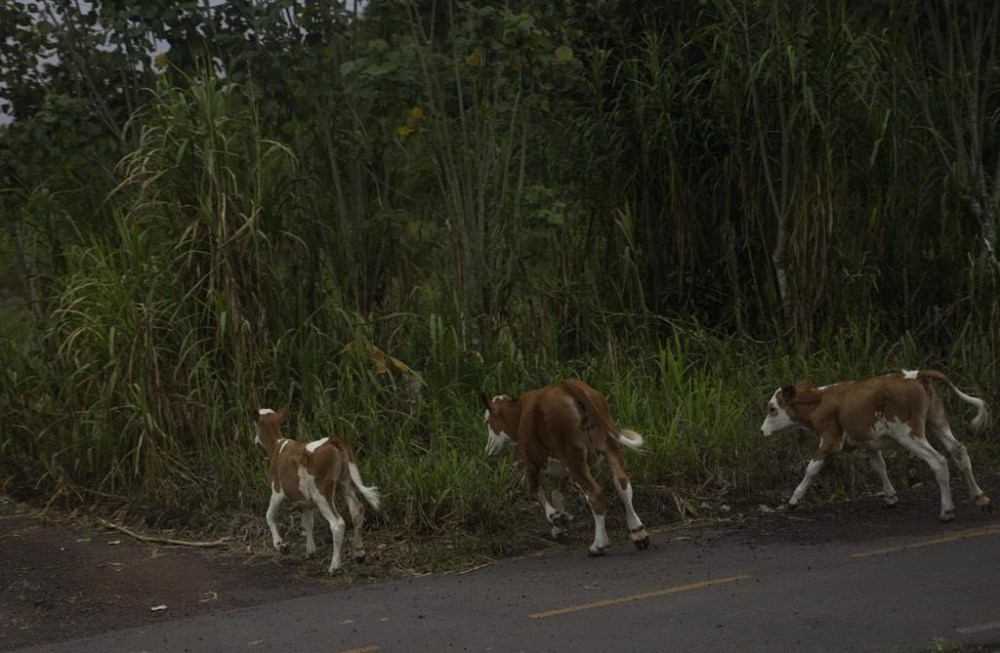
Untagged and unbranded cattle roam the highland grounds where giant tortoises feed on a reserve called Rancho Primicias on Saturday, June 15, 2024, on Santa Cruz, Ecuador in the Galapagos. This invasive species, along with others brought by humans like feral cats, dogs and pigs, threaten the endemic species on the islands. (AP Photo/Alie Skowronski)

While the Galapagos are known for a great multitude of species, their numbers aren’t unlimited.

“We have something of everything here – that’s why people say the Galapagos is so diverse – but we have a small number of each thing,” said Natasha Cabezas, a naturalist guide.

The Galapagos have always been sensitive to changes in ocean temperature. The archipelago itself is located where major ocean currents converge — cool from the south, warm from the north, and a cold upwelling current from the west. Then there’s El Nino, the periodic and natural Pacific Ocean warming that affects weather worldwide.

While temperatures vary depending on the season and other naturally-occurring climate events, ocean temperatures have been rising because of human-caused climate change as oceans absorb the vast majority of excess heat in the atmosphere. The ocean experienced its warmest decade since at least the 1800s in the last 10 years, and 2023 was the ocean’s warmest year on record.

Early June brings winter in the Southern Hemisphere, and the Cromwell current brings whale sharks, hammerheads, and massive sunfish to the surface. It also provides nutrients for penguins, marine iguanas and sea lions in search of food. As more of those animals make themselves known this season, scientists are tracking how they fared in the warming of the past year’s El Nino.

El Nino can bring food shortages for some species like marine iguanas and sea turtles, as the warmer ocean means dwindling food sources. Scientists observing the species have noted a significant decline in population numbers during El Nino events.

Marine iguanas swim like snakes through the water from rock to rock as waves crash against the shore of Fernandina Island. They latch themselves onto the undersea rocks to feed on algae growing there, while sea lions spin around them like puppies looking for someone to play with.

The iguanas were “one of the most affected species from El Niño last year and right now they are still recovering,” said Galapagos Conservancy Director Jorge Carrión.

As rising ocean temperatures threaten aquatic or seagoing life, on land there’s a different problem. Feral animals — cats, dogs, pigs, goats and cattle, none of them native — are threatening the unique species of the islands.

After the COVID-19 pandemic, many people are abandoning the dogs and cats they wanted to keep them company, Cabezas said.

“If you don’t take care of them they become a problem and now it’s a shame to see dogs everywhere. We have a big problem right now I don’t know what we’re going to do,” she said.

The non-native animals are a special threat to the giant tortoises closely associated with the Galapagos. The tortoises declined dramatically in the 19th century due to hunting and poaching, and authorities have worked to protect them from humans. It’s been illegal to kill a giant tortoise since 1933.

“In one night, a feral pig can destroy all nesting sites in an area,” Carrión said. Park rangers try to visit areas with nesting sites once a day, and kill pigs when they find them. But the pigs are elusive, Carrion said.

Feral cats feed on marine iguana hatchings, and both pigs and cats compete for food with the tortoises.

If invasive species and warming oceans weren’t enough, there’s the plastic that is a widespread problem in the world’s oceans. One recent study reported microplastics in the bellies of Galapagos penguins.

“There are no animals in the Galapagos that do not have microplastics in their food,” Carrión said.

___

The Associated Press’ climate and environmental coverage receives financial support from multiple private foundations. AP is solely responsible for all content. Find AP’s standards for working with philanthropies, a list of supporters and funded coverage areas at AP.org.

Report Error Submit a Tip

More Stories

Hellebuyck standoff caused by… Nathan MacKinnon?

Mike McIntyre 6 minute read Preview

Hellebuyck standoff caused by… Nathan MacKinnon?

Mike McIntyre 6 minute read Friday, Sep. 18, 2026

Looking for someone to blame in the Connor Hellebuyck fiasco and cast as public enemy No. 1? How about long-time Winnipeg Jets nemesis Nathan MacKinnon?

Allow us to explain as we fire up the time machine and head back to February in Italy.

Oh, what could have been if MacKinnon had been able to score on what appeared to be an open net late in the third period of the men’s gold medal game with Hellebuyck down and seemingly out of position.

Instead, the star forward fired wide, keeping the score deadlocked at 1-1 as the clock ticked down on regulation.

Read
Friday, Sep. 18, 2026

American Hostage stars recall warmth of Winnipeggers during brutal winter

Randall King 7 minute read Preview

American Hostage stars recall warmth of Winnipeggers during brutal winter

Randall King 7 minute read Friday, Sep. 18, 2026

TORONTO — When you stream the eight-part series American Hostage, a sense of familiarity may strike.

That’s because the show was shot in Winnipeg — especially in the Exchange District — from November of last year to the beginning of February, with Winnipeg portraying Indianapolis circa 1977.

The whole world seemed to be watching that midwest American city that year as a hostage crisis unfolded involving one Tony Kiritsis, an angry man who goes ballistic when a mortgage brokerage was poised to foreclose on property he had dreamed of developing into a shopping centre.

Kiritsis kidnapped his mortgage broker, Richard Hall, wiring a shotgun to the back of his head, and demanded a public airing of his grievances, with the reluctant help of popular radio broadcaster Fred Heckman.

Read
Friday, Sep. 18, 2026

News briefs for Sunday, September 20, 2026

2 minute read Updated: 3:36 PM CDT

A collection of breaking news briefs filed on Sunday, September 20, 2026

Woman charged after Toronto Street shooting

3:18 PM

The Winnipeg Police Service Major Crimes Unit is continuing to investigate a shooting in the 600 block of Toronto Street that took place around 1 a.m. on Friday.

The Galapagos Islands and many of their unique creatures are at risk from warming waters

Alie Skowronski, The Associated Press 5 minute read Preview

The Galapagos Islands and many of their unique creatures are at risk from warming waters

Alie Skowronski, The Associated Press 5 minute read Monday, Jul. 29, 2024

GALÁPAGOS ISLANDS, Ecuador (AP) — Warm morning light reflects from the remains of a natural rock arch near Darwin Island, one of the most remote islands in the Galapagos. In clear, deep blue water, thousands of creatures — fish, hammerhead sharks, marine iguanas — move in search of food.

The 2021 collapse of Darwin's Arch, named for the famed British naturalist behind the theory of evolution, came from natural erosion. But its demise underscored the fragility of a far-flung archipelago that's coming under increased pressure both from climate change and invasive species.

Warming oceans affect the food sources of many of the seagoing animals in the Galapagos. Marine iguanas — one of many species that are endemic, or unique, to the Galapagos — have a harder time finding the red and green algae they prefer. Sea turtles struggle to nest in warmer temperatures. Raising young gets harder as water warms and fewer nutrients are available.

While the Galapagos are known for a great multitude of species, their numbers aren't unlimited.

Read
Monday, Jul. 29, 2024

Elmwood–East Kildonan candidate promises to tackle ‘inefficiency’ in government

Gabrielle Piché 3 minute read Preview

Elmwood–East Kildonan candidate promises to tackle ‘inefficiency’ in government

Gabrielle Piché 3 minute read Yesterday at 6:17 PM CDT

The former assistant of late Elmwood–East Kildonan councillor Jason Schreyer is again running for the seat.

Chris Sweryda officially launched his campaign Saturday. He did so with the backdrop of a grocery program he runs, where food is sold near-cost out of St. Gerard School’s gym.

Rows of cereal, pasta sauce and chips filled tables ahead of the program’s afternoon opening. Sweryda created the pop-up with Schreyer months ahead of the former councillor’s April 2025 death.

The program sees roughly 500 people each day it’s open (which is every other week on Saturday), Sweryda said.

Read
Yesterday at 6:17 PM CDT

Gillingham in lead with decided voters

Nicole Buffie 6 minute read Preview

Gillingham in lead with decided voters

Nicole Buffie 6 minute read Friday, Sep. 18, 2026

A cloud of uncertainty is hanging over Winnipeg as October’s municipal election nears.

Three months after a poll showed more than 40 per cent of Winnipeggers wanted to see someone other than current mayor Scott Gillingham elected, a new Abacus Data poll indicates more than half of Winnipeg voters are undecided heading into next month’s civic election.

Of decided voters, 55 per cent favour Gillingham compared to 23 per cent for former councillor and provincial cabinet minister Kevin Klein and 11 per cent for funeral director Mike Vogiatzakis.

Of all respondents, just over 50 per cent said they were unsure while 13 per cent said they will not vote.

Read
Friday, Sep. 18, 2026