Building the future Rural teacher develops robotics course; hopes for provincewide expansion
Read this article for free:
or
Already have an account? Log in here »
To continue reading, please subscribe:

Digital Subscription
One year of digital access for only $205*
- Enjoy unlimited reading on winnipegfreepress.com
- Read the E-Edition, our digital replica newspaper
- Access News Break, our award-winning app
- Play interactive puzzles
*First annual payment billed as $205.00 + GST for one year. This annual subscription will automatically renew at $233.00 + GST every 52 weeks (10% off the regular annual price of $259.35). Offer available to new and qualified returning subscribers only. Cancel any time.
To continue reading, please subscribe:
Add Free Press access to your Brandon Sun subscription for only an additional
$1 for the first 4 weeks*
- Enjoy unlimited reading on winnipegfreepress.com
- Read the E-Edition, our digital replica newspaper
- Access News Break, our award-winning app
- Play interactive puzzles
*Your next Brandon Sun subscription payment will increase by $1.00 and you will be charged $17.95 plus GST for four weeks. After four weeks, your payment will increase to $24.95 plus GST every four weeks.
Read unlimited articles for free today:
or
Already have an account? Log in here »
Hey there, time traveller!
This article was published 23/01/2025 (587 days ago), so information in it may no longer be current.
Unlike other provinces, Manitoba does not have a standardized robotics curriculum or credit — but one rural technology teacher is trying to change that.
JP Jamieson is raising awareness about a one-of-a-kind program at Morris School in the hopes that one day, his students will not have to leave the province to enter their robots in a contest and hone their engineering skills.
The kindergarten-to-Grade 12 school’s two robotics teams will travel to Minnesota this weekend for a VEX V5 competition. The event will be a first for many of the students who are enrolled in grades 8 to 11.
“They have to figure out it’s not a one-person show. They have to work together to make a better robot,” Jamieson said, referring to both his teams’ players and the students enrolled in his homemade high school course on the subject.
MIKE DEAL / FREE PRESS From left: Gold team members, Zajac St. Godard, Tennyson Janke and Hannah Klassen, teacher JP Jamieson and blue team members, Andrew Hildebrandt, Cody Dueck, Kayden Grattan, and Josh Hildebrandt. 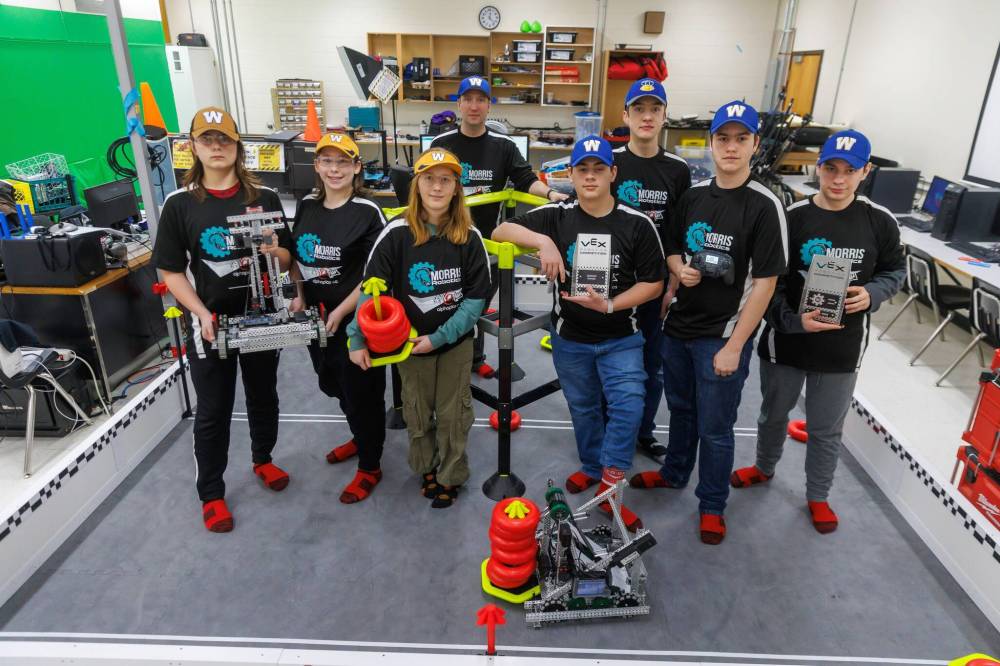
The technology teacher describes robotics as “an incredible learning unit,” composed of coding, driving and other STEM (science, technology, engineering and mathematics) lessons.
Not only must they learn how to build a robot, but they have to brainstorm innovative ideas to improve its performance, communicate their ideas to teammates and convince others to get on board, he noted.
Jamieson’s interest in robotics as an educational tool dates back to the roughly dozen years he spent delivering Canadian curriculum overseas. He has taught at accredited schools in Beijing and Tokyo, where robotics has become a common extracurricular.
Upon returning to his home province in 2020, he recalled being surprised to learn about its small robotics community and limited options for student participation.
The volunteer-run Manitoba Robot Games attracts robotics enthusiasts to challenge one another’s creations at Technical Vocational High School’s “field house” in Winnipeg every year.
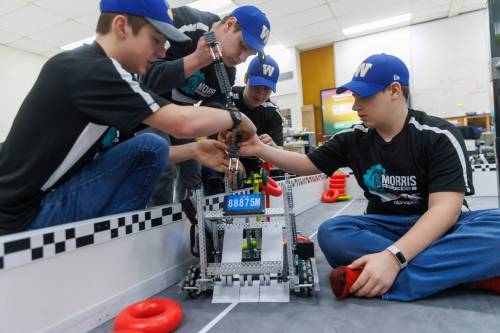
MIKE DEAL / FREE PRESS Blue team members Cody Dueck (from left), Josh Hildebrandt, Kayden Grattan and Andrew Hildebrandt rush to make a repair during testing. 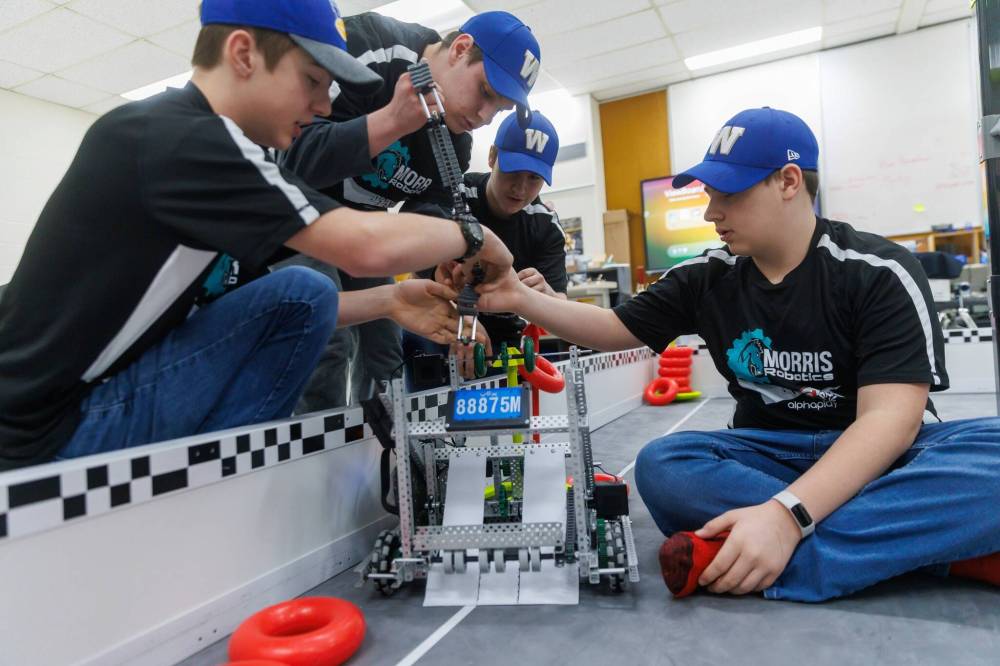
As far as Jamieson is concerned, there’s room for those school-based programs — which are affordable to start up, with build-it-yourself robot kits ranging between $25 and $50 — and VEX teams.
The latter requires a larger investment, with a $1,600 starter set that forces students to code complex sensors so their creations can complete a range of tasks. In comparison, the Manitoba Robot Games revolves around building a small machine that can push a competitor’s design out of a circular ring.
“Seeing how far we’ve come, from having a basic robot to having an absolute beast of a robot competing against some of the best teams of the world… It’s very (empowering),” said Andrew Hildebrandt, a Grade 9 student at Morris School.
The 14-year-old transferred schools this year to participate in Manitoba’s only formal VEX program and he stands by the decision.
His team’s robot — the latest iteration of which weighs 10 pounds — has been entered into three international competitions since the 2024-25 school year began.
“When you walk into a tech lab or robotics lab, there’s a buzz in the air”–Teacher JP Jamieson
They have secured two awards and are vying for more as they face off against peers on their school’s new second team, as well as others from classrooms across the U.S.
Grade 10 competitor Zajac St. Godard said he was filled with nervous energy ahead of his inaugural international challenge, which begins Friday.
Zajac, 15, joined the extracurricular to learn teamwork skills and expand his knowledge in STEM because he wants to pursue a related career after graduation.
His team uniform is gold Winnipeg Blue Bombers baseball caps. Zajac’s other opponents, including Andrew, don blue caps.
The boys’ coach said their school community is a unique place, given teenagers spend weekends reading about pneumatics — a branch of engineering that explains how pressurized air can power a robot and perform other mechanical work.
MIKE DEAL / FREE PRESS Gold team members (from left) Zajac St. Godard, Tennyson Janke and Hannah Klassen, work on their robot. 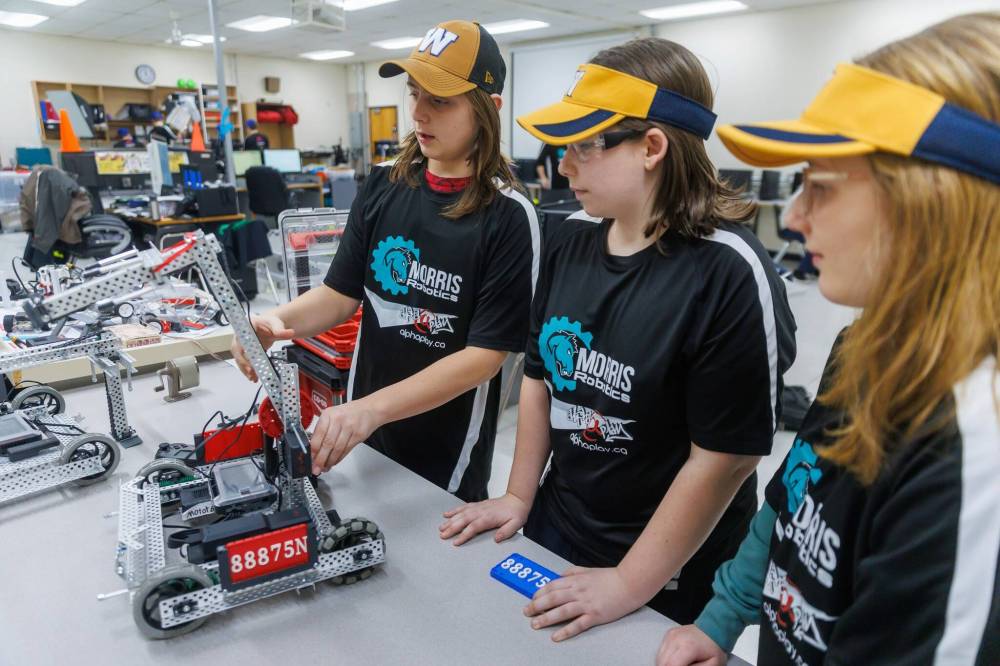
“When you walk into a tech lab or robotics lab, there’s a buzz in the air — the students have their heads down, they’re collaborating, they’re showing off what they’ve learned and how excited they are,” Jamieson said.
Morris School has its own “robot battle ring” for its two teams to tweak designs and practise challenges.
Manitoba needs at least 14 more teams to become an official VEX region under the Robotics Education and Competition Foundation, a global non-profit dedicated to increasing student engagement in computer science.
The company that builds the educational robotics products, which Jamieson likens to IKEA packages, is headquartered in Texas.
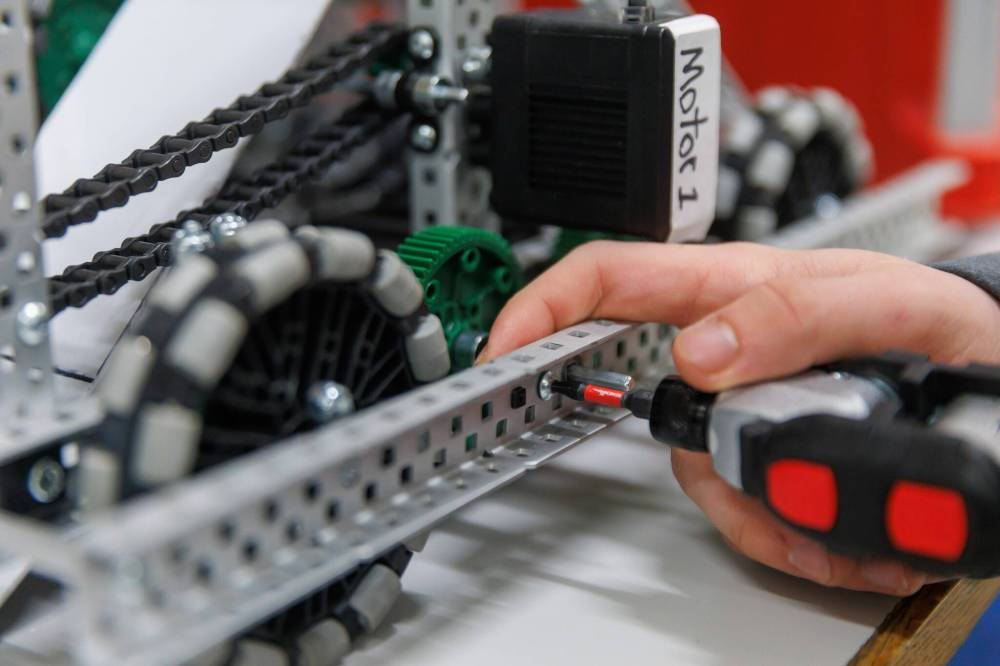
MIKE DEAL / FREE PRESS Adjustments are made to the blue team's robot.
Education Minister Tracy Schmidt said she was keen to explore the possibility of expanding the initiative and creating a provincial curriculum on robotics.
“This is the way of the future. We know that students in our education system are looking for and excited about this type of programming,” Schmidt said, noting the recent creation of the province’s department of innovation and new technology.
The minister applauded Jamieson’s creativity and dedication in getting a first-of-its-kind program up and running.
The technology teacher said he’s optimistic more teams will form in Manitoba.
“I don’t see how it doesn’t take off,” Jamieson said, “but how do we get a curriculum, how do we get a credit and how do we get people to spend the money that’ll pay off (in growing STEM experts and industries down the line)?”
Saskatchewan launched a stand-alone robotics and automation curriculum in 2019.
maggie.macintosh@freepress.mb.ca


Maggie Macintosh
Education reporter
Maggie Macintosh reports on education for the Free Press. Originally from Hamilton, Ont., she first reported for the Free Press in 2017. Read more about Maggie.
Funding for the Free Press education reporter comes from the Government of Canada through the Local Journalism Initiative.
Every piece of reporting Maggie produces is reviewed by an editing team before it is posted online or published in print — part of the Free Press‘s tradition, since 1872, of producing reliable independent journalism. Read more about Free Press’s history and mandate, and learn how our newsroom operates.
Our newsroom depends on a growing audience of readers to power our journalism. If you are not a paid reader, please consider becoming a subscriber.
Our newsroom depends on its audience of readers to power our journalism. Thank you for your support.