Trump’s order to block ‘woke’ AI in government encourages tech giants to censor their chatbots
Advertisement
Read this article for free:
or
Already have an account? Log in here »
To continue reading, please subscribe:

Digital Subscription
One year of digital access for only $205*
- Enjoy unlimited reading on winnipegfreepress.com
- Read the E-Edition, our digital replica newspaper
- Access News Break, our award-winning app
- Play interactive puzzles
*First annual payment billed as $205.00 + GST for one year. This annual subscription will automatically renew at $233.00 + GST every 52 weeks (10% off the regular annual price of $259.35). Offer available to new and qualified returning subscribers only. Cancel any time.
To continue reading, please subscribe:
Add Free Press access to your Brandon Sun subscription for only an additional
$1 for the first 4 weeks*
- Enjoy unlimited reading on winnipegfreepress.com
- Read the E-Edition, our digital replica newspaper
- Access News Break, our award-winning app
- Play interactive puzzles
*Your next Brandon Sun subscription payment will increase by $1.00 and you will be charged $17.95 plus GST for four weeks. After four weeks, your payment will increase to $24.95 plus GST every four weeks.
Read unlimited articles for free today:
or
Already have an account? Log in here »
Hey there, time traveller!
This article was published 24/07/2025 (434 days ago), so information in it may no longer be current.
Tech companies looking to sell their artificial intelligence technology to the federal government must now contend with a new regulatory hurdle: proving their chatbots aren’t “woke.”
President Donald Trump’s sweeping new plan to counter China in achieving “global dominance” in AI promises to cut regulations and cement American values into the AI tools increasingly used at work and home.
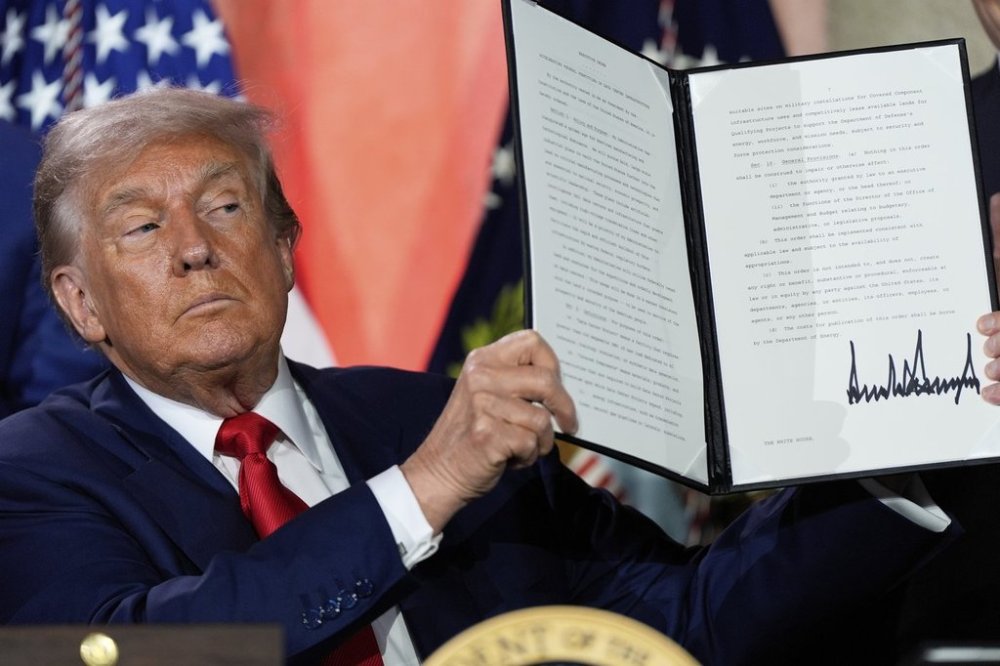
But one of Trump’s three AI executive orders signed Wednesday — the one “preventing woke AI in the federal government” — marks the first time the U.S. government has explicitly tried to shape the ideological behavior of AI.
Several leading providers of the AI language models targeted by the order — products like Google’s Gemini and Microsoft’s Copilot — have so far been silent on Trump’s anti-woke directive, which still faces a study period before it gets into official procurement rules.
While the tech industry has largely welcomed Trump’s broader AI plans, the anti-woke order forces the industry to leap into a culture war battle — or try their best to quietly avoid it.
“It will have massive influence in the industry right now,” especially as tech companies are already capitulating to other Trump administration directives, said civil rights advocate Alejandra Montoya-Boyer, senior director of The Leadership Conference’s Center for Civil Rights and Technology.
The move also pushes the tech industry to abandon years of work to combat the pervasive forms of racial and gender bias that studies and real-world examples have shown to be baked into AI systems.
“First off, there’s no such thing as woke AI,” Montoya-Boyer said. “There’s AI technology that discriminates and then there’s AI technology that actually works for all people.”
Molding the behaviors of AI large language models is challenging because of the way they’re built and the inherent randomness of what they produce. They’ve been trained on most of what’s on the internet, reflecting the biases of all the people who’ve posted commentary, edited a Wikipedia entry or shared images online.
“This will be extremely difficult for tech companies to comply with,” said former Biden administration official Jim Secreto, who was deputy chief of staff to U.S. Secretary of Commerce Gina Raimondo, an architect of many of President Joe Biden’s AI industry initiatives. “Large language models reflect the data they’re trained on, including all the contradictions and biases in human language.”
Tech workers also have a say in how they’re designed, from the global workforce of annotators who check their responses to the Silicon Valley engineers who craft the instructions for how they interact with people.
Trump’s order targets those “top-down” efforts at tech companies to incorporate what it calls the “destructive” ideology of diversity, equity and inclusion into AI models, including “concepts like critical race theory, transgenderism, unconscious bias, intersectionality, and systemic racism.”
The directive has invited comparison to China’s heavier-handed efforts to ensure that generative AI tools reflect the core values of the ruling Communist Party. Secreto said the order resembles China’s playbook in “using the power of the state to stamp out what it sees as disfavored viewpoints.”
The method is different, with China relying on direct regulation by auditing AI models, approving them before they are deployed and requiring them to filter out banned content such as the bloody Tiananmen Square crackdown on pro-democracy protests in 1989.
Trump’s order doesn’t call for any such filters, relying on tech companies to instead show that their technology is ideologically neutral by disclosing some of the internal policies that guide the chatbots.
“The Trump administration is taking a softer but still coercive route by using federal contracts as leverage,” Secreto said. “That creates strong pressure for companies to self-censor in order to stay in the government’s good graces and keep the money flowing.”
The order’s call for “truth-seeking” AI echoes the language of the president’s one-time ally and adviser Elon Musk, who has made it the mission of the Grok chatbot made by his company xAI.
But whether Grok or its rivals will be favored under the new policy remains to be seen.
Despite a “rhetorically pointed” introduction laying out the Trump administration’s problems with DEI, the actual language of the order’s directives shouldn’t be hard for tech companies to comply with, said Neil Chilson, a Republican former chief technologist for the Federal Trade Commission.
“It doesn’t even prohibit an ideological agenda,” just that any intentional methods to guide the model be disclosed, said Chilson, head of AI policy at the nonprofit Abundance Institute. “Which is pretty light touch, frankly.”
Chilson disputes comparisons to China’s cruder modes of AI censorship.
“There is nothing in this order that says that companies have to produce or cannot produce certain types of output,” he said. “It says developers shall not intentionally encode partisan or ideological judgments.”
With their AI tools already widely used in the federal government, tech companies have reacted cautiously. OpenAI on Thursday said it is awaiting more detailed guidance but believes its work to make ChatGPT objective already makes the technology consistent with Trump’s directive.
Microsoft, a major supplier of online services to the government, declined to comment.
Musk’s xAI, through spokesperson Katie Miller, a former Trump official, pointed to a company comment praising Trump’s AI announcements but didn’t address the procurement order. xAI recently announced it was awarded a U.S. defense contract for up to $200 million, just days after Grok publicly posted a barrage of antisemitic commentary that praised Adolf Hitler.
Anthropic, Google, Meta, and Palantir didn’t respond to emailed requests for comment Thursday.
The ideas behind the order have bubbled up for more than a year on the podcasts and social media feeds of Trump’s top AI adviser David Sacks and other influential Silicon Valley venture capitalists, many of whom endorsed Trump’s presidential campaign last year. Their ire centered on Google’s February 2024 release of an AI image-generating tool that produced historically inaccurate images before the tech giant took down and fixed the product.
Google later explained that the errors — including generating portraits of Black, Asian and Native American men when asked to show American Founding Fathers — were the result of an overcompensation for technology that, left to its own devices, was prone to favoring lighter-skinned people because of pervasive bias in the systems.
Trump allies alleged that Google engineers were hard-coding their own social agenda into the product.
“It’s 100% intentional,” said prominent venture capitalist and Trump adviser Marc Andreessen on a podcast in December. “That’s how you get Black George Washington at Google. There’s override in the system that basically says, literally, ‘Everybody has to be Black.’ Boom. There’s squads, large sets of people, at these companies who determine these policies and write them down and encode them into these systems.”
Sacks credited a conservative strategist who has fought DEI initiatives at colleges and workplaces for helping to draft the order.
“When they asked me how to define ‘woke,’ I said there’s only one person to call: Chris Rufo. And now it’s law: the federal government will not be buying WokeAI,” Sacks wrote on X.
Rufo responded that he helped “identify DEI ideologies within the operating constitutions of these systems.”
But some who agreed that Biden went too far promoting DEI also worry that Trump’s new order sets a bad precedent for future government efforts to shape AI’s politics.
“The whole idea of achieving ideological neutrality with AI models is really just unworkable,” said Ryan Hauser of the Mercatus Center, a free-market think tank. “And what do we get? We get these frontier labs just changing their speech to meet the political requirements of the moment.”