B.C. wolves use line to pull up crab traps in first possible tool use by species

Advertisement

Advertise with us

Researchers have captured video footage of wild wolves in British Columbia pulling crab traps out of the sea by their lines to eat the bait inside, in the first evidence of possible tool use by the animals.

Read this article for free:


or

Already have an account? Log in here »

To continue reading, please subscribe:

Subscribe and receive a limited-edition Free Press branded hat or tote.

Digital Subscription

One year of digital access for only $205*

  • Enjoy unlimited reading on winnipegfreepress.com
  • Read the E-Edition, our digital replica newspaper
  • Access News Break, our award-winning app
  • Play interactive puzzles

*First annual payment billed as $205.00 + GST for one year. This annual subscription will automatically renew at $233.00 + GST every 52 weeks (10% off the regular annual price of $259.35). Offer available to new and qualified returning subscribers only. Cancel any time.

To continue reading, please subscribe:

Add Free Press access to your Brandon Sun subscription for only an additional

$1 for the first 4 weeks*

  • Enjoy unlimited reading on winnipegfreepress.com
  • Read the E-Edition, our digital replica newspaper
  • Access News Break, our award-winning app
  • Play interactive puzzles
Start now

*Your next Brandon Sun subscription payment will increase by $1.00 and you will be charged $17.95 plus GST for four weeks. After four weeks, your payment will increase to $24.95 plus GST every four weeks.

Hey there, time traveller!
This article was published 17/11/2025 (281 days ago), so information in it may no longer be current.

Researchers have captured video footage of wild wolves in British Columbia pulling crab traps out of the sea by their lines to eat the bait inside, in the first evidence of possible tool use by the animals.

A report released Monday in the scientific journal Ecology and Evolution by researchers Kyle Artelle and Paul Paquet says they placed cameras on the beach aimed at Heiltsuk First Nation crab traps to work out what was repeatedly damaging them.

The traps, set up near Bella Bella, on B.C.’s central coast, were being used to control the invasive European green crab, and some were in deeper water submerged at all times, leading researchers to believe the damage that started in 2023 was caused by marine mammals.

“We were going, ‘Well, what the heck is doing this, right?'” said Artelle, a researcher with State University of New York’s College of Environmental Science and Forestry, who was involved with the Heiltsuk Nation’s efforts to respond to the green crabs.

“It can’t be a bear, a wolf. They’re not going to dive down to get to the trap. So, what is getting the traps?”

Their assumptions were wrong.

Within a day of the cameras being set up in May last year, researchers  captured footage of a sea wolf emerging from the water with a buoy hanging from its mouth.

The footage then showed the wolf dropping the buoy on the beach, picking up the exposed line, and pulling it until the crab trap emerged from the water.

The wolf then picked up the trap with its mouth, moved it to shallower waters and ate the bait inside.

“We had to pick our jaws off the floor,” Artelle said.

“We know that they’re really, really smart, but it hadn’t crossed our mind that, oh, maybe a wolf is swimming out to the deeper traps and bringing the buoy to shore, pulling the line up just like a person would.”

The cameras then picked up a second sea wolf also pulling up a crab trap in a similar way earlier this year, leading researchers to believe other wolves in the local pack may have learned from each other.

Sea wolves are a grey wolf subspecies known for their marine-based diet.
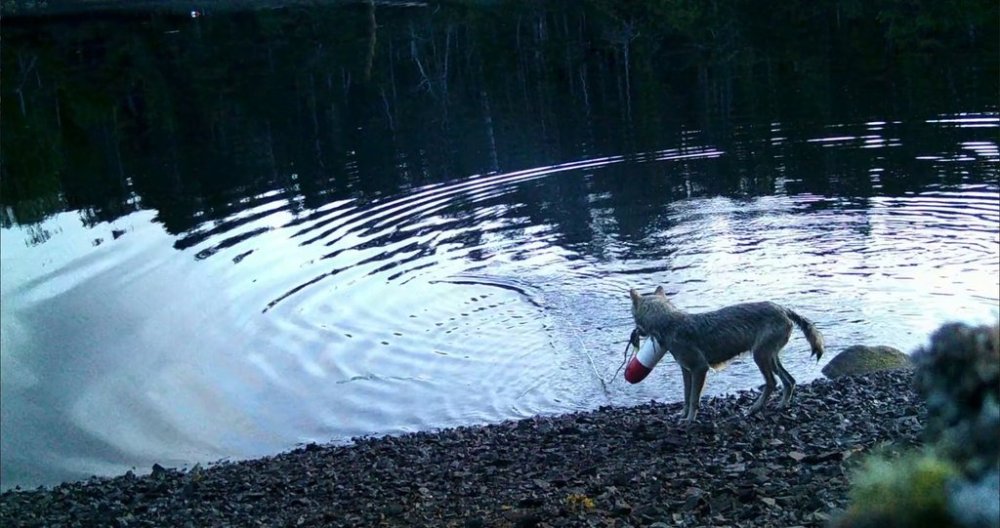
A sea wolf is captured on video, in this handout still image, near Bella Bella, B.C., extracting a submerged crab trap using a buoy and an attached line, in what researchers are calling the first evidence of possible tool-use by the wild animal species. THE CANADIAN PRESS/Handout - Kyle Artelle (Mandatory Credit)

As for how the behaviour started, Artelle said researchers can only speculate.

“We ultimately don’t know, but the two most likely explanations in our minds, one would be that the wolves started doing this with traps that were exposed at a low tide because that’s really easy,” Artelle said.

“There might’ve been this incremental learning that started with the trap fully onshore to traps partly submerged, to then associating the line with the trap and then the buoy with the line … It would make a lot of sense, and that’s often how we learn.”

Researchers say a few cameras at the B.C. site are now dedicated 24-7 to the crab traps to track the behaviour of sea wolves in the area, while work is “in progress” to prevent too much damage to the traps that may inhibit the invasive crab study.

“Some really special things are happening here, and we want to understand more about that. What else is happening on the ground? What else do these wolves have to teach us? And so that’s a focus for the next decades as we explore more about wolves here,” Artelle said.

“This is really just the tip of the iceberg.”

This report by The Canadian Press was first published Nov. 17, 2025.
Report Error Submit a Tip

More Stories

Puzzles Palace

1 minute read Monday, Jul. 27, 2026

To solve our puzzles, please subscribe with this special offer: |

Province provides $2.4M to build housing in Winkler for women, children fleeing violence

Free Press staff 2 minute read Preview

Province provides $2.4M to build housing in Winkler for women, children fleeing violence

Free Press staff 2 minute read 2:46 PM CDT

The province has pledged $2.4 million toward construction of a new transitional housing complex in Winkler offering safe, affordable housing for women and children leaving family violence.

Premier Wab Kinew and Families Minister Nahanni Fontaine, minister responsible for women and gender equity, announced the funding for Genesis House in Winkler.

“Every woman or family in Manitoba deserves to be safe,” Kinew said in a news release.

Genesis House currently runs a five-bedroom emergency shelter that provides accommodations and supportive services for women and their children, along with a stand-alone transitional housing unit owned by Manitoba Housing.

Read
2:46 PM CDT

Inflation-battered U.S. voters could prove to be key Canadian ally in fight against Trump’s trade tyranny

Dan Lett 6 minute read Preview

Inflation-battered U.S. voters could prove to be key Canadian ally in fight against Trump’s trade tyranny

Dan Lett 6 minute read Yesterday at 1:37 PM CDT

Is there anything or anyone that can help Canada and the United States avoid an unprecedented trade war?

Both nations stand poised on the precipice of a tariff battle that could — in the worst-case scenario — trigger an economic downturn. Both countries have a lot to lose, but neither country is showing any sign of backing down.

Canadian Prime Minister Mark Carney has, by all accounts, given negotiation a full chance to defuse the trade war. It didn’t work and it appears now that nothing — neither thoughtful negotiation or retaliatory measures — will dissuade U.S. President Donald Trump from his war of trade attrition.

Increasingly, it appears that if Trump is going to back away from punitive tariffs against Canada, it will be because of mounting pressure from within the United States and not because of tough talk and countermeasures from this side of the border.

Read
Yesterday at 1:37 PM CDT

‘I’m proud of our country right now’: Kinew on Canada’s counter-tariffs

Gabrielle Piche 2 minute read Preview

‘I’m proud of our country right now’: Kinew on Canada’s counter-tariffs

Gabrielle Piche 2 minute read 3:45 PM CDT

Canada is showing the rest of the world you “don’t have to take a knee” to the United States, Premier Wab Kinew said Tuesday.

He spoke about Canada-U.S. trade at an unrelated news conference, hours after Ottawa announced $27.6 billion worth of tariffs on United States imports.

“I think it’s always a time to negotiate and engage,” Kinew said of reigniting trade talks ahead of the counter-tariffs’ Sept. 8 implementation date.

“But I think Canada is showing the rest of the world right now that you don’t have to take a knee. You don’t have to bow down. You can be proud, you can have backbone and you can stand up for your own economy and your own jobs.

Read
3:45 PM CDT

Woman dies in house fire on Fleet Avenue

Morgan Modjeski 4 minute read Preview

Woman dies in house fire on Fleet Avenue

Morgan Modjeski 4 minute read Updated: 9:37 AM CDT

A woman is dead after a fire destroyed part of a house in Winnipeg’s Rockwood community.

Neighbour Russ Kolisnyk said he watched as fire crews battled the blaze at about 10:30 a.m. at 1076 Fleet Ave. Monday.

“They went into the back of the house with hoses, all of the other equipment, they were in their full gear,” the 61-year-old said. “Then we heard a person coming out and they came out the front door with her.”

A couple, believed to be in their 60s, lived in the home, another neighbour said.

Read
Updated: 9:37 AM CDT

AI literacy course mandatory at U of W Collegiate

Maggie Macintosh 5 minute read Preview

AI literacy course mandatory at U of W Collegiate

Maggie Macintosh 5 minute read Updated: 9:25 AM CDT

The University of Winnipeg Collegiate is requiring new students to complete artificial intelligence 101 lessons and offering a first-of-its-kind elective for those who want to perfect their chatbot prompts.

The private high school is piloting two projects this year in a bid to improve digital literacy on the downtown campus.

Every Grade 9 and 10 student will have to pass an approximately two-hour long online course about “AI essentials.”

Dean Osaed Khan likened the mandatory e-learning sessions to requiring students to complete a safety course before they can participate in a science lab.

Read
Updated: 9:25 AM CDT