University of Calgary researchers find northern sensor array also has military value

Advertisement

Advertise with us

CALGARY - Researchers at the University of Calgary's space weather network have attracted the attention of Canada’s military, the U.S. Navy and NATO with their eyes on the sky.

Read this article for free:


or

Already have an account? Log in here »

To continue reading, please subscribe:

Subscribe and receive a limited-edition Free Press branded hat or tote.

Digital Subscription

One year of digital access for only $205*

  • Enjoy unlimited reading on winnipegfreepress.com
  • Read the E-Edition, our digital replica newspaper
  • Access News Break, our award-winning app
  • Play interactive puzzles

*First annual payment billed as $205.00 + GST for one year. This annual subscription will automatically renew at $233.00 + GST every 52 weeks (10% off the regular annual price of $259.35). Offer available to new and qualified returning subscribers only. Cancel any time.

To continue reading, please subscribe:

Add Free Press access to your Brandon Sun subscription for only an additional

$1 for the first 4 weeks*

  • Enjoy unlimited reading on winnipegfreepress.com
  • Read the E-Edition, our digital replica newspaper
  • Access News Break, our award-winning app
  • Play interactive puzzles
Start now

*Your next Brandon Sun subscription payment will increase by $1.00 and you will be charged $17.95 plus GST for four weeks. After four weeks, your payment will increase to $24.95 plus GST every four weeks.

Hey there, time traveller!
This article was published 25/11/2025 (270 days ago), so information in it may no longer be current.

CALGARY – Researchers at the University of Calgary’s space weather network have attracted the attention of Canada’s military, the U.S. Navy and NATO with their eyes on the sky.

They run 22 ground-based, high-frequency remote sensors — resembling big metal umbrellas — are strung across Canada and in the northern United States, and monitor the near-Earth space environment.

Susan Skone, professor in the Department of Geomatics Engineering, said the sensors are important to study space, but also support real-time systems important in northern defence, natural resource exploration and telecommunications.
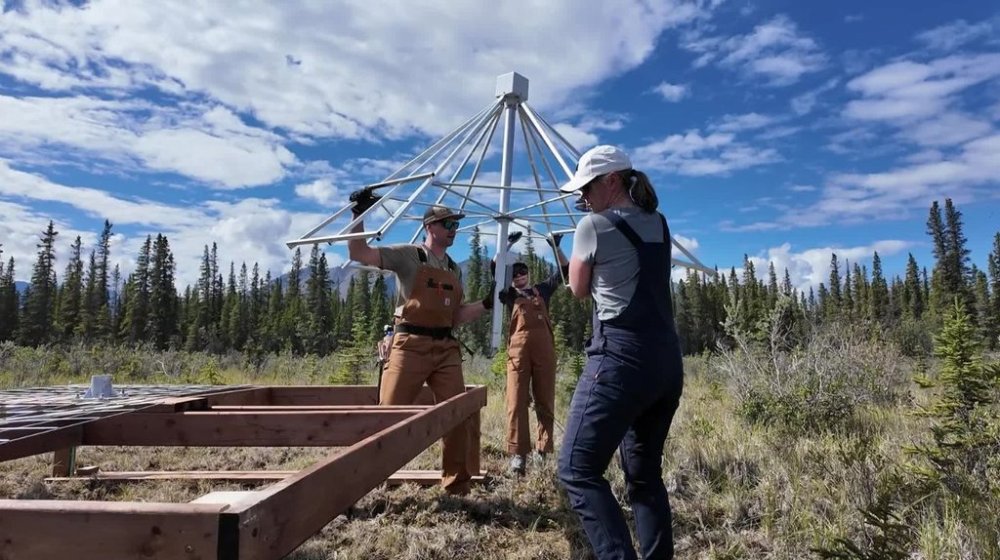
Lukas Vollmerhaus, left to right, Shaakira Gadiwan and Emma Spanswick are shown installing a riometer, a type of high frequency sensor package, at the Kluane Lake Research Station in Yukon in an undated handout photo. The sensors are dual-use, meaning that they are capable of being used in both civil and defence applications. THE CANADIAN PRESS/Handout — University of Calgary (Mandatory Credit)

She said the sensors can determine what disruptions are naturally occurring and what might be caused by people. 

“That allows us to detect jamming, spoofing, other forms of anomalous behaviour in Canada earth space environment,” Skone said.

She added that the team can feed the data into larger-scale models to find vulnerabilities and threats to navigation systems used by everyone, such as GPS. 

“The GPS signals are vulnerable to natural and human-made interference, and are affected by exactly what we are resolving using these types of … instruments,” she said.

Emma Spanswick, associate professor in the Department of Physics and Astronomy, said the information is particularly important as Canada works to modernize its defensive systems, including the development of a northward facing defensive radar system.

She said the technology has been around for the past 40 years and they have since begun collaborating with Canada’s Department of National Defence and with Defence Research and Development Canada.

“We started working with DND and DDRC to develop that capacity and some of these operational systems, which now use the model and the real time data and — boom — now we’ve got a system that’s supporting two distinctive classes of users,” she said.

“It is very cool.”

This report by The Canadian Press was first published Nov. 25, 2025.
Report Error Submit a Tip

More Stories

Transit union pleads for full shields after near ‘hijacking situation’

Nicole Buffie 5 minute read Preview

Transit union pleads for full shields after near ‘hijacking situation’

Nicole Buffie 5 minute read Thursday, Aug. 20, 2026

The union representing Winnipeg Transit drivers says the need for full safety shields is critical after an operator was threatened with a hatchet early Thursday.

Read
Thursday, Aug. 20, 2026

ER wait times have hit all-time highs in Winnipeg and are impacting nearly all aspects of hospital operations

Tom Brodbeck 16 minute read Preview

ER wait times have hit all-time highs in Winnipeg and are impacting nearly all aspects of hospital operations

Tom Brodbeck 16 minute read Yesterday at 6:00 AM CDT

On most days at Health Sciences Centre’s adult emergency department, all 58 treatment beds are filled with sick patients. Another dozen or so brought in by ambulance line the hallways on stretchers, with only one nurse to look after them.

Out in the waiting room, about 30 or 40 people — sometimes more — are slouched in chairs in pain or discomfort, waiting hours to see a doctor. Most have been assessed by a triage nurse, but many will have to wait 10 to 20 hours to be examined by a physician because there’s no room for them in the treatment area.

Some patients leave because they can no longer tolerate the excruciating wait, only to return days later, sicker than they were before.

Welcome to the emergency department at Manitoba’s largest hospital, where some of the highest-acuity patients seek medical care but now face delays that were unimaginable a few years ago.

Read
Yesterday at 6:00 AM CDT

NDP touts health-care gains, but critics question impact on ER wait times

Tom Brodbeck 5 minute read Preview

NDP touts health-care gains, but critics question impact on ER wait times

Tom Brodbeck 5 minute read Yesterday at 6:00 AM CDT

Health Minister Uzoma Asagwara doesn’t mince words when describing how bad things are in the province’s emergency departments and urgent-care centres.

“The wait times that we are seeing in Manitoba are unacceptable,” said Asagwara in an interview with the Free Press.

“I hear from families, I hear from providers, I hear from Manitobans who are concerned about the wait times that they’re seeing, that they’re experiencing, and those concerns are valid — I share those concerns.”

So what is the NDP, who promised voters nearly three years ago it had the answers to bring down wait times, doing about it?

Read
Yesterday at 6:00 AM CDT

Don’t buy U.S. booze if, when it’s back on Liquor Mart shelves: Kinew

Chris Kitching 6 minute read Preview

Don’t buy U.S. booze if, when it’s back on Liquor Mart shelves: Kinew

Chris Kitching 6 minute read Updated: Yesterday at 10:25 AM CDT

Manitoba hasn’t agreed to put American liquor back on shelves despite Prime Minister Mark Carney’s request while his government finalizes a trade deal with the U.S. to avoid new tariffs.

Read
Updated: Yesterday at 10:25 AM CDT

Residents fear mailbox crime sprees

Morgan Modjeski 4 minute read Preview

Residents fear mailbox crime sprees

Morgan Modjeski 4 minute read 2:01 AM CDT

Some North End residents are concerned new community mailboxes will become a target for vandalism and crime after the base of one was recently lit ablaze — before it was even installed.

The community mailboxes started to show up on Andrews Street within the last two weeks. Some have been installed, while at other locations, only the concrete foundation is in place.

“They just dumped them on the boulevard,” said Stephen Giesbrecht, who lives beside one of the boxes in the St. John’s neighbourhood. “They dumped them on the corner and then they were gone.”

One of the concrete slabs has already played host to a fire and some of the hardware needed to install the mailbox melted.

Read
2:01 AM CDT

Fish briefs

Grace Penner 2 minute read 2:01 AM CDT

The Sioux Falls Canaries had a taste for fish as the club beat the Winnipeg Goldeyes in this week’s series.

Despite being on the road, the Winnipeg Goldeyes (45-37) started off the series with a strong win on Tuesday night. They soloed the scoreboard into the fourth inning with a 7-0 sweep until the Canaries (43-41) snuck in two runs in the bottom. Peyton Holt, Adam Hall, Ramón Bramasco, and Noah Marcelo had four runs in the top of that inning.

Even though Sioux Falls were able to slowly make their way up to six runs, catcher/infielder Marcelo secured their lead hitting two homers driving in two runs during the game.

Pitcher Landen Bourassa held the mound the majority of the innings, striking out seven, with relief pitchers Sage Ferguson and Derrick Cherry guarding the lead to give the Fish the 9-6 win.