Trump administration vows crackdown on Chinese companies ‘exploiting’ AI models made in US
Advertisement
Read this article for free:
or
Already have an account? Log in here »
To continue reading, please subscribe:

Digital Subscription
One year of digital access for only $205*
- Enjoy unlimited reading on winnipegfreepress.com
- Read the E-Edition, our digital replica newspaper
- Access News Break, our award-winning app
- Play interactive puzzles
*First annual payment billed as $205.00 + GST for one year. This annual subscription will automatically renew at $233.00 + GST every 52 weeks (10% off the regular annual price of $259.35). Offer available to new and qualified returning subscribers only. Cancel any time.
To continue reading, please subscribe:
Add Free Press access to your Brandon Sun subscription for only an additional
$1 for the first 4 weeks*
- Enjoy unlimited reading on winnipegfreepress.com
- Read the E-Edition, our digital replica newspaper
- Access News Break, our award-winning app
- Play interactive puzzles
*Your next Brandon Sun subscription payment will increase by $1.00 and you will be charged $17.95 plus GST for four weeks. After four weeks, your payment will increase to $24.95 plus GST every four weeks.
Read unlimited articles for free today:
or
Already have an account? Log in here »
WASHINGTON (AP) — The Trump administration is vowing to crack down on foreign tech companies’ exploitation of U.S. artificial intelligence models, singling out China at a time that country is narrowing the gap with the U.S. in the AI race.
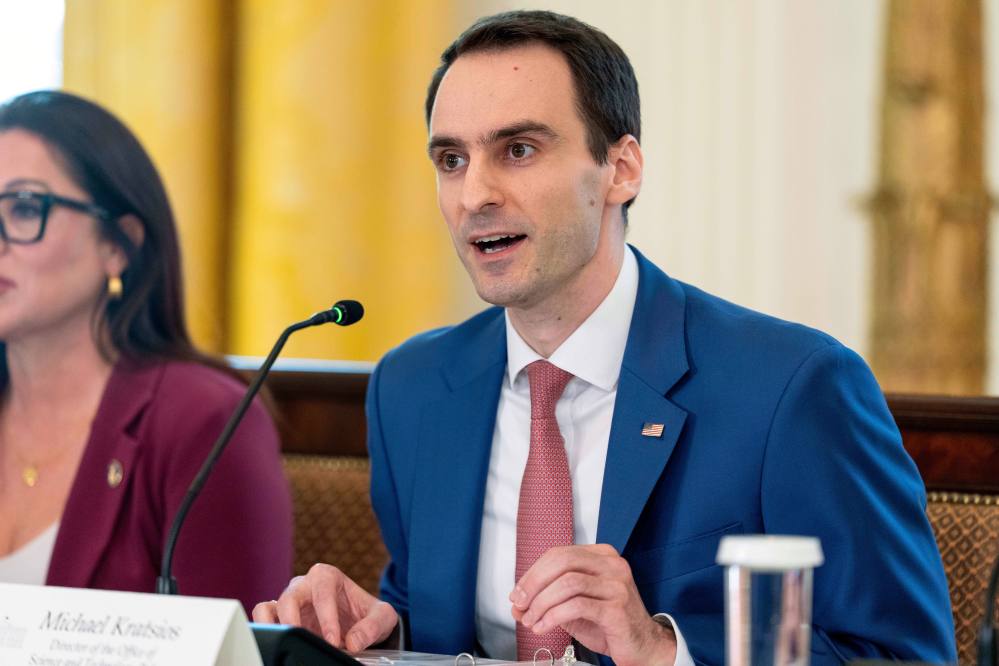
In a Thursday memo, Michael Kratsios, the president’s chief science and technology adviser, accused foreign entities “principally based in China” of engaging in deliberate, industrial-scale campaigns to “distill,” or extract capabilities from, leading AI systems made in the U.S. and “exploiting American expertise and innovation.”
The administration, Kratsios wrote, will work with American AI companies to identify such activities, build defenses and find ways to punish offenders.
The memo arrives at a time when China is challenging U.S. dominance in artificial intelligence, an area where the White House says the U.S. must prevail to set global standards and reap economic and military benefits. But the U.S.-China gap in performance of top AI models has “effectively closed,” according to a recent report from Stanford University’s Institute for Human-Centered AI.
China’s embassy in Washington said it opposed “the unjustified suppression of Chinese companies by the U.S.”
“China has always been committed to promoting scientific and technological progress through cooperation and healthy competition. China attaches great importance to the protection of intellectual property rights,” said Liu Pengyu, the embassy spokesperson.
In Beijing, China’s Foreign Ministry spokesperson Guo Jiakun told reporters Friday that the U.S. claims are groundless and were smearing the achievements of China’s artificial intelligence industry.
“China firmly opposes this. We urge the U.S. to respect facts, discard prejudice, stop suppressing China’s technological development, and do more to promote scientific and technological exchange and cooperation between the two countries,” he said.
Kratsios’ memo also came the same week that the House Foreign Affairs Committee offered unanimous, bipartisan support for a bill to set up a process to identify foreign actors that extract “key technical features” of closed-source, U.S.-owned AI models and to punish them with measures including sanctions.
“Model extraction attacks are the latest frontier of Chinese economic coercion and theft of U.S. intellectual property,” said Rep. Bill Huizenga, R-Mich., who sponsored the bill. “American AI models are demonstrating transformative cyber capabilities, and it is critical we prevent China from stealing these technological advancements.”
Last year, the Chinese startup DeepSeek rattled U.S. markets when it released a large language model that could compete with U.S. AI giants but at a fraction of the cost.
David Sacks, then serving as President Donald Trump’s AI and crypto adviser, suggested that DeepSeek copied U.S. models. “There’s substantial evidence that what DeepSeek did here is they distilled the knowledge out of OpenAI’s models,” Sacks said then.
In a February letter to U.S. lawmakers, OpenAI, the developer of ChatGPT, made similar allegations and said China should not be allowed to advance “autocratic AI” by “appropriating and repackaging American innovation.”
Anthropic, the maker of the Claude chatbot, in February accused DeepSeek and two other China-based AI laboratories of engaging in campaigns to “illicitly extract Claude’s capabilities to improve their own models” using the distillation technique that “involves training a less capable model on the outputs of a stronger one.”
Anthropic said distillation can be a legitimate way to train AI systems but it’s a problem when competitors “use it to acquire powerful capabilities from other labs in a fraction of the time, and at a fraction of the cost, that it would take to develop them independently.”
But it can go both ways. San Francisco-based startup Anysphere, maker of the popular coding tool Cursor, recently acknowledged that its latest product was based on an open-source model made by Chinese company Moonshot AI, maker of the chatbot Kimi.
Kyle Chan, a fellow at the Washington-based think tank The Brookings Institution and an expert on China’s technology development, said it will be like “looking for needles in an enormous haystack” to separate unauthorized distillation from the vast volume of legitimate requests for data. But information sharing and coordination among U.S. AI labs could help, and the federal government can play an important role in facilitating anti-distillation efforts across labs, Chan said.
It’s hard to assess how far the House bill can go, but Chan said Trump may not want to rock the boat with Chinese President Xi Jinping ahead of a planned mid-May state visit to Beijing.
___
AP Technology Writer Matt O’Brien contributed to this report from Providence, Rhode Island.