Quebec and Alberta plan to work together to integrate AI in government

Advertisement

Advertise with us

MONTREAL - The Quebec and Alberta governments plan to work together to implement artificial intelligence in public administration, which Quebec's cybersecurity minister says will help both provinces build on each other's experience to develop new tools.

Read this article for free:


or

Already have an account? Log in here »

To continue reading, please subscribe:

Subscribe and receive a limited-edition Free Press branded hat or tote.

Digital Subscription

One year of digital access for only $205*

  • Enjoy unlimited reading on winnipegfreepress.com
  • Read the E-Edition, our digital replica newspaper
  • Access News Break, our award-winning app
  • Play interactive puzzles

*First annual payment billed as $205.00 + GST for one year. This annual subscription will automatically renew at $233.00 + GST every 52 weeks (10% off the regular annual price of $259.35). Offer available to new and qualified returning subscribers only. Cancel any time.

To continue reading, please subscribe:

Add Free Press access to your Brandon Sun subscription for only an additional

$1 for the first 4 weeks*

  • Enjoy unlimited reading on winnipegfreepress.com
  • Read the E-Edition, our digital replica newspaper
  • Access News Break, our award-winning app
  • Play interactive puzzles
Start now

*Your next Brandon Sun subscription payment will increase by $1.00 and you will be charged $17.95 plus GST for four weeks. After four weeks, your payment will increase to $24.95 plus GST every four weeks.

MONTREAL – The Quebec and Alberta governments plan to work together to implement artificial intelligence in public administration, which Quebec’s cybersecurity minister says will help both provinces build on each other’s experience to develop new tools.

France-Élaine Duranceau, Quebec minister of cybersecurity and digital technology, announced an agreement between the provinces on Tuesday alongside Nate Glubish, Alberta minister of technology and innovation.

The agreement will span five years and includes no financial engagement, but rather a sharing of knowledge between both administrations. 
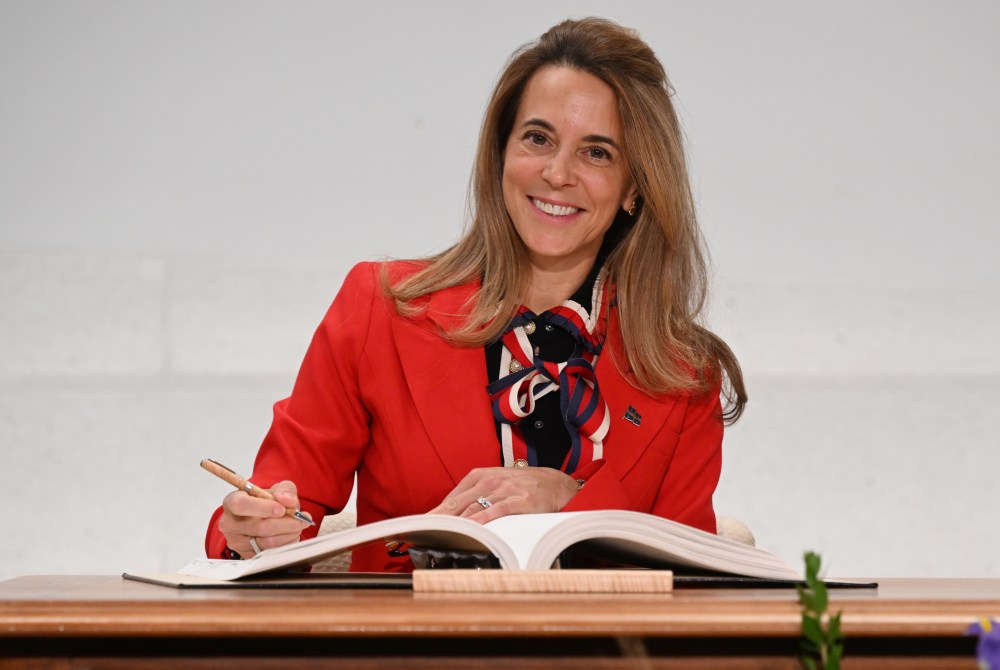
Quebec Treasury Board President France-Elaine Duranceau is sworn in at the legislature in Quebec City Tuesday, April 21, 2026. THE CANADIAN PRESS/Jacques Boissinot

“We’re all moving forward on AI, it’s new, and it changes at a phenomenal speed,” Duranceau said in a phone interview. “So why start from scratch, each on our own? We chose to work together and exchange freely to learn from what the other jurisdiction is doing.”

She explained that talks between the two provinces on AI have been ongoing since 2022, with Tuesday’s agreement making the partnership “official,” and praised Alberta’s interest in AI development. 

“They’ve really made it a priority to transform their public administration and to set the tone from the top, and I think Quebec has that same wish,” she said.

Alberta has leaned into AI and is the centre of Canada’s emerging data centre landscape, according to recent research out of York University. Meta, the tech giant behind Facebook and Instagram, recently announced a $13-billion-plus investment to build a data centre in Alberta, its first in Canada.

Duranceau suggests that the provinces could share AI tools they’ve developed, such as the one developed by Alberta to assist in their budgetary authorization or the one developed by Quebec to identify cybersecurity vulnerabilities. She also points to training for civil servants as an area where the provinces could share ideas, noting that Quebec is rolling out training to help employees use Microsoft Copilot, for example. 

“Citizens are currently using AI to organize their travel in record time, to write letters quickly…. Those are examples of how citizens can be more efficient in their personal lives. Well, at the state level, we have to automate tasks in that way,” said Duranceau. 

This agreement could help find ways to use AI to make government services faster by performing some administrative tasks or assisting with research, she said. 

Vass Bednar, managing director of the think tank Canadian Shield Institute, sees this announcement as a continuation of the general direction of AI policy in Canada. She points to the significance of Quebec and Alberta — “the two provinces who are both deeply engaged in their own kind of sovereignty questions” — joining forces in this deal.

Duranceau says that parallel had little to do with the agreement, except when it comes to a shared policy philosophy. “We have similarities in our desire to take the lead on issues that affect our population and not wait for the federal government on these issues,” she said.

To Bednar, the agreement announced on Tuesday lacks important discussions about digital sovereignty and building Canadian digital infrastructure. Rather than focusing on using AI to save money, she said governments should consider the cost-cutting potential of owning digital infrastructure to do things like video calls and sending emails. 

“For whatever reason, our imagination is not there yet,” she said. 

She criticized Canadian governments’ use of American AI and tech tools, and encouraged them to invest instead in Canadian innovation.

“(Sovereignty) is something you build and work towards. It’s not just going to be under our pillow one day when we wake up,” she said. 

This report by The Canadian Press was first published July 15, 2026.

Report Error Submit a Tip

More Stories

Uncaring hubby fell flat at first hurdle

Maureen Scurfield 4 minute read Yesterday at 2:00 AM CDT

DEAR MISS LONELYHEARTS: I re-rented my favourite summer cabin this fall because I’m trying to finish my thesis. My husband of just over a year was very annoyed with me for going on my own, but didn’t say much about it because I paid.

I thought we were both OK with this arrangement, until I got the flu up at the lake very badly and couldn’t keep anything down. I felt faint. I phoned him and he said he was at a party with the guys. I could hear music and girls laughing.

He wouldn’t come for me, so at 4 a.m. when I was getting even more sick and scared, I drove back to the city unannounced.

I went straight to my parents’ house and pretty much fell through the door. Mom said to me when she grabbed me: “This is not right. You could have died in the ditch. Where is your husband?”

Obsessed stalker who shot, killed young woman at bus stop in 1993 dies behind bars at age 74

Erik Pindera 3 minute read Preview

Obsessed stalker who shot, killed young woman at bus stop in 1993 dies behind bars at age 74

Erik Pindera 3 minute read 5:53 PM CDT

A Winnipeg man who stalked a woman for several years before shooting her dead in the street in 1993 has died in Stony Mountain prison.

On Monday, 74-year-old Ronald Edd Bell died of apparent natural causes at the federal prison just north of Winnipeg, the Correctional Service of Canada said.

Bell had been in prison since May 30, 1994, when he was given a life sentence with no chance of parole for 18 years for killing Terry-Lyn Babb, 25, on Jan. 21, 1993.

Bell walked up behind an unsuspecting Babb, who was waiting at a bus stop at Sherbrook Street and Wolseley Avenue, and shot her in the head with a pistol in front of horrified witnesses, says the Free Press report of his sentencing hearing.

Read
5:53 PM CDT

Completely separating inmates unrealistic, inquest judge says in report on three Stony Mountain slayings

Erik Pindera 5 minute read Preview

Completely separating inmates unrealistic, inquest judge says in report on three Stony Mountain slayings

Erik Pindera 5 minute read 1:43 PM CDT

Nothing short of keeping inmates separated at all times could have prevented three unrelated prisoner-on-prisoner killings several years ago in Stony Mountain Institution’s maximum-security unit, an inquest judge has found.

Provincial court Judge Lindy Choy made the finding after overseeing an inquest earlier this year into the slayings of Adrian Fillion, 42, Michael Monney, 27, and Nolan Thomas, 26, all of which occurred at the hands of fellow maximum-security inmates in the federal prison just north of Winnipeg. The killings occurred when cells were unlocked, allowing inmates to briefly move around to other areas in the cell block.

“The overall impression I was left with from the (Stony Mountain Institution) witnesses was that management of inmates in a custodial facility is a very complex undertaking. There are clearly multiple levels of oversight involved in any decisions that are made and it is all done in a very structured manner,” Choy wrote in her report on the inquest, which was made public Tuesday.

“While maintaining complete physical distance between inmates at all times would have prevented the homicides from occurring, we know that from a social and psychological perspective, this is not generally realistic nor acceptable.”

Read
1:43 PM CDT

Province to acquire campground near former residential school

Morgan Modjeski 3 minute read Preview

Province to acquire campground near former residential school

Morgan Modjeski 3 minute read 6:00 AM CDT

A burial site for dozens of children who died while attending the Brandon Indian Residential School will be acquired by the province, the Free Press has learned.

Premier Wab Kinew will announce the province’s plan to protect Turtle Crossing Campground at a news conference in Brandon Wednesday to mark National Day for Truth and Reconciliation. The move is in partnership with the City of Brandon.

The graves of at least 56 children are located at the campground, the Sioux Valley Dakota Nation has said, pointing to a geophysical study conducted by an archaeology firm in 2018.

There have been longstanding concerns from Indigenous leaders and community members that people were camping on the resting place of children victimized by colonialism.

Read
6:00 AM CDT

Puzzles Palace

1 minute read Monday, Jul. 27, 2026

To solve our puzzles, please subscribe with this special offer: |

Hero fought to remember children lost at residential school

Niigaan Sinclair 5 minute read Preview

Hero fought to remember children lost at residential school

Niigaan Sinclair 5 minute read 6:25 PM CDT

The story of the gravesites of students who attended the Brandon Indian Residential School underneath the Turtle Crossing Campground is truly a Manitoba tragedy.

Read
6:25 PM CDT