

Premier plays politics with rail-yard relocation plan

Advertisement
Read this article for free:
or
Already have an account? Log in here »
To continue reading, please subscribe:

Digital Subscription
One year of digital access for only $205*
- Enjoy unlimited reading on winnipegfreepress.com
- Read the E-Edition, our digital replica newspaper
- Access News Break, our award-winning app
- Play interactive puzzles
*First annual payment billed as $205.00 + GST for one year. This annual subscription will automatically renew at $233.00 + GST every 52 weeks (10% off the regular annual price of $259.35). Offer available to new and qualified returning subscribers only. Cancel any time.
To continue reading, please subscribe:
Add Free Press access to your Brandon Sun subscription for only an additional
$1 for the first 4 weeks*
- Enjoy unlimited reading on winnipegfreepress.com
- Read the E-Edition, our digital replica newspaper
- Access News Break, our award-winning app
- Play interactive puzzles
*Your next Brandon Sun subscription payment will increase by $1.00 and you will be charged $17.95 plus GST for four weeks. After four weeks, your payment will increase to $24.95 plus GST every four weeks.
Read unlimited articles for free today:
or
Already have an account? Log in here »
Hey there, time traveller!
This article was published 15/11/2015 (3965 days ago), so information in it may no longer be current.
NDP Premier Greg Selinger — whose political life is hanging by a thread — will attempt to bolster his chances for re-election when his government announces plans for a comprehensive process to relocate major rail lines running through Winnipeg, including the CPR Winnipeg Yards.
Government sources confirmed Monday’s throne speech will contain a commitment to striking a special committee of government and private-sector representatives — including officials from CN and CP — that will begin the arduous task of negotiating a deal to remove most of the railway assets that criss-cross the city now. The sources said that group could be unveiled as early as next month.
The relocation of the CPR Winnipeg Yards is a particularly pressing matter, given the city is facing the prospect of replacing the Arlington Bridge, one of the key crossings that connects the North End to downtown over the rail yards, and increase traffic capacity on other routes.
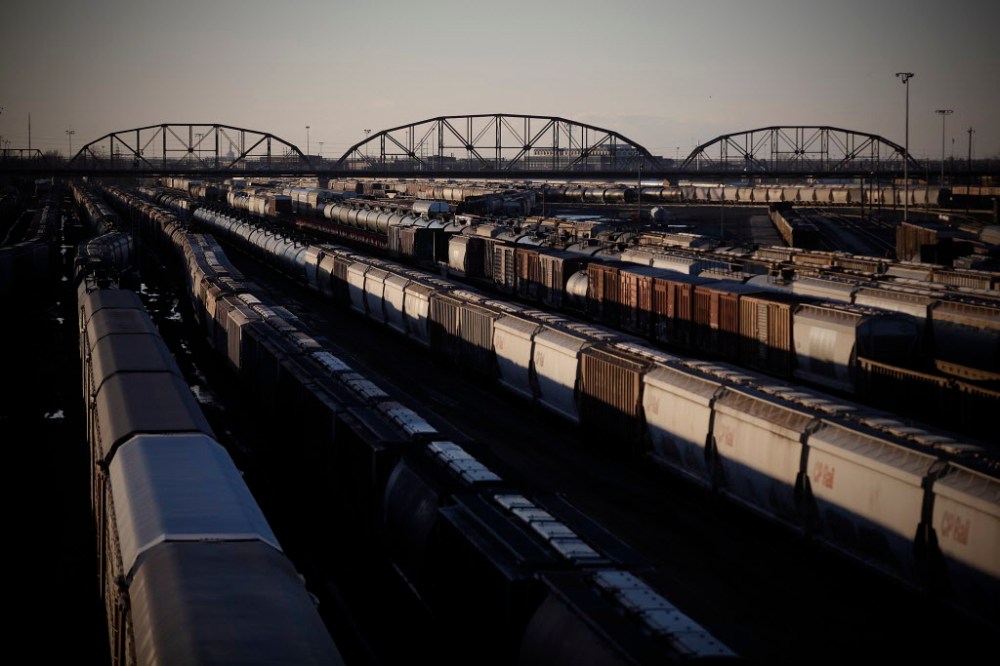
The city announced in September the century-old Arlington Bridge was beyond repair, with a new bridge expected to cost hundreds of millions of dollars. In addition, the city expects to pay hundreds of millions of additional dollars to widen underpasses, or construct new tunnels, to move growing traffic volumes over or under the rail yards.
Government sources said Selinger will argue all this money would be better spent on a trilateral plan to move the CPR yards and repurpose the land on which it sits now. He is further expected to argue untold future property taxes from new developments could help pay for the upfront costs of relocating the yards and reclaiming the old land.
Political critics are likely to portray it as an empty promise that cannot possible make any progress before next April’s election. The NDP clearly hopes the promise of future change will be enough to breathe life into its moribund electoral hopes.
Notwithstanding the politics, it is unprecedented to have the major railways involved in a group charged with formulating a relocation plan. To date, the railways have been aloof whenever the subject of relocation was raised by elected officials.
For Selinger — who over the last year had a near-death experience after a group of cabinet ministers tried to force him out — progress on railway relocation could be the realization of a life-long dream.
In his days before politics, Selinger lobbied municipal and provincial governments to remove the CPR yards to remove a physical rift between the city’s famed North End and downtown. His interest in the subject continued in the late 1990s, when he used his failed experience trying to get government to move the yards as the subject of his PhD thesis at the London School of Economics.
Since Selinger became a provincial politician, there has been no progress on the relocation of the CP yards. Some of the reasons for Selinger’s inaction were beyond his control; others are less flattering.
First, it’s obvious Selinger is not sitting on a pot of discretionary money that could be used to get rail relocation moving. This is a government mired in deficit and absent an effective plan for bringing the budget back into surplus.
Complicating matters is that over the past four years, Manitoba has been forced to pay out hundreds of millions of dollars to fight, mitigate and repair the damage from repeated floods.
It’s hard to undertake game-changing, once-in-a-generation capital projects when you’re (literally) trying to keep your head above water.
Finally, Selinger had to deal with the fact his predecessor, Gary Doer, committed the province to a pair of enormous public works projects — the expansion of the Red River Floodway and the construction of the Canadian Museum for Human Rights — that consumed large amounts of federal infrastructure funding and goodwill.
It is against this backdrop Selinger will make a bid to accomplish something that has evaded local, provincial and federal politicians in this city for more than 40 years. It helps that this initiative is being launched at a time when there is a new Liberal government in Ottawa with an activist bent and a pledge to significantly increase infrastructure funding.
There is a pre-existing federal legislative process in place to guide rail relocation projects, in part to ensure the railways do not suffer financially in order to move their assets. Unfortunately, that legislation has not been used in more than 20 years.
There is a chance this will be viewed as little more than a Selinger legacy project, something lame-duck leaders launch when they know the end is nearing. And without a doubt, the timing of the initiative is somewhat suspect.
Given Selinger’s deep and apparently sincere interest in the project, there is really no good excuse for waiting until now, when he is fully in the shadow of an impending provincial election, to announce a working group.
It’s also not clear what kind of political benefit Selinger can glean from the issue. The relocation of the CP central yards, in particular, has the potential to change the future fortunes of the city. However, the CP yards on their own may not have a huge political upside in areas of the province where the NDP needs to hold seats to stay in power.

Of course, as this process is more fully revealed, it’s possible we could see a broader political strategy. Particularly if, along with moving the CP yards, the NDP is able to move smaller lines.
Government sources confirmed the process outlined in the throne speech will likely not evolve quickly enough to remove the need to build the $175-million Waverley underpass, a priority project for the large and growing population of southwest Winnipeg. However, there are still a host of secondary rail lines, some of which run right through dense residential neighbourhoods, such as River Heights, that could be erased, much to the delight of locals.
At this stage, it is impossible to avoid portraying any pledge from the Selinger government as part of the NDP’s re-election strategy. And there is a chance it could breathe life into the premier’s fading hopes.
However, one would hope that once started, any government would continue to pursue a project that has the very real potential to fundamentally change the future of Winnipeg.
dan.lett@freepress.mb.ca
Dan Lett is a columnist for the Free Press, providing opinion and commentary on politics in Winnipeg and beyond. Born and raised in Toronto, Dan joined the Free Press in 1986. Read more about Dan.
Dan’s columns are built on facts and reactions, but offer his personal views through arguments and analysis. The Free Press’ editing team reviews Dan’s columns before they are posted online or published in print — part of the our tradition, since 1872, of producing reliable independent journalism. Read more about Free Press’s history and mandate, and learn how our newsroom operates.
Our newsroom depends on a growing audience of readers to power our journalism. If you are not a paid reader, please consider becoming a subscriber.
Our newsroom depends on its audience of readers to power our journalism. Thank you for your support.
Read more
Read more about what rail yard redevelopment would mean for Winnipeg in this series, Off the Rails: http://www.winnipegfreepress.com/special/offtherails/
Dan Lett is a columnist for the Free Press, providing opinion and commentary on politics in Winnipeg and beyond. Born and raised in Toronto, Dan joined the Free Press in 1986. Read more about Dan.
Dan’s columns are built on facts and reactions, but offer his personal views through arguments and analysis. The Free Press’ editing team reviews Dan’s columns before they are posted online or published in print — part of the our tradition, since 1872, of producing reliable independent journalism. Read more about Free Press’s history and mandate, and learn how our newsroom operates.
Our newsroom depends on a growing audience of readers to power our journalism. If you are not a paid reader, please consider becoming a subscriber.
Our newsroom depends on its audience of readers to power our journalism. Thank you for your support.
Related Articles
Throne speech kicks off election strategy

Advertisement Advertise With Us
Advertisement Advertise With Us
History
Updated on Monday, November 16, 2015 11:52 AM CST: Corrects typo.