Bus? Pass! How can Transit become the main artery Winnipeg needs if only 12 per cent of residents use it. A new series starts by looking at that fear and reluctance
Read this article for free:
or
Already have an account? Log in here »
To continue reading, please subscribe:

Digital Subscription
One year of digital access for only $205*
- Enjoy unlimited reading on winnipegfreepress.com
- Read the E-Edition, our digital replica newspaper
- Access News Break, our award-winning app
- Play interactive puzzles
*First annual payment billed as $205.00 + GST for one year. This annual subscription will automatically renew at $233.00 + GST every 52 weeks (10% off the regular annual price of $259.35). Offer available to new and qualified returning subscribers only. Cancel any time.
To continue reading, please subscribe:
Add Free Press access to your Brandon Sun subscription for only an additional
$1 for the first 4 weeks*
- Enjoy unlimited reading on winnipegfreepress.com
- Read the E-Edition, our digital replica newspaper
- Access News Break, our award-winning app
- Play interactive puzzles
*Your next Brandon Sun subscription payment will increase by $1.00 and you will be charged $17.95 plus GST for four weeks. After four weeks, your payment will increase to $24.95 plus GST every four weeks.
Read unlimited articles for free today:
or
Already have an account? Log in here »
Hey there, time traveller!
This article was published 26/12/2023 (1011 days ago), so information in it may no longer be current.
Would you ride a Winnipeg Transit bus?
For a city where the car has long ruled the roadways, it’s a question that is most likely to elicit a laugh or a hard no. Particularly against a backdrop of high-profile incidents of violence on buses, frustration over service disruptions and flagging ridership numbers.
However, as governments look to public transit as a key tool in reducing greenhouse gas emissions, as the city grapples with budgetary constraints and as Winnipeg falls further behind other Canadian municipalities in the delivery of a modern, efficient public transportation system, it’s becoming a more pressing question. And it’s one reason why the Free Press is kicking off a series that explores the current and future state of Winnipeg Transit.
In Transit
A special series examining the state of Winnipeg’s public transportation system. Read the full series here.
Over the coming days, we’ll look at our city’s transit system from a variety of perspectives — from the mayor’s view on his bus commute to the maintenance work to keep the fleet of 640 buses on the road, to the new transit safety team, to life in and around bus shelters. Part 1 looks at the public’s perception of public transit.
So, would you ride the bus?
Tanis Baydak knows her answer. Not anymore.
She was prepared to give Transit a chance after signing up for summer classes at the University of Manitoba in 2022. Instead of driving, she thought she could relax and catch up on her reading while on the bus. In hindsight, the idea was both laughable and naïve, she said.
MIKE DEAL / WINNIPEG FREE PRESS Tanis Baydak used Winnipeg Transit for 12 weeks, bussing from the North End to the University of Manitoba, before stopping because it was too unreliable.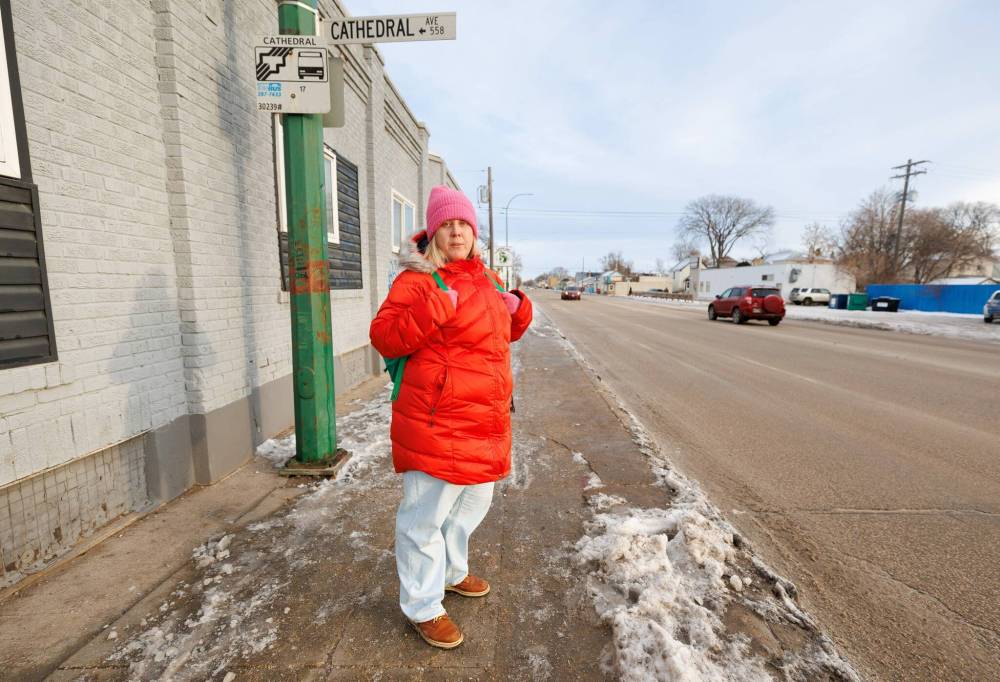
She gave herself an hour and 40 minutes to commute from her North End home to the university campus. The actual length of time was rarely the same: the wait for her downtown connection varied daily — from five minutes to 30. And as a passenger, she had a front seat to the poverty and mental health challenges plaguing the city.
“That’s very difficult to watch,” Baydak said. “I felt very sad… I felt helpless a lot of the time.”
She ditched her bus pass after three months.
MIKE DEAL / WINNIPEG FREE PRESS Tanis Baydak says in hindsight, the idea of using a bus to commute was both laughable and naïve.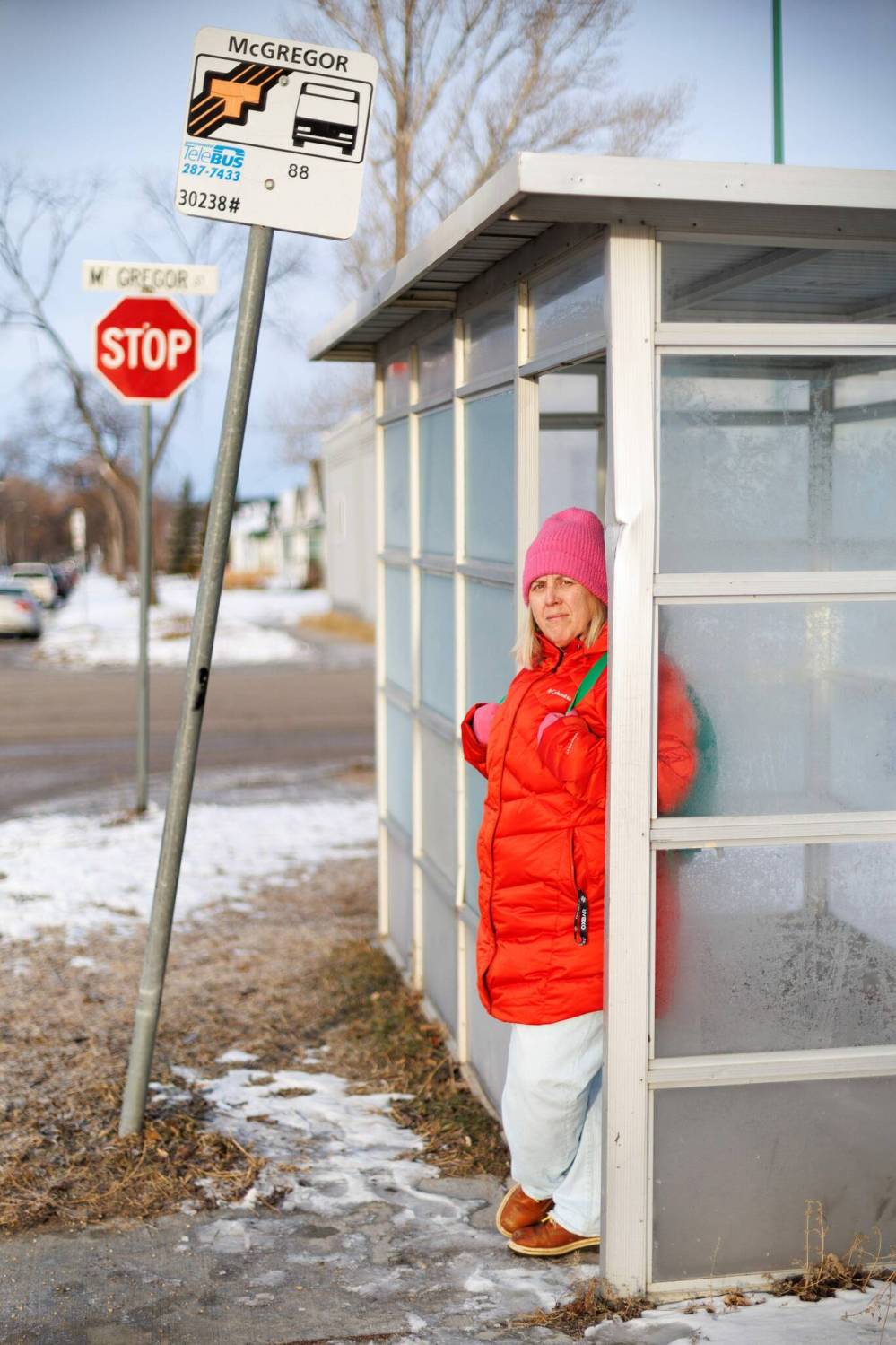
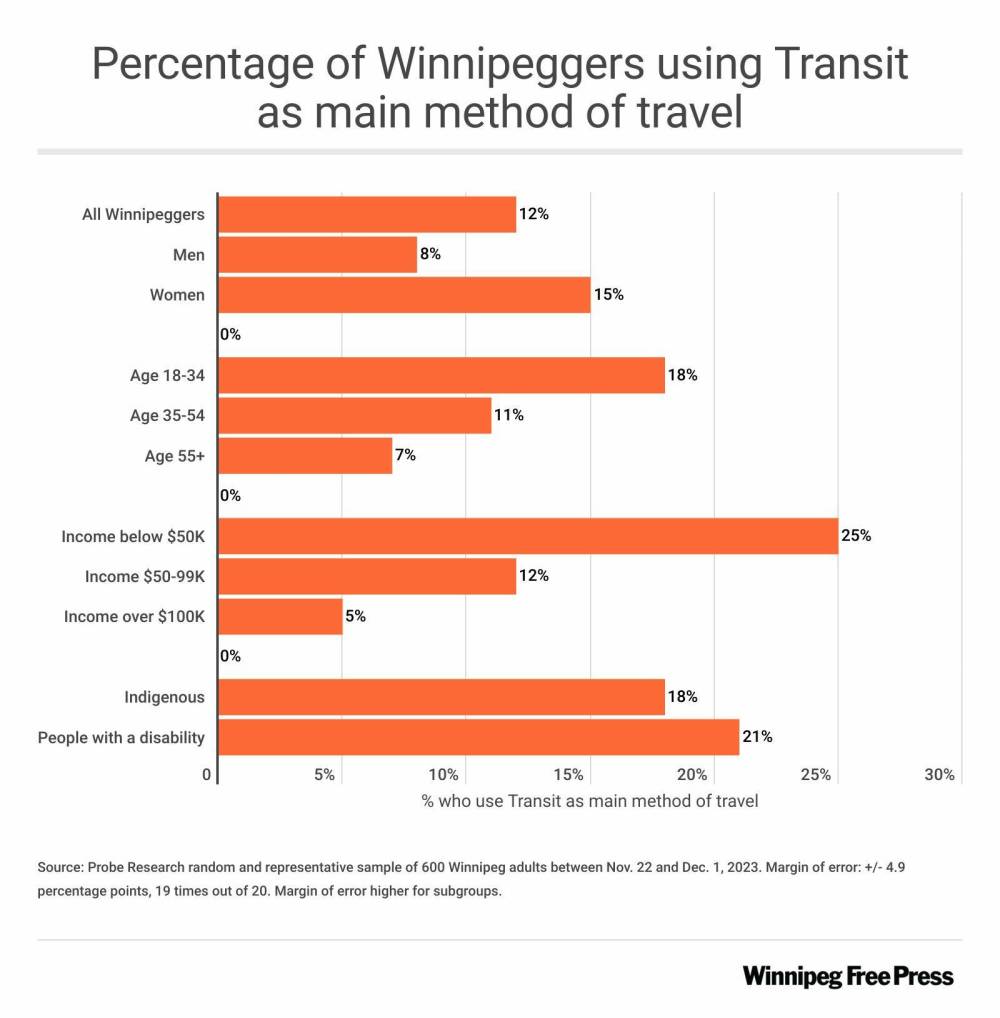
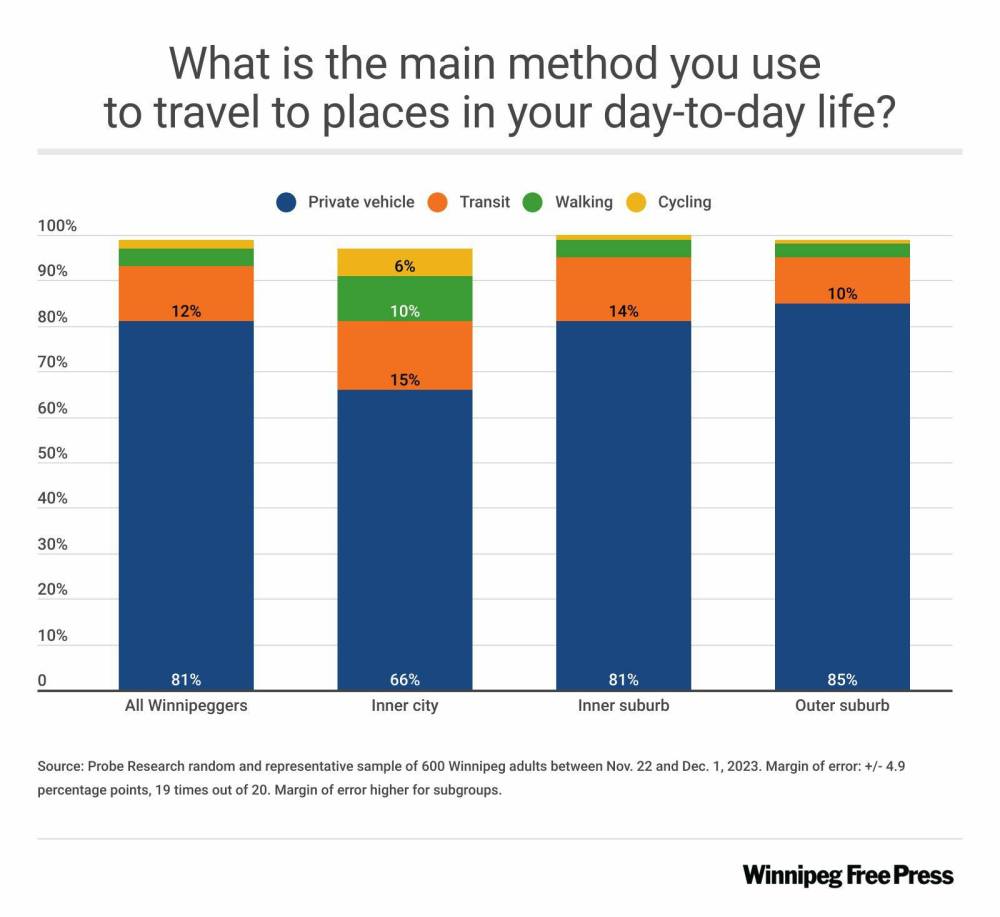
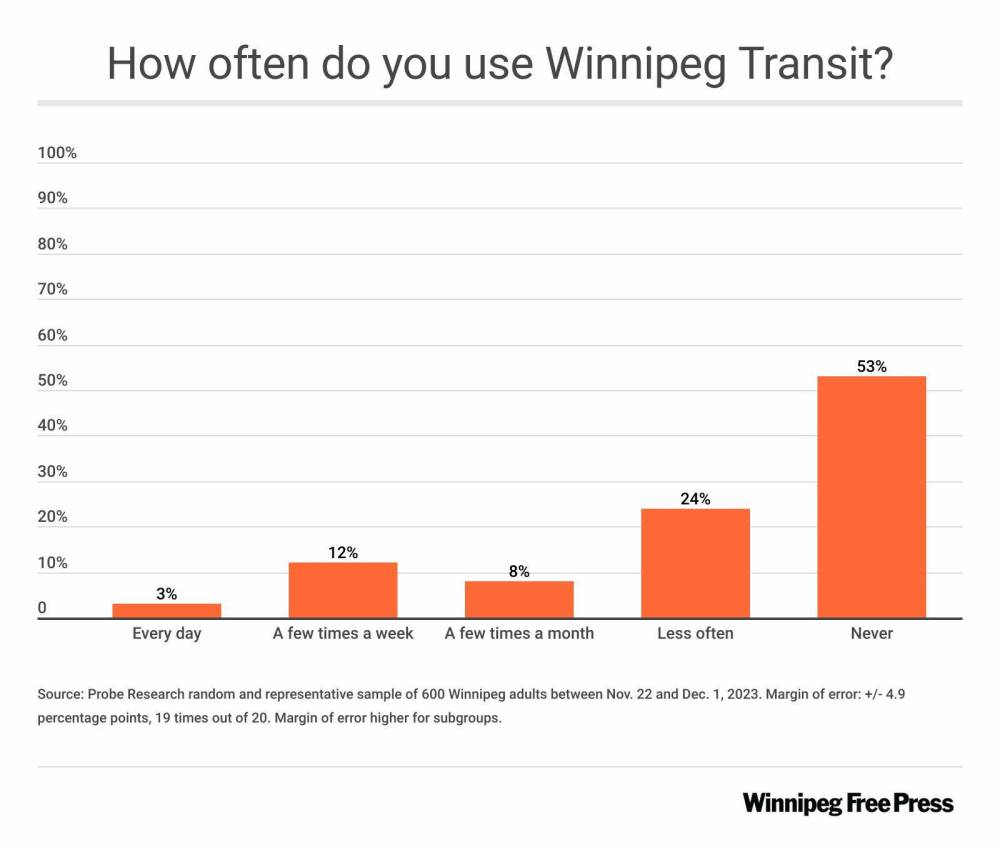
Currently, just 12 per cent of Winnipeg residents use transit as their main source of transportation, compared to 81 per cent who rely on a private vehicle and six per cent who either walk or bike to get around, according to a recent Probe Research poll commissioned by the Free Press.
Inner-city residents and people between the ages of 18 and 34 are most likely to use Transit, however two-thirds of the former group and three-quarters of the latter are still more likely to rely on other transportation options. Not surprisingly, the vast majority of older adults and those who live in outlying suburban areas tend to be more car-dependent.
“That’s pretty much what we’d expect,” said Curtis Brown, a principal at Probe Research.
“I think this shows that despite all of the strides that had been made over the last 10, 15 years… Winnipeg is still a very car-dependent city.”
Broken down further, usage is highest among women (15 per cent vs. eight per cent among men), BIPOC Winnipeggers (18 per cent) and those with a disability (21 per cent).
Winnipeg Transit recorded 32.8 million passenger trips in 2022. Ridership numbers have been inching up this year — now at 94 per cent of 2019 levels, when 48.8 million passenger trips were recorded.
While ridership numbers are returning to pre-pandemic levels, Transit’s biggest hurdle remains bus-related violence, both real and perceived.
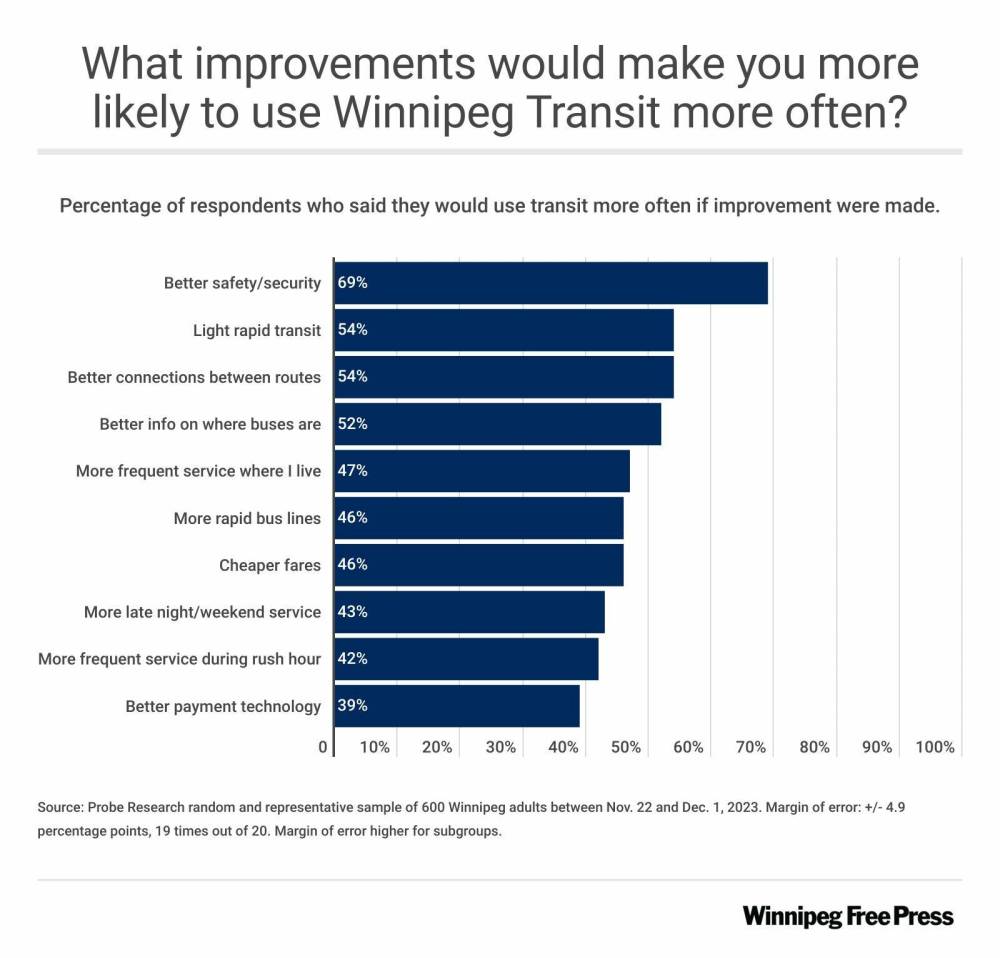
According to the Probe poll of 600 adults who completed an online survey between Nov. 22 and Dec. 1, 27 per cent of respondents, whether they were frequent, infrequent or non-users said the most important improvement Transit can make revolves around safety and security. By doing so, ridership would likely increase, they believe. Fifteen per cent want better connections between routes, while 14 per cent said the city should invest in light rail lines, which are common in most major Canadian cities.
The City is in the process of launching a transit community safety team to reduce violent encounters and to allay riders’ fears. The safety officers are expected to start patrolling on buses and around shelters in February.
Anthony Krushel-Wiebe, who commutes daily by bus from North Kildonan to Victoria Hospital in the south end of the city, said he wouldn’t feel comfortable with his kids riding the bus when they get older: ‘It’s just not safe.”
He’s never seen a physical fight, but there have been many arguments with the threat of physicality, he said.
Related Articles
The people on the bus










While U of M-bound Baydak never felt unsafe, security concerns have kept Karie Bell from returning to transit. The downtown worker stopped bussing once COVID-19 hit.
She considered buying a Peggo card — Transit’s tap-and-go payment system — when it seemed clear she’d be back in the office, but then she heard stories of bear-spray attacks and people injecting unknown substances while on the bus.
“I couldn’t justify the safety risk of taking the bus,” Bell said. Instead, she drives downtown every workday. Her parking costs $15 daily.
“I couldn’t justify the safety risk of taking the bus.”–Karie Bell
Yet, she misses the bus. There was a sense of community. “If you hadn’t seen someone in a while, you’d be like, ‘Oh man, I hope she’s OK.’
“It might’ve taken me a little longer to get downtown, but it’s nice to unwind on the way home from work and not have to worry about traffic.”
Baydak echoed Bell — she misses the community and lack of responsibility.
“I want to drive less. That is a goal,” Baydak said. “(But) I still have to live my life on a schedule, and those two things aren’t conducive right now — taking transit and sticking to a schedule.”
Service disruption is a common complaint among transit users.
Krushel-Wiebe spends his time at stops refreshing his bus-tracking app, watching the minutes count down until his ride appears. Lately, at least once a week, the scheduled bus does not show, he said.
“It’s becoming less and less compelling to be a one-car family,” he said, adding that even though it goes against his environmental values, he thinks about buying another vehicle “almost every day.”
“It’s becoming less and less compelling to be a one-car family.”–Krushel-Wiebe
A driver shortage is cited as the primary reason for service gaps. In November, the fleet was 109 drivers short of a full complement. It would need up to 170 more to return to a pre-pandemic service level.
Winnipeg once had a “robust” public transportation system but has since fallen behind the likes of Ottawa, Calgary, Edmonton and Waterloo, University of Winnipeg Prof. Jino Distasio said.
Having studied urban transportation for years, Distasio offered a blunt assessment of Transit’s current state.
“Behind the times,” he said.
Even something as simple as being able to pay for a fare using a phone’s digital wallet, which he was able to do earlier this year in B.C., is not available in Winnipeg. Here, riders regularly have to swipe Peggo cards multiple times because they fail to register on the fare scanner.
With the exception of the relatively new Southwest Transitway, a rapid bus line connecting downtown to the U of M campus, Winnipeg Transit is running the same system that it did nearly 60 years ago, Distasio said.
However, all is not lost. He’s enthusiastic about the service’s 25-year, $1.5-billion master plan, which city council approved in 2021. The plan calls for a complete overhaul of the route network, a heavy emphasis on increased bus frequency on major routes and the expansion of rapid transit lines to all quadrants of the city.
“If Winnipeg is a growing city… we’ve got to take the next step and really get behind investing in an advanced transportation system,” Distasio said.
“If Winnipeg is a growing city… we’ve got to take the next step and really get behind investing in an advanced transportation system.”–Jino Distasio, Prof. at University of Winnipeg
Mayor Scott Gillingham is a firm believer in the master transit plan.
“It will really change the way our transit system works,” Gillingham said in a recent interview. “It’s about building a modern transit service for a modern, growing city.”
For Gillingham, transit is an essential service and worth the cost. The department’s current budget is $238 million, with approximately 1,560 employees, two-thirds of which are bus drivers. By comparison, the police service budget is $326 million.
But tough budgetary decisions will have to be made in 2024. Gillingham warned in mid-December that Transit operating subsidies have jumped to $90.6 million, $20 million more than originally forecasted. Rising fuel prices, lower ridership numbers and the introduction of reduced fares for low-income and under-12 passengers were factors for the increase.
He’s hopeful a better funding arrangement can be worked out with the new NDP provincial government. In 2017, the previous Progressive Conservative government froze its funding support for Transit at 2016 levels, ending a 50-50 cost sharing agreement.
In some ways the city’s future is tied to Transit, said Winnipeg Chamber of Commerce president Loren Remillard.
Poor public transportation is “a very visible sign of disorganization” and can negatively impact a city’s image, he said.
It also means employees might show up to work late by no fault of their own, and businesses without accessible transit nearby have their talent pools limited to who can drive or walk to them, Remillard said.
Likewise, potential customers are less inclined to hop off a bus and visit a shop if they worry they’ll wait too long for the next one, he continued.
“We shouldn’t just be doing it OK,” Remillard said, adding the chamber is pleased the City is moving on a master plan that focuses on higher frequency of buses. “That is the direction we need to go.”
gabrielle.piche@winnipegfreepress.com

Gabrielle Piché reports on business for the Free Press. She interned at the Free Press and worked for its sister outlet, Canstar Community News, before entering the business beat in 2021. Read more about Gabrielle.
Every piece of reporting Gabrielle produces is reviewed by an editing team before it is posted online or published in print — part of the Free Press‘s tradition, since 1872, of producing reliable independent journalism. Read more about Free Press’s history and mandate, and learn how our newsroom operates.
Our newsroom depends on a growing audience of readers to power our journalism. If you are not a paid reader, please consider becoming a subscriber.
Our newsroom depends on its audience of readers to power our journalism. Thank you for your support.