The future is Blue Despite initial bumps in the road, the express Blue Line is Transit’s busiest route and packed with lessons for system expansion
Read this article for free:
or
Already have an account? Log in here »
To continue reading, please subscribe:

Digital Subscription
One year of digital access for only $205*
- Enjoy unlimited reading on winnipegfreepress.com
- Read the E-Edition, our digital replica newspaper
- Access News Break, our award-winning app
- Play interactive puzzles
*First annual payment billed as $205.00 + GST for one year. This annual subscription will automatically renew at $233.00 + GST every 52 weeks (10% off the regular annual price of $259.35). Offer available to new and qualified returning subscribers only. Cancel any time.
To continue reading, please subscribe:
Add Free Press access to your Brandon Sun subscription for only an additional
$1 for the first 4 weeks*
- Enjoy unlimited reading on winnipegfreepress.com
- Read the E-Edition, our digital replica newspaper
- Access News Break, our award-winning app
- Play interactive puzzles
*Your next Brandon Sun subscription payment will increase by $1.00 and you will be charged $17.95 plus GST for four weeks. After four weeks, your payment will increase to $24.95 plus GST every four weeks.
Read unlimited articles for free today:
or
Already have an account? Log in here »
Hey there, time traveller!
This article was published 01/01/2024 (993 days ago), so information in it may no longer be current.
It’s 7:31 a.m. Wednesday, Dec. 13 outside Balmoral Station when the metaphorical whistle blows — a text exchange between a bus rider and motorist ending with, “Race on.”
The former is a reporter. The latter is a photographer, who is competing against Winnipeg Transit’s Blue Line in a marked Free Press vehicle during rush hour.
The rules are straightforward: Start driving when the rapid transit bus leaves its first downtown stop of the route, follow the speed limit and stop the timer upon parking at the University of Manitoba.
In Transit
A special series examining the state of Winnipeg’s public transportation system
Read the full series here.
Just over 22 minutes later, the vehicle driver is first to arrive. An accordion bus pulls up to the Fort Garry campus’ main stretch at 8:11 a.m, capping off a public transit commute nearly twice the length of a drive.
Winnipeg Transit’s Bjorn Radstrom would argue that an asterisk must be attached to the vehicle driver’s win, especially given both the skies and roads were clear.
Radstrom said “rapid transit” is a misnomer because while he said speed is valued, the most important thing for the local Transit service, per rider feedback, is reliability. (Frequency is also high up on the service’s list of priorities, he said.)
“If somebody is driving to the U of M or from the south end of the city to downtown and traffic is going really well, sure, odds are they’re going to be faster in their car than on a bus. But when things get really congested for cars, the bus should always take roughly the same amount of time,” said the manager of Transit service development at the City of Winnipeg.
“You can rely on that and not be concerned your whole day is going to be messed up because of a snowstorm or bad traffic.”
To his point, the city’s Navigo trip-planner estimated the morning Transit trip from downtown to Fort Garry would take 38 minutes via the express route, and it ended up taking just shy of 40 minutes.
The Blue Line spans 11.2 kilometres in length – much of it parallel to Pembina Highway, on a roadway that was built to keep buses separate from other traffic and allow them to travel at speeds up to 80 km/h.
The $467-million project, also known as the Southwest Transitway, sought to divert traffic from a busy commuter corridor between downtown and the U of M.
And it’s been successful in doing so. Despite initial bumps in the road, the express line is now the busiest in Winnipeg Transit’s network.
The busiest bus routes in 2023
Winnipeg Transit statistics show the Southwest Transitway is the most popular route, per the city’s latest daily weekday boarding figures.
- Blue Line (Southwest Transitway): 16,937
- Route 11 (Portage-Kildonan): 12,187
- Route 47 (Transcona): 10,958
- Route 16 (Selkirk-Osborne): 10,653
- Route 18 (North Main-Corydon): 10,133
Source: Winnipeg Transit
The first phase of the transitway was unveiled in 2012. The completed project’s highly anticipated launch happened eight years later, during a historic low in public transit use and as city officials were pleading with residents to stay home to slow the spread of COVID-19.
Daily boardings across the city have returned to 94 per cent of pre-pandemic levels. On the Blue Line, the number of weekday boardings is more than four times what it was shortly after its rollout in April 2020.
On average, there were 3,906 daily user transactions on the Blue Line during the fall of the launch year. That figure climbed to 7,112 in 2021, 13,715 in 2022, and is currently sitting at 16,937.
“I don’t think I’ve ever been on a bus (en route home) that hasn’t been packed,” said Elise D’Aoust, a U of M student who takes the Blue Line to and from classes.
D’Aoust, who lives in Charleswood, parks her car at Chancellor Station and rides the bus if she does not need her vehicle to get to work later in the day. She said she can typically count on the Transit ride taking fewer than 15 minutes in either direction.
Costly parking and the U-Pass — a discounted bus pass that provides post-secondary students with unlimited rides during their studies, in exchange for the entire student body paying a mandatory fee — are both motivators to use a sustainable mode of transportation, D’Aoust said.
Another bonus is she has free hands to scroll social media or read a textbook on the bus. “If I want to force myself to study, I’ll make sure that I bus,” she added.
Forty-one per cent of all students, staff and faculty members travel via public transit to U of M’s main campus, one of the most popular transit hubs in the city — second only to the downtown core.
Driving alone is the second most popular mode of transportation, followed by carpooling, walking and biking — accounting for 25 per cent, 11 per cent, four per cent and one per cent of all commuters, respectively.
Sixteen per cent of individuals work or study from home, and the remainder did not disclose their exact commute logistics in the university’s 2023 campus commute survey.
Nearly 6,000 community members, representing a 15 per cent response rate, completed the online poll between Jan. 16-31, 2023.
Related Articles
Transit plan offers hope, but only if the provincial and federal governments buy in









“There’ve been a few shifts — for staff, especially, in the 2023 survey because there has been a little more flexibility in terms of some work-from-home days so that has changed the commute lens a little bit,” said Jessie Klassen, U of M’s sustainability projects co-ordinator, during a recent episode of Not Necessarily the Automobile — a campus radio show that explores public and active transportation issues.
Citing respondents’ frustrations about late buses, overcrowding and pass-bys due to full loads, a report on the latest commuter findings includes a call for administration to address service-level concerns with Winnipeg Transit.
“Our students pay for a lot of Transit and get the absolute minimum,” one participant said in their 2023 submission. Another wrote they often cannot catch a transfer until five or six packed buses come and go during rush hour.
“Ridership has really come back very strongly (post-pandemic) and if anything, it’s higher than we expected it to be, so what we’re struggling with now is really high passenger loads on the Blue Line.”– Bjorn Radstrom, Winnipeg Transit
Several community members indicated they purchased vehicles because of their poor service experiences.
Transit service development boss Radstrom said he welcomes formal complaints — the more specific, the better — so that staffers know where the problems are and can work to fix them.
“Ridership has really come back very strongly (post-pandemic) and if anything, it’s higher than we expected it to be, so what we’re struggling with now is really high passenger loads on the Blue Line,” he said.
The aftermath of COVID-19’s system-wide halt, government funding approval delays and supply chain problems are currently causing Winnipeg Transit challenges, he said.
Radstrom noted that Transit needs more of the articulated or “bendy buses,” each of which can fit about 50 more passengers than traditional 40-foot-long vehicles, because the existing fleet is aging. That aging, in turn, adds to service issues because there are not enough usable buses to meet ridership demands.
Blue Line buses are scheduled to make stops along the main line — which splits in two around Waverley Heights so drivers can service U of M and St. Norbert loops — every four to five minutes during weekday rush hours.
Buses become more infrequent during quieter times, although passengers are never supposed to wait more than 35 minutes for a ride at a major stop, per Winnipeg Transit’s schedule.
The successes of the transitway, including its spine and feeder model, are now informing plans to overhaul the city’s wider network.
Radstrom said change is required to simplify and straighten out routes by minimizing left turns, among other updates that will speed up run times and increase the efficiency of the existing system, which he calls “convoluted.”
A Winnipeg Transit bus headed to the University of Manitoba on the Blue Line in December. (Mikaela Mackenzie / Winnipeg Free Press)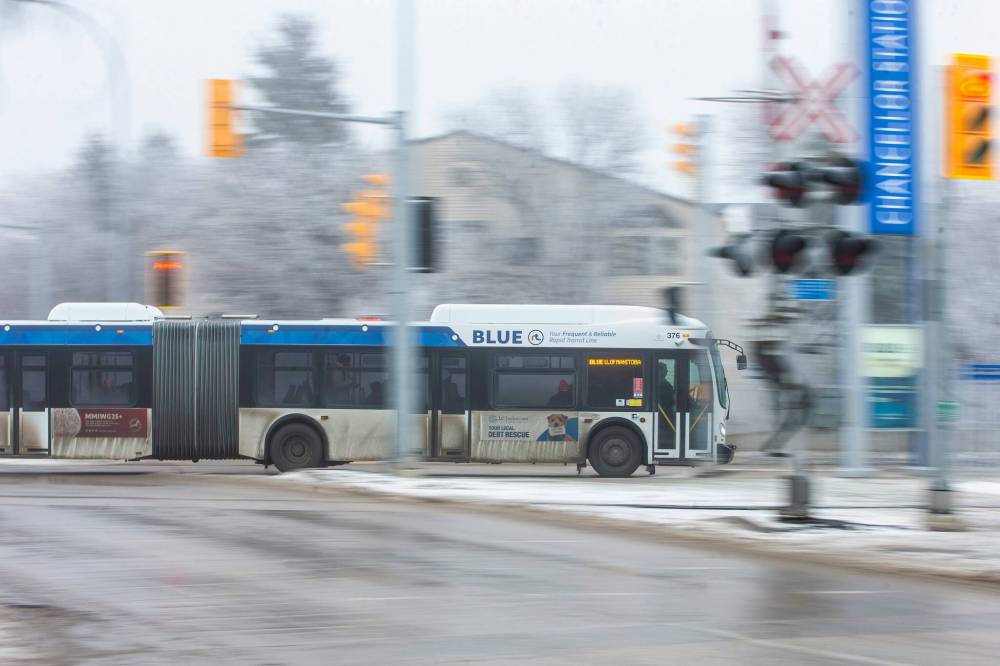
The host of UMFM’s Not Necessarily the Automobile has no shortage of ideas on how to improve service and in turn reduce CO2 emissions in the city — more than half of which are currently linked to transportation.
Adam Johnston said the city needs to implement universal low-cost fares, bolster advertising efforts to attract riders, and do a better job of linking bus routes to active transportation paths.
“If Winnipeg wants to get to a million people, we can’t just keep expanding freeways like Kenaston and Chief Peguis,” Johnston said.
“We have to have serious discussions about land use and getting out of the car and building sustainable communities, and that does include a more equitable Transit system here in the city.”
maggie.macintosh@freepress.mb.ca

Maggie Macintosh
Education reporter
Maggie Macintosh reports on education for the Free Press. Originally from Hamilton, Ont., she first reported for the Free Press in 2017. Read more about Maggie.
Funding for the Free Press education reporter comes from the Government of Canada through the Local Journalism Initiative.
Every piece of reporting Maggie produces is reviewed by an editing team before it is posted online or published in print — part of the Free Press‘s tradition, since 1872, of producing reliable independent journalism. Read more about Free Press’s history and mandate, and learn how our newsroom operates.
Our newsroom depends on a growing audience of readers to power our journalism. If you are not a paid reader, please consider becoming a subscriber.
Our newsroom depends on its audience of readers to power our journalism. Thank you for your support.