On the road again (and again) A peek inside one of the garages that keeps Winnipeg’s 640-bus fleet rinsed, repaired, refueled and returned to route
Read this article for free:
or
Already have an account? Log in here »
To continue reading, please subscribe:
Digital Subscription
One year of digital access for only $1.44 a week*
- Enjoy unlimited reading on winnipegfreepress.com
- Read the E-Edition, our digital replica newspaper
- Access News Break, our award-winning app
- Play interactive puzzles
*Billed as $5.77 plus GST every four weeks. After 52 weeks, price increases to the regular rate of $19.95 plus GST every four weeks. Offer available to new and qualified returning subscribers only. Cancel any time.
To continue reading, please subscribe:
Add Free Press access to your Brandon Sun subscription for only an additional
$1 for the first 4 weeks*
- Enjoy unlimited reading on winnipegfreepress.com
- Read the E-Edition, our digital replica newspaper
- Access News Break, our award-winning app
- Play interactive puzzles
*Your next Brandon Sun subscription payment will increase by $1.00 and you will be charged $17.95 plus GST for four weeks. After four weeks, your payment will increase to $24.95 plus GST every four weeks.
Read unlimited articles for free today:
or
Already have an account? Log in here »
Hey there, time traveller!
This article was published 28/12/2023 (1032 days ago), so information in it may no longer be current.
It’s unusually quiet at Winnipeg Transit’s main maintenance campus, a vast compound sprawling across more than a million square feet.
The early morning rush has just died down and the majority of the 640-strong fleet is already out on the road, each newly cleaned vehicle working its way along the spider-web network of routes.
In Transit
A special series examining the state of Winnipeg’s public transportation system
We all know the wheels on the bus go round and round, round and round, but what does it take to keep the fleet going all through town?
The majority of that work takes place here, at 421 Osborne St. Originally built in 1969, it’s the largest of Transit’s three garages — the other two are at 600 Brandon Ave. and 1520 Main St. The space houses various offices and shops as well as three essential zones: the bus maintenance area; the major overhaul and repair area; and the vehicle servicing area.
Winnipeg has more than 5,100 bus stops, so each zone plays an important role in ensuring the vehicles are cleaned, repaired and ready to hit one of 88 routes scattered across the city.
It’s a 24/7 tightly timed operation conducted by 245 people.
On a recent visit to the 272,027-sq.-ft. bus servicing garage, a lone vehicle sits in one of two service lanes as a employee goes through his checklist. As well as topping up bus fluids, he fills the 400-litre diesel fuel tank, a task that takes only a minute. Annually, Winnipeg Transit uses about 18 million litres of diesel fuel.
MIKE DEAL / WINNIPEG FREE PRESS Rhenan opens up the engine compartment to check the oil levels while he does the vehicles daily service maintenance. 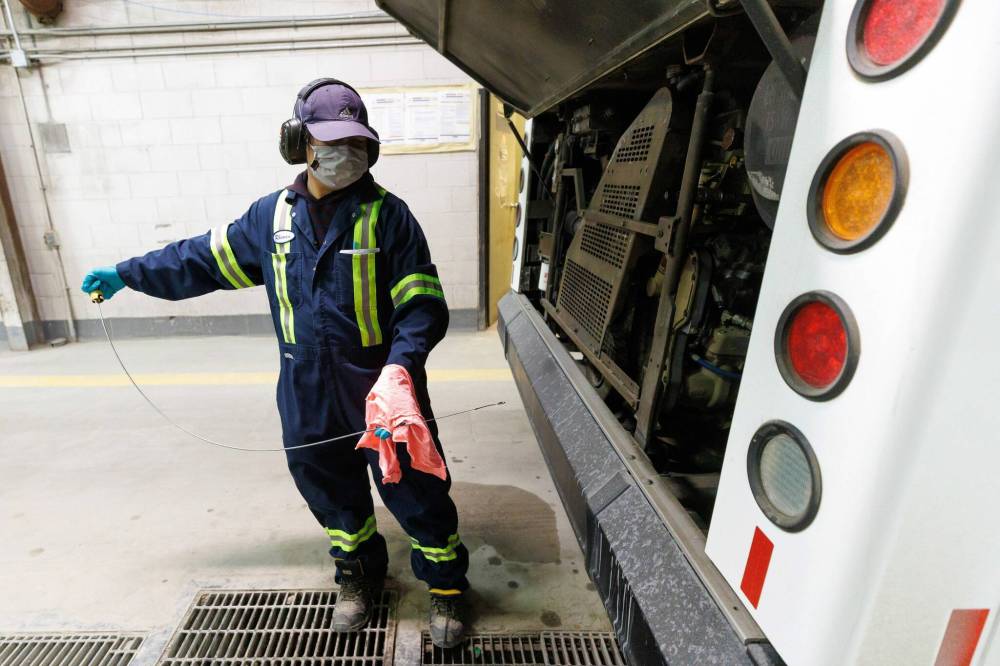
Part of bus servicer’s job is to remove the farebox and place it in a secure vault. While Transit’s preloaded touch-and-pay Peggo cards are in use, cash is still king and the majority of users pay with coins.
Farebox unloaded, the servicer sweeps the interior to remove the litter and does a walk-through to pick up and bag items left behind. The latter will make its way to Transit’s Lost Property office.
Once interior cleaning is complete, the bus is driven to a giant carwash where jets spray the bus with water and cleaning fluid before blowers dry off the vehicle. Every one of the 640 buses is washed at least once a day.
“Bus servicers only have 15 minutes to service a bus from the time they get in,” explains Don Glowatsky, manager of Winnipeg Transit Plant and Equipment.
“There are buses pulling in all the time. Buses come back, they need to get serviced and cleaned. We have to get so many buses moving in and out.”
MIKE DEAL / WINNIPEG FREE PRESS Don Glowatsky, manager of Winnipeg Transit Plant and Equipment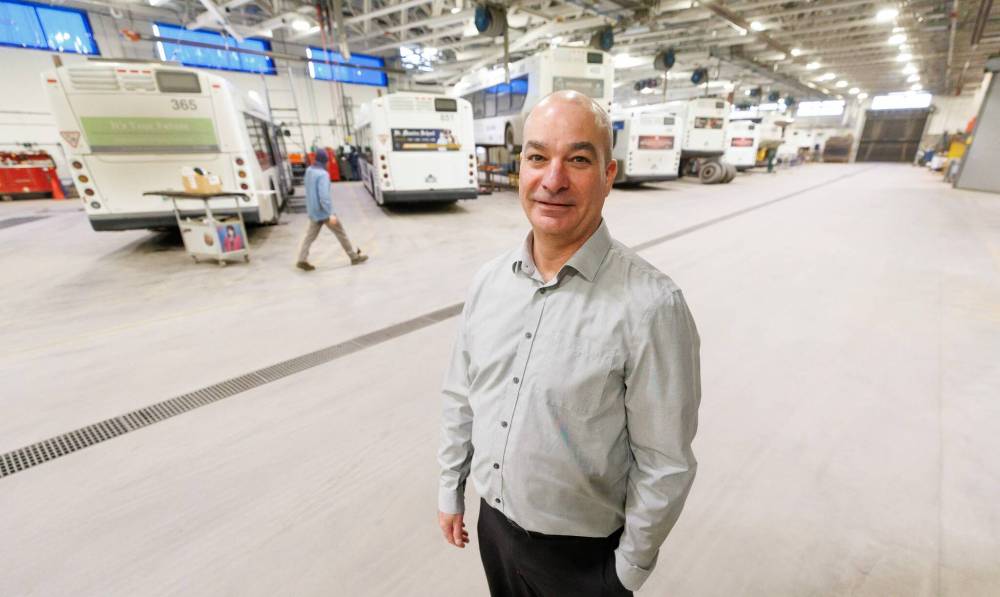
The longer the bus is on the road during the day, the dirtier it tends to be.
This winter, the longest bus run is 22 hours and two minutes long. The bus leaves the garage at 3:42 a.m. and pulls back in at 1:44 a.m. the next day, travelling 434 kilometres on Run 20-1. It operates as a work bus route until 4:47 a.m. to get operators to their early shifts, and then on to the No. 20 (Academy-Watt) route for the rest of the day, and is driven, in shifts by five different operators.
“Those ones generally are dirtiest when they come back because of the amount of people coming on and off the buses,” Glowatsky says.
Spring and autumn are the seasons requiring the most cleaning. Really cold and really hot temperatures mean buses stay cleaner for longer. Glowatsky prefers the extreme temperatures.
“Usually I really enjoy the really cold weather because once the cold weather sets in that’s usually when our defects (such as windshield wiper not working) stop coming in. Any of the sloppy weather we get we have to wash buses more often. When it becomes really hot and dry then it’s great, and cold and no snow is also great too,” he says.
MIKE DEAL / WINNIPEG FREE PRESS A transit bus goes through one of two automatic bus washers.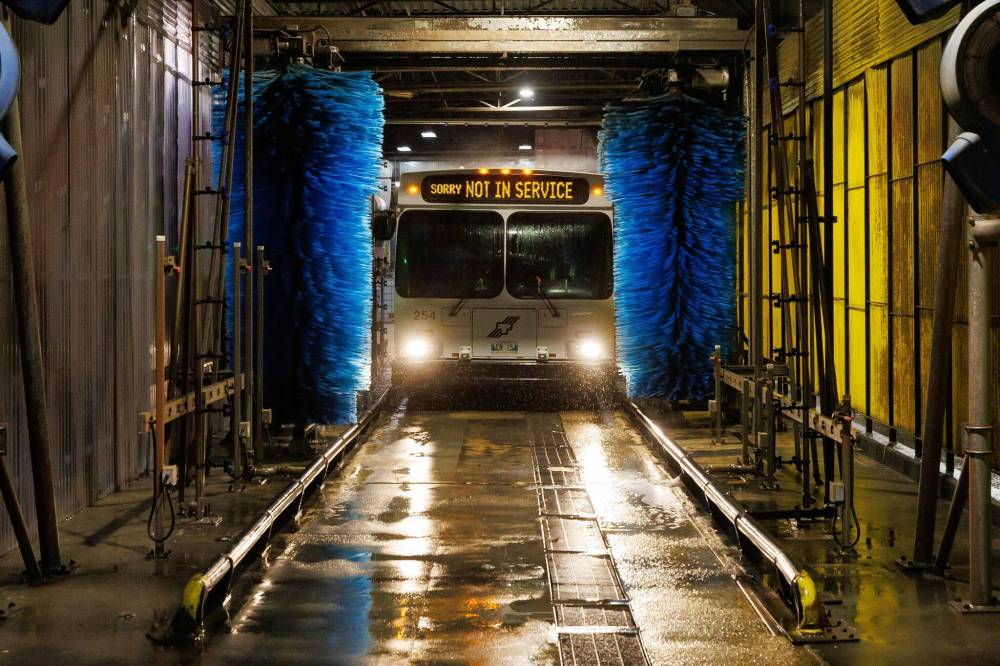
On the other side of the bus wash, a row of dirty vehicles wait for a thorough interior clean. Tougher stains and vandalized seats require pressure-washing, and sometimes more elbow grease. A ramp on the floor raises the buses so the entirety of the interior can be hosed from the lights to the seats to the floor.
Harder to remove stains are scrubbed out with a brush.
The inside of buses are “wet capable,” Glowatsky explains. It’s a crucial feature in Winnipeg’s climate where snow and rain often muddies floors and seats.
“All the newer buses we’re ordering have seats which have leather vinyl on them. They are easier to clean, easier to get graffiti off and easier to disinfect,” Glowatsky says.
Across the way from the servicing area is the maintenance, major overhaul and repair garage.
The space includes a shop for almost everything imaginable — inspection, brake/tire, general maintenance, body repair, bus refurbishing, welding, electrical and, of course, motors.
This is also where vehicles destined for the scrap yard are thoroughly picked over by mechanical engineers, who salvage reuseable parts such as fareboxes, radio systems and operator shields, mending them to be installed into new buses.
MIKE DEAL / WINNIPEG FREE PRESS Evan works right in the guts of a buses engine compartment. 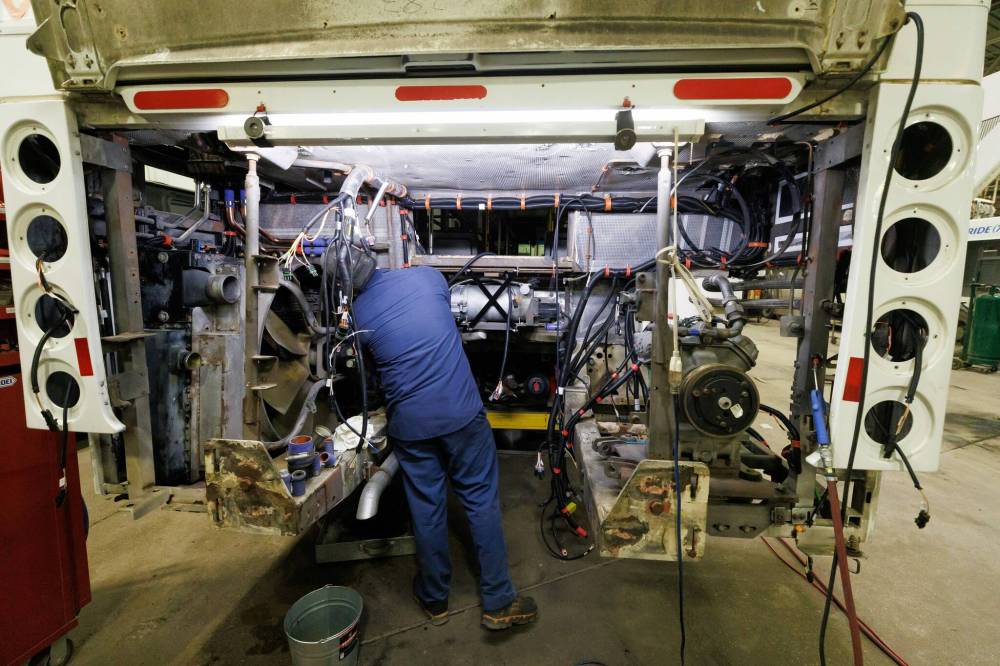
The area is noticeably calmer and quieter than the service garage. The pace less frenzied. Some buses here are in for regularly scheduled maintenance, such as oil changes, while others are awaiting longer-term repairs.
“The guys who work here are not under as intense pressure as they are in the service garage. We have some time to repair them if they are in here,” Glowatsky says.
Engineers tinker in the machine shop rebuilding engines, transmissions and large bus components that will be stored in a room abutting the garage packed with shelves of parts and supplies.
Paint booths, about 150-feet long, have been installed in the body shop to accommodate the city’s 40-foot and 60-foot articulated buses. Buses that have been vandalized or damaged will be repainted here.
“We do everything here. Everything you can do to a bus, we do it here,” Glowatsky says. “It’s our job to make sure that they are all prepared to go out at any route at any time.
”We have processes that we go through to make sure that we have enough materials and parts on hand to keep the fleet on the road. Here we have whatever we need to keep our buses going.”
av.kitching@freepress.mb.ca

AV Kitching is an arts and life writer at the Free Press. She has been a journalist for more than two decades and has worked across three continents writing about people, travel, food, and fashion. Read more about AV.
Every piece of reporting AV produces is reviewed by an editing team before it is posted online or published in print — part of the Free Press‘s tradition, since 1872, of producing reliable independent journalism. Read more about Free Press’s history and mandate, and learn how our newsroom operates.
Our newsroom depends on a growing audience of readers to power our journalism. If you are not a paid reader, please consider becoming a subscriber.
Our newsroom depends on its audience of readers to power our journalism. Thank you for your support.
Related Articles
Bus? Pass!