Betting on bus rapid transit Winnipeg’s choice of BRT bucks the national trend toward light rail transit, but could it pay off?
Read this article for free:
or
Already have an account? Log in here »
To continue reading, please subscribe:
Digital Subscription
One year of digital access for only $1.44 a week*
- Enjoy unlimited reading on winnipegfreepress.com
- Read the E-Edition, our digital replica newspaper
- Access News Break, our award-winning app
- Play interactive puzzles
*Billed as $5.77 plus GST every four weeks. After 52 weeks, price increases to the regular rate of $19.95 plus GST every four weeks. Offer available to new and qualified returning subscribers only. Cancel any time.
To continue reading, please subscribe:
Add Free Press access to your Brandon Sun subscription for only an additional
$1 for the first 4 weeks*
- Enjoy unlimited reading on winnipegfreepress.com
- Read the E-Edition, our digital replica newspaper
- Access News Break, our award-winning app
- Play interactive puzzles
*Your next Brandon Sun subscription payment will increase by $1.00 and you will be charged $17.95 plus GST for four weeks. After four weeks, your payment will increase to $24.95 plus GST every four weeks.
Read unlimited articles for free today:
or
Already have an account? Log in here »
Hey there, time traveller!
This article was published 02/01/2024 (1028 days ago), so information in it may no longer be current.
Last month, a photo of Toronto Maple Leafs’ forward William Nylander went viral on social media. The hockey star was pictured sitting back, listening to music on his phone as he rode the subway to a game. When asked why someone who earns $20,000 per day takes public transit to work, his answer was basically that it’s more convenient than driving.

The target market may not be pro hockey players, but if a city’s public transit system can attract a diverse demographic of people who ride out of choice rather than necessity, it can both transform urban mobility and become a powerful city-building tool.
Canada’s largest cities are realizing this opportunity by making generational investments into the construction of rapid transit systems, largely light rail transit (LRT), growing ridership by redefining the image, capacity and service quality of public transportation.
When a rapid transit system is fast, convenient, reliable and a high-quality rider experience, it can persuade a wide demographic of people to leave their cars at home and become riders of choice. When this happens, people naturally want to live within walking distance of the stations that access the system.
This demand increases property values around each access point as land becomes a target for redevelopment. Developers will naturally want to capitalize on this market pressure, incentivizing them to build as many housing units as is viable, resulting in high density residential development around each transit station.
In Transit
A special series examining the state of Winnipeg’s public transportation system
Read the full series here.
This high residential density in turn drives the development of commerce, employment, services and amenities to support the new population. This cascade of economic and development impacts driven by the attraction of an effective public transit network is known as Transit Oriented Development (TOD). It has become a powerful city-building tool that allows city planners to strategically locate rapid transit stations to target areas for growth.
The approach leverages government investment in public transit to amplify private development and guide it into areas deemed desirable from a strategic planning perspective, whether that is along major corridors, in areas needing new investment and economic stimulation, at reclaimed commercial and industrial sites, or even downtown.
Used strategically, Transit Oriented Development can create a more economically sustainable city by directing urban growth to infill sites that capitalize on existing infrastructure. The resulting more compact urban form results in more taxpayers paying for fewer roads and sewer pipes, less snow-clearing and other public services.
Targeted infill development also creates housing diversity that allows more people and families to have access to good neighbourhoods and it pushes new investment and population growth into existing communities to support local businesses, schools and community centres.
Canadian cities are making record investments in rapid transit construction for several reasons, including increasing social equity and opportunity, improving quality of life, reducing cost of living, lowering infrastructure costs and addressing climate change, but Transit Oriented Development and its related economic growth often play a key role in its promotion as a public spending priority.
Related Articles
Express Blue Line is Transit’s busiest route and packed with lessons for system expansion



There are currently 18 LRT projects under construction or in development across the country, and if Quebec City can get its plans off the ground, Winnipeg would become the only one of Canada’s 10 largest cities without light rail as a central component of its transit service.
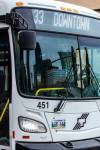
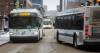
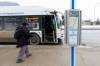
Winnipeg has elected instead to pursue Bus Rapid Transit (BRT) as its preferred system, largely because of its significantly lower costs. The plan will integrate three rapid transit lines onto existing major roadways, using priority signal lanes.
Outside of downtown, dedicated transit corridors on routes such as Main Street, Regent and Grant avenues, will run down the centre of the road, with stations located in the median, similar to Winnipeg’s old streetcar network.
Bus Rapid Transit is generally considered less effective at inspiring Transit Oriented Development, but if done well, it can have important development impacts. The most physically transformational component of Winnipeg’s rapid transit plan will be realized downtown, where all three lines are to converge. The plan is to create two major rapid transit hubs in downtown, one using historic Union Station, with buses running behind on the elevated rail lines, and a second at Portage and Main.
These stations will become significant centres of gravity and development catalysts in downtown, presenting an opportunity to establish major multi-modal hubs that are anticipated to attract more than 50,000 people every day.
When transit is relocated to Portage Avenue and Main Street, a new opportunity also arises to transform the current bus corridor along Graham Avenue into a kilometre-long linear park or public space spanning downtown. If Winnipeg can dovetail this transit strategy into CentrePlan 2050, the new downtown plan under development, we can leverage rapid transit investment to become a Transit Oriented Development catalyst and transformational force in the future of downtown.
Despite Winnipeg’s entire Bus Rapid Transit network being projected to cost about half of Edmonton’s single new LRT line, and about the same as Kitchener-Waterloo’s first phase of LRT, its implementation timeline remains part of a 25-year masterplan.
Rapid transit investment in Winnipeg is the linchpin to desperately needed downtown renewal, the backbone of a new high frequency transit model soon to be implemented across the city, and a powerful tool to guide and incentivize new residential development during a housing crisis.
While other major Canadian cities are realizing the transformational benefits of bold rapid transit investment today, unless funding priorities and implementation timelines change, Winnipeg is still a generation away.
Brent Bellamy is creative director at Number Ten Architectural Group.

Brent Bellamy is creative director for Number Ten Architectural Group.
Our newsroom depends on a growing audience of readers to power our journalism. If you are not a paid reader, please consider becoming a subscriber.
Our newsroom depends on its audience of readers to power our journalism. Thank you for your support.
History
Updated on Tuesday, January 2, 2024 7:52 AM CST: Adds photo, adds link, adds fact box
Updated on Tuesday, January 2, 2024 8:10 AM CST: Changes format, changes background photo