Step in the right direction: GPS issues on buses fixed, Transit says
Read this article for free:
or
Already have an account? Log in here »
To continue reading, please subscribe:

Digital Subscription
One year of digital access for only $205*
- Enjoy unlimited reading on winnipegfreepress.com
- Read the E-Edition, our digital replica newspaper
- Access News Break, our award-winning app
- Play interactive puzzles
*First annual payment billed as $205.00 + GST for one year. This annual subscription will automatically renew at $233.00 + GST every 52 weeks (10% off the regular annual price of $259.35). Offer available to new and qualified returning subscribers only. Cancel any time.
To continue reading, please subscribe:
Add Free Press access to your Brandon Sun subscription for only an additional
$1 for the first 4 weeks*
- Enjoy unlimited reading on winnipegfreepress.com
- Read the E-Edition, our digital replica newspaper
- Access News Break, our award-winning app
- Play interactive puzzles
*Your next Brandon Sun subscription payment will increase by $1.00 and you will be charged $17.95 plus GST for four weeks. After four weeks, your payment will increase to $24.95 plus GST every four weeks.
Read unlimited articles for free today:
or
Already have an account? Log in here »
Hey there, time traveller!
This article was published 04/02/2026 (225 days ago), so information in it may no longer be current.
Winnipeg Transit says the GPS failure that wreaked havoc with bus schedules for several months has been fixed.
That will provide much more extensive and accurate data to help improve the new primary transit network, said Coun. Janice Lukes (Waverley West).
“It’s just so huge because there’s a lot of conversation and suggestions and feedback that we’re getting that the buses aren’t connecting (well) … We can now take some of those buses that aren’t being utilized (enough and) put them on routes that need higher frequency, so we can make those connections. This (repair) is huge and this is a great news,” said Lukes, chairwoman of the public works committee.

MIKAELA MACKENZIE / FREE PRESS FILES
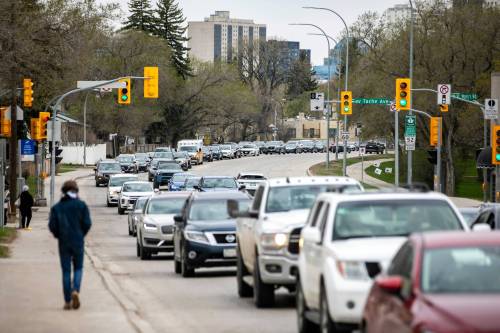
Transit riders can count on bus arrival times on Navigo, bus schedule boards and Transit’s website to be generally accurate after GPS issues were fixed.
On July 7, a “widespread” GPS issue began leading incorrect bus arrival times to appear on Navigo, bus schedule boards and Transit’s website, Transit previously noted. About 18 to 24 per cent of bus location reports were incorrect at the peak of the problem.
“This (repair) is huge and this is a great news.”
On Wednesday, Transit said the number of GPS error messages is now within one per cent of a normal “baseline” error level of about three to four per cent of all reports.
That improvement was first achieved in November but hasn’t impacted routes yet, since schedules take time to plan out.
Transit expects the more accurate data will start helping improve some routes in April, since the GPS system collects ridership data as well as bus timing details.
Lukes noted the GPS failure began at the worst possible time, shortly after Transit switched to a new route network on June 29, which changed virtually every route in the city.
The new spine-and-feeder concept, where direct spines along major corridors are supported by a network of feeder routes, means many rides that begin outside of a main route now require transfers, making bus timing even more important.
Lukes said the failures had nothing to do with the route change but added confusion just as riders were learning the new system, noting it wasn’t clear what caused some missed and late buses.
Following a presentation at a public works meeting Wednesday, Winnipeg Transit officials said the more accurate data that’s now available will allow the city to pinpoint where some changes are needed.
“It gives us the ability to know where our passengers are with a higher degree of certainty. So, when we look at making some of the changes in terms of redistributing frequency (of buses) … we know exactly where and when you want to place the frequency,” said Adam Budowski, a senior Transit planner.
“(We’re) looking forward to April (when) we’re making additional changes, more changes to frequency of routes like the F8. We’re improving that even more,” said Budowski.
“It gives us the ability to know where our passengers are with a higher degree of certainty.”
Transit declined to offer further details of upcoming changes, noting those will be released in a future report.
The fix should also make some buses easier to track for riders. That’s because arrival times posted online for buses with glitching GPS systems would rely only on the bus schedule, instead of reflecting real-time delays.
Winnipeg Transit director Greg Ewankiw said the issue required a lengthy process to fix.

“We had to install a cable on each bus. And as you get to the older models of buses, the cabling becomes more complex, so it actually takes longer for each bus to (be fixed),” said Ewankiw.
He said about 45 remaining buses still have cable issues that are now being addressed, a relatively small portion of Transit’s 640-bus fleet.
“We actually have better reporting (on locations) now than what we did before this problem even started,” said Ewankiw.
joyanne.pursaga@freepress.mb.ca
X: @joyanne_pursaga

Joyanne is city hall reporter for the Winnipeg Free Press. A reporter since 2004, she began covering politics exclusively in 2012, writing on city hall and the Manitoba Legislature for the Winnipeg Sun before joining the Free Press in early 2020. Read more about Joyanne.
Every piece of reporting Joyanne produces is reviewed by an editing team before it is posted online or published in print — part of the Free Press‘s tradition, since 1872, of producing reliable independent journalism. Read more about Free Press’s history and mandate, and learn how our newsroom operates.
Our newsroom depends on a growing audience of readers to power our journalism. If you are not a paid reader, please consider becoming a subscriber.
Our newsroom depends on its audience of readers to power our journalism. Thank you for your support.
Related Articles
Without key GPS data, transit plan lacked direction