

Young activists fight for kids’ voting rights in trustee elections

Advertisement
Read this article for free:
or
Already have an account? Log in here »
To continue reading, please subscribe:

Digital Subscription
One year of digital access for only $205*
- Enjoy unlimited reading on winnipegfreepress.com
- Read the E-Edition, our digital replica newspaper
- Access News Break, our award-winning app
- Play interactive puzzles
*First annual payment billed as $205.00 + GST for one year. This annual subscription will automatically renew at $233.00 + GST every 52 weeks (10% off the regular annual price of $259.35). Offer available to new and qualified returning subscribers only. Cancel any time.
To continue reading, please subscribe:
Add Free Press access to your Brandon Sun subscription for only an additional
$1 for the first 4 weeks*
- Enjoy unlimited reading on winnipegfreepress.com
- Read the E-Edition, our digital replica newspaper
- Access News Break, our award-winning app
- Play interactive puzzles
*Your next Brandon Sun subscription payment will increase by $1.00 and you will be charged $17.95 plus GST for four weeks. After four weeks, your payment will increase to $24.95 plus GST every four weeks.
Read unlimited articles for free today:
or
Already have an account? Log in here »
It doesn’t sit right with a pair of St. Boniface students that they don’t get a say in who’s elected to the nine-seat governing board in the Louis Riel School Division.
A petition to lower the age of voter eligibility in trustee elections has been circulating during recess at École Henri-Bergeron in recent months.
Grade 5 students Libby and Helen are behind the campaign.
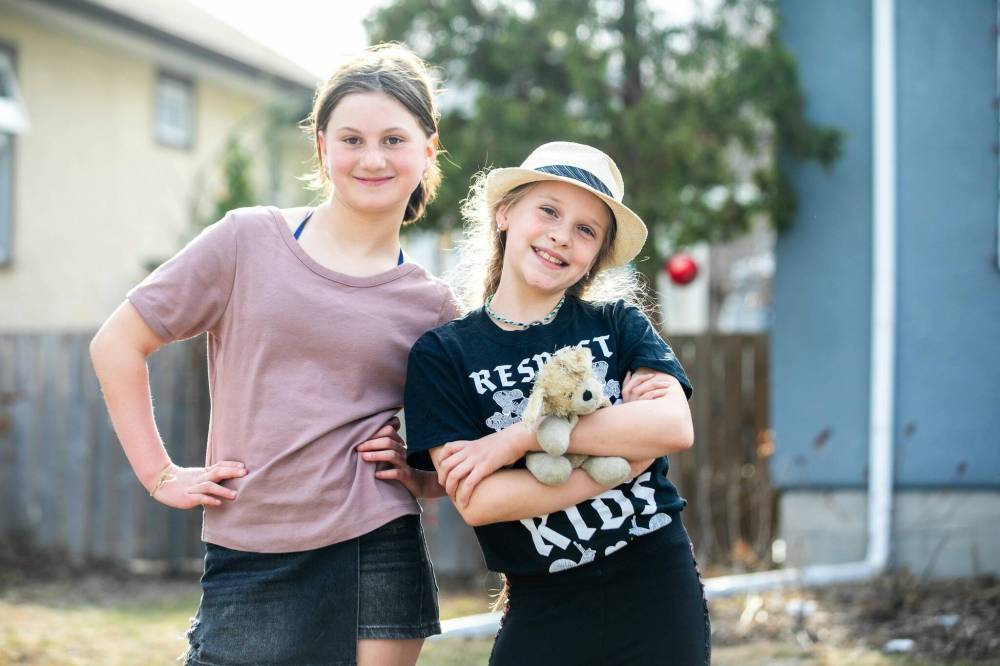
“It’s really, really unfair that adults get to make ginormous decisions about our learning and we don’t even get to vote for (them),” Libby, 10, told the Free Press.
For the better part of the school year, the girls have been making the case that children aged seven or older should be able to vote in school board races. Their rationale is that students generally have basic literacy skills by their seventh birthday.
Their petition has more than 160 signatories, including Grades 4 to 8 students and employees at their school.
Flanked by their teacher and vice-principal, the students took it to the school board Tuesday.
Their bilingual presentation was met with applause inside the boardroom at 50 Monterey Rd., Ward 4 trustee Chipalo Simunyola encouraged the young organizers to expand their advocacy efforts.
Simunyola and his colleagues’ four-year term will be up later this year. Winnipeggers are scheduled to head to the polls on Oct. 28.
Canadian citizens aged 18 and up are eligible to participate in the ward they live in, as long as they have lived there for at least six months before election day.
Ontario allows students or student councils acting on their behalf to elect representatives to school boards. Every board in that province is required to have at least two student trustee positions.
“It’s really, really unfair that adults get to make ginormous decisions about our learning and we don’t even get to vote for (them).”
Manitoba should follow suit, as far as Libby and Helen are concerned, but any changes require the approval of the legislative assembly.
MLAs recently rejected a private member’s bill that sought to allow permanent residents and students aged 16 and up to vote in municipal and school board races.
Independent MLA Mark Wasyliw, a former trustee, failed to win over colleagues by arguing that voter turnout would improve because schools could promote participation and students would put pressure on their parents to vote.
Winnipeg’s 2022 municipal and school board elections had a 37.5 per cent turnout rate. Only five per cent of eligible voters cast ballots in the most recent race in the Louis Riel School Division — a late October byelection in Ward 3.
It was around then, as candidates were putting up signs and knocking on doors, when Libby first approached Helen to see if she’d join a special advocacy project.
Their campaign has been met with words of encouragement, as well as apathy and skepticism that “kids aren’t responsible enough.”
Their stance is students would be prepared if they received formal lessons in the leadup to a race.
Many schools run mock elections, but the organizers suggested those activities don’t empower students to make change or give them a voice in decision-making that affects them.
Asked about key issues that are overlooked, Helen said students are concerned their playground is inadequate and there is only one gender-neutral bathroom at their school.
“These are young people who are taking the initiative to (share) their ideas, their thoughts around what public education should be and can be.”
“Most students are on the second floor, so (those) who don’t feel like going into male or female bathrooms have to walk all the way downstairs, which costs them some learning time — just to go to the bathroom,” she added.
Multiple trustees said they were impressed by the proposal, but the board has yet to endorse it or commit to bringing their ideas to the province.
“These are young people who are taking the initiative to (share) their ideas, their thoughts around what public education should be and can be,” board chair Sandy Nemeth said.
Parent Anna Weier echoed that sentiment, saying she’s proud to support the student-led initiative. Libby, her daughter, is “a really justice-minded kid,” Weier said.
She noted that public schools aim to graduate citizens who are active participants in their communities so it makes perfect sense to include them in democratic processes “as early as possible.”
The St. Vital-based school division has a student advisory committee, but such entities aren’t required by provincial legislation.
Manitoba’s education minister has an advisory council made up of high schoolers from urban and rural areas.
Asked about whether her office would consider adjusting voter eligibility in trustee elections, Tracy Schmidt called the topic “a really worthwhile discussion.” The minister said she’s interested in meeting with Libby and Helen to hear their arguments.
maggie.macintosh@freepress.mb.ca
Maggie Macintosh
Education reporter
Maggie Macintosh reports on education for the Free Press. Originally from Hamilton, Ont., she first reported for the Free Press in 2017. Read more about Maggie.
Funding for the Free Press education reporter comes from the Government of Canada through the Local Journalism Initiative.
Every piece of reporting Maggie produces is reviewed by an editing team before it is posted online or published in print — part of the Free Press‘s tradition, since 1872, of producing reliable independent journalism. Read more about Free Press’s history and mandate, and learn how our newsroom operates.
Our newsroom depends on a growing audience of readers to power our journalism. If you are not a paid reader, please consider becoming a subscriber.
Our newsroom depends on its audience of readers to power our journalism. Thank you for your support.
Maggie Macintosh
Education reporter
Maggie Macintosh reports on education for the Free Press. Originally from Hamilton, Ont., she first reported for the Free Press in 2017. Read more about Maggie.
Funding for the Free Press education reporter comes from the Government of Canada through the Local Journalism Initiative.
Every piece of reporting Maggie produces is reviewed by an editing team before it is posted online or published in print — part of the Free Press‘s tradition, since 1872, of producing reliable independent journalism. Read more about Free Press’s history and mandate, and learn how our newsroom operates.
Our newsroom depends on a growing audience of readers to power our journalism. If you are not a paid reader, please consider becoming a subscriber.
Our newsroom depends on its audience of readers to power our journalism. Thank you for your support.
Related Articles
City councillors fear backlash over tax bills thanks to huge increases in education portion


Advertisement Advertise With Us
Advertisement Advertise With Us