

Cost of moving homeless $256K: city
Mayor heralds returning sites ‘to the public’

Advertisement
Read this article for free:
or
Already have an account? Log in here »
To continue reading, please subscribe:

Digital Subscription
One year of digital access for only $205*
- Enjoy unlimited reading on winnipegfreepress.com
- Read the E-Edition, our digital replica newspaper
- Access News Break, our award-winning app
- Play interactive puzzles
*First annual payment billed as $205.00 + GST for one year. This annual subscription will automatically renew at $233.00 + GST every 52 weeks (10% off the regular annual price of $259.35). Offer available to new and qualified returning subscribers only. Cancel any time.
To continue reading, please subscribe:
Add Free Press access to your Brandon Sun subscription for only an additional
$1 for the first 4 weeks*
- Enjoy unlimited reading on winnipegfreepress.com
- Read the E-Edition, our digital replica newspaper
- Access News Break, our award-winning app
- Play interactive puzzles
*Your next Brandon Sun subscription payment will increase by $1.00 and you will be charged $17.95 plus GST for four weeks. After four weeks, your payment will increase to $24.95 plus GST every four weeks.
Read unlimited articles for free today:
or
Already have an account? Log in here »
The City of Winnipeg has spent about $256,000 to remove homeless encampments from many public spaces since mid-November — a cost the mayor says is well worth it.
Scott Gillingham said that investment has resulted in “good progress” on returning sites to their intended public uses.
“We can’t have children playing in playgrounds where (there are) needles. Those belong to the public. Those are not places for encampments,” said Gillingham.
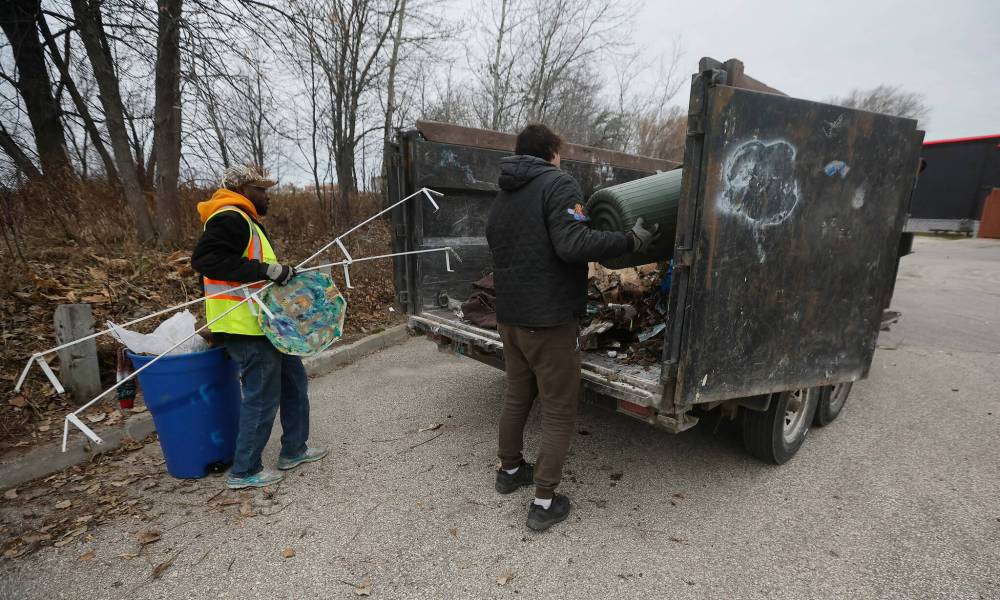
JOHN WOODS / FREE PRESS FILES
Work crews clean up the remnants of a homeless encampment beside Omands Creek last fall. The City of Winnipeg has spent about $256,000 to remove homeless encampments from many public spaces since mid-November.
A city protocol took effect Nov. 17 that bans homeless camps from transit shelters, playgrounds, pools, spray pads, recreation facilities, schools, daycares, adult care facilities, traffic islands and medians, bridges, docks, piers, rail lines and rail crossings, as well as wherever the camps obstruct traffic or pose a “life safety issue.”
The ban affects those “sensitive” areas at all times, while enforcement is prioritized during daytime hours at encampments on all other city property.
A new report notes the city devoted 3,176 staff hours and about $256,000 by March to enforce the rules. City officials had responded to encampments at 20 public properties with site visits, no-camping signs and/or offers of housing through an outreach organization. They cleared garbage and debris to remediate 58 sites, including some that had been vacated with no city intervention.
Bylaw enforcement officers also completed 199 on-site inspections.
The city did not release the number of people who moved out of encampments or reveal whether they relocated to shelters or more permanent housing.
The founder of one outreach organization said those details are critical to assessing the effect of the policy.
“What did they do with those folks? Did they link them to income supports? Did they actually house those individuals?” asked Marion Willis of St. Boniface Street Links.
Street Links said the large amount of debris that remains at a former encampment site in Midwinter Park along the Red River in Elmwood, and others like it, shows the city needs a more robust camp cleanup policy.
“We need to be able to keep our green spaces clean. It’s not good for the land, it’s not good for our rivers. It’s not good for people,” said Willis.
She had lobbied the city to add a managed (designated) encampment site that offers services such as washrooms and garbage pickup, while directing people into housing. Willis said that would create a destination for people required to move on from other sites.
The city has rejected the idea so far, which she believes led people to be displaced.
“We’re simply just pushing people further into the fringes, into stairwells and hallways, buildings, any place where they can seek shelter,” said Willis.
An East Exchange District resident who has long demanded action on large encampments in her area said plenty of debris was left behind this winter, due to a few weather-related issues.
“The river was quite high … (and) inundated the areas where the encampments were, so abandoned sites couldn’t be cleaned up because … they were under water and then they (materials) were frozen to the ground when the temperature dropped,” said Laurie Nealin.
Nealin said encampments that stretch through Fort Douglas Park, largely between the Alexander Docks and Annabella Street, would be a “huge undertaking” to vacate and clean up.
She also expressed disappointment that some form of designated encampment site with services was not created as a destination for people who agree to leave encampments but reject other housing options.

John Woods / THE CANADIAN PRESS FILES
Marion Willis, executive director and founder of St. Boniface Street Links.
“There has to be somewhere where you can say, if you’re not interested in the housing options we presented, then you will have to move to this designated encampment site,” she said.
However, a recent meeting with city officials left Nealin hopeful the city will address the encampments near her home.
“There’s optimism that they’re with us, they get it, they see it and… they’re determined to do something about it,” she said.
Coun. Vivian Santos, the head of council’s community services committee, estimates there are more than 40 encampments in Winnipeg, half of which are in her Point Douglas ward, including those around Fort Douglas Park.
Santos said city officials do expect to take action at that site this spring and summer.
The councillor also believes further cleanup efforts are needed.
Santos will ask city staff to consider restoring a program that allowed regular weekly garbage pickups at encampments while people still lived at them.

“I’m hoping … we can get back to a more mindful cleanup … I did think that was really a good way to ensuring that the sites were clean,” she said.
A pilot project of that work ran for about five months in 2024 but never resumed after the city found trash continued to pile up soon after it was collected.
Santos noted many encampments tend to emerge in warmer months and appear to be increasing now.
joyanne.pursaga@freepress.mb.ca
X : @joyanne_pursaga
Joyanne is city hall reporter for the Winnipeg Free Press. A reporter since 2004, she began covering politics exclusively in 2012, writing on city hall and the Manitoba Legislature for the Winnipeg Sun before joining the Free Press in early 2020. Read more about Joyanne.
Every piece of reporting Joyanne produces is reviewed by an editing team before it is posted online or published in print — part of the Free Press‘s tradition, since 1872, of producing reliable independent journalism. Read more about Free Press’s history and mandate, and learn how our newsroom operates.
Our newsroom depends on a growing audience of readers to power our journalism. If you are not a paid reader, please consider becoming a subscriber.
Our newsroom depends on its audience of readers to power our journalism. Thank you for your support.
Joyanne is city hall reporter for the Winnipeg Free Press. A reporter since 2004, she began covering politics exclusively in 2012, writing on city hall and the Manitoba Legislature for the Winnipeg Sun before joining the Free Press in early 2020. Read more about Joyanne.
Every piece of reporting Joyanne produces is reviewed by an editing team before it is posted online or published in print — part of the Free Press‘s tradition, since 1872, of producing reliable independent journalism. Read more about Free Press’s history and mandate, and learn how our newsroom operates.
Our newsroom depends on a growing audience of readers to power our journalism. If you are not a paid reader, please consider becoming a subscriber.
Our newsroom depends on its audience of readers to power our journalism. Thank you for your support.
Related Articles
Winnipeg on track to reject managed encampment pilot









Advertisement Advertise With Us
Advertisement Advertise With Us