Mayor flip-flops on cutting tree-planting budget after intense criticism

Public opposition has prompted Mayor Scott Gillingham to change his mind about chopping $1.2 million from the city’s tree-planting program.

Read this article for free:


or

Already have an account? Log in here »

To continue reading, please subscribe:

Subscribe and receive a limited-edition Free Press branded hat or tote.

Digital Subscription

One year of digital access for only $205*

  • Enjoy unlimited reading on winnipegfreepress.com
  • Read the E-Edition, our digital replica newspaper
  • Access News Break, our award-winning app
  • Play interactive puzzles

*First annual payment billed as $205.00 + GST for one year. This annual subscription will automatically renew at $233.00 + GST every 52 weeks (10% off the regular annual price of $259.35). Offer available to new and qualified returning subscribers only. Cancel any time.

To continue reading, please subscribe:

Add Free Press access to your Brandon Sun subscription for only an additional

$1 for the first 4 weeks*

  • Enjoy unlimited reading on winnipegfreepress.com
  • Read the E-Edition, our digital replica newspaper
  • Access News Break, our award-winning app
  • Play interactive puzzles
Start now

*Your next Brandon Sun subscription payment will increase by $1.00 and you will be charged $17.95 plus GST for four weeks. After four weeks, your payment will increase to $24.95 plus GST every four weeks.

Public opposition has prompted Mayor Scott Gillingham to change his mind about chopping $1.2 million from the city’s tree-planting program.

“There’s been an overwhelming response (from the public). I’ve talked to our staff and the corporate finance team about the possibility of finding ways to maintain the tree budget. And I believe that there are ways,” said Gillingham.

City considers million-dollar chop to tree planting program
MIKAELA MACKENZIE / FREE PRESS FILES
                                Winnipeg’s Elm tree canopy over Casey Street in Riverview.

The Manitoba government recently directed the city to spend an additional $1.236 million of its provincial “strategic infrastructure basket” funding on the Assiniboine Park Conservancy Journey to Churchill Exhibit, a city finance report says.

Finance officials recommended transferring some tree funding to fill that gap, and council’s executive policy committee voted in favour of the plan on Tuesday.

However, the mayor said public feedback about the decision convinced him to raise a new proposal to find the money elsewhere.

“The public wants this tree-planting funding protected. I agree, and I’ll be bringing forward a plan to (city) council next week to do exactly that,” said the mayor in a news release issued by his office.

Later, in an interview, the mayor said a detailed proposal will be raised at the July 16 city council meeting, which would require a final council vote.

He said the city is still working out where the money will come from.

RUTH BONNEVILLE / FREE PRESS FILES
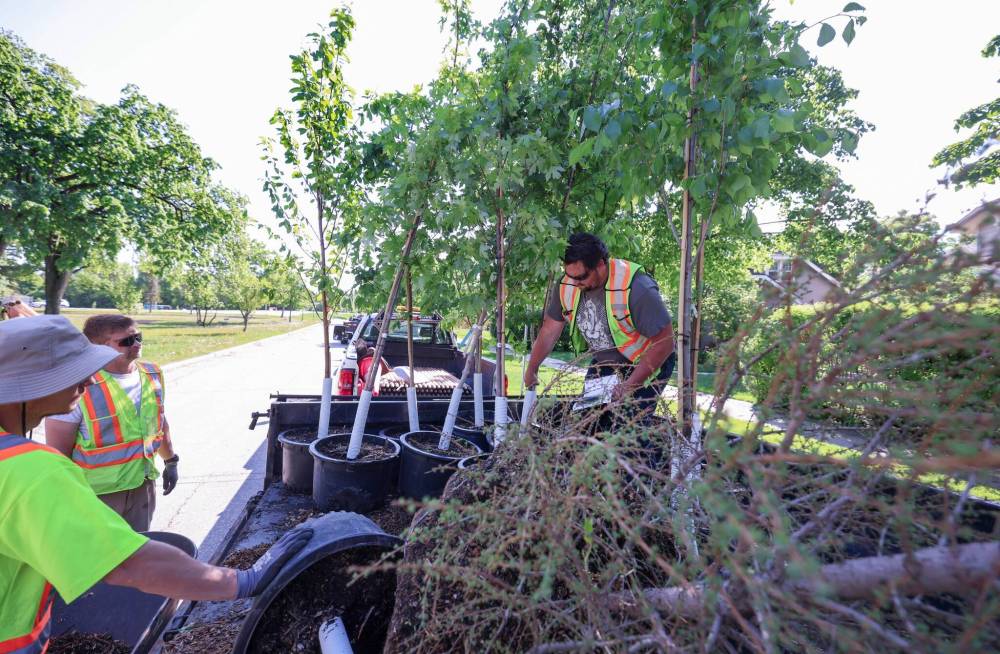
City crews plant trees in Andrew Currie Park in June. The proposed $1.2-million budget cut would reduce the 2026 tree planting budget to $9.825 million.

RUTH BONNEVILLE / FREE PRESS FILES

City crews plant trees in Andrew Currie Park in June. The proposed $1.2-million budget cut would reduce the 2026 tree planting budget to $9.825 million.

When asked why he changed his mind, after voting in favour of the cost-cutting proposal two days earlier, the mayor cited public feedback and his own priorities.

“Trees are important to Winnipeggers. They’re important to me. I believe we can find a way to protect the tree budget and that’s what I intend to do,” he said.

The cut would reduce the 2026 tree planting budget to $9.825 million and “delay the implementation” of Winnipeg’s urban forest strategy, the finance report notes.

The report did not offer further details about the impact of those changes.

Gillingham noted city council increased combined operating and capital spending on the tree canopy to $33.6 million in 2026, up from $21 million in 2022. Over the past four years, that funding boost allowed the city to hire more staff, ramp up its tree-pruning cycle from once every 16.4 years to about once every 8.5 years and increase the number of boulevard and park trees planted each year to 6,686, from 4,333, he said.

MIKAELA MACKENZIE / FREE PRESS FILES
“Trees are important to Winnipeggers. They’re important to me,” Mayor Scott Gillingham said.
MIKAELA MACKENZIE / FREE PRESS FILES

“Trees are important to Winnipeggers. They’re important to me,” Mayor Scott Gillingham said.

A member of a local tree protection group said she’s glad the city will likely cancel the cut, pending a final council vote.

“We are, of course, pleased … It’s interesting that they thought this was a good move in the first place and, secondly, that they didn’t expect there would be outrage,” said Jean Altemeyer, a member of Trees Please Winnipeg.

Altemeyer said severe weather linked to climate change raises the urgency to plant as many trees as possible and any funding cut would interfere with that goal.

“The increasing volatility of the weather and the loss of big, mature trees means it’s all the more important that more trees get planted because there’s all sorts of evidence that one of the best ways to deal with global warming is to have more trees. They take in carbon dioxide, they give off oxygen, they control storm runoff, they provide habitat,” she said.

Altemeyer said she’s “thrilled but cautious” about the update. Since the city has not yet confirmed where the money will come from, that leaves the risk another program could be cut, she said.

“We will continue to monitor (this closely.)”

joyanne.pursaga@freepress.mb.ca

X: @joyanne_pursaga

Joyanne Pursaga

Joyanne Pursaga
Reporter

Joyanne is city hall reporter for the Winnipeg Free Press. A reporter since 2004, she began covering politics exclusively in 2012, writing on city hall and the Manitoba Legislature for the Winnipeg Sun before joining the Free Press in early 2020. Read more about Joyanne.

Every piece of reporting Joyanne produces is reviewed by an editing team before it is posted online or published in print — part of the Free Press‘s tradition, since 1872, of producing reliable independent journalism. Read more about Free Press’s history and mandate, and learn how our newsroom operates.

Our newsroom depends on a growing audience of readers to power our journalism. If you are not a paid reader, please consider becoming a subscriber.

Our newsroom depends on its audience of readers to power our journalism. Thank you for your support.

Report Error Submit a Tip

More Stories

A Winnipeg lawyer has been disbarred after admitting to six counts of professional misconduct and two counts of providing incompetent service involving eight clients.

The career-ending decision marks the sixth time Gisele Champagne has been disciplined by the Law Society of Manitoba since she was called to the bar in 1992.

“Disbarment is the appropriate remedy when a lawyer has demonstrated a repeated pattern of conduct that violates professional standards,” a law society panel said in a written decision released Wednesday.

“A lawyer who has been unable to learn from past discipline proceedings to fulfill his or her obligation to provide ethical and high-quality legal services must at some point lose the privilege of practising law.”

Gillingham in lead with decided voters

Nicole Buffie 6 minute read Preview

Gillingham in lead with decided voters

Nicole Buffie 6 minute read Yesterday at 6:55 PM CDT

A cloud of uncertainty is hanging over Winnipeg as October’s municipal election nears.

Three months after a poll showed more than 40 per cent of Winnipeggers wanted to see someone other than current mayor Scott Gillingham elected, a new Abacus Data poll indicates more than half of Winnipeg voters are undecided heading into next month’s civic election.

Of decided voters, 55 per cent favour Gillingham compared to 23 per cent for former councillor and provincial cabinet minister Kevin Klein and 11 per cent for funeral director Mike Vogiatzakis.

Of all respondents, just over 50 per cent said they were unsure while 13 per cent said they will not vote.

Read
Yesterday at 6:55 PM CDT

Near-future U.S. the setting for surreal dual-world storyline

Reviewed by Morley Walker 4 minute read Preview

Near-future U.S. the setting for surreal dual-world storyline

Reviewed by Morley Walker 4 minute read 2:01 AM CDT

It’s not every day you encounter a seriously intended literary novel that attempts to dramatize a mind-bending physics theory like quantum entanglement.

But then the B.C.-born-and-raised Emily St. John Mandel is not your everyday Canadian literary writer.

In her late 40s, she has lived in the U.S. for her entire writing career. She is best known for her 2014 dystopian novel Station Eleven, about a Shakespearean acting troupe navigating a pandemic-ravaged America.

Her new outing, her seventh, Exit Party, shares DNA with detective and sci-fi genres more than with conventional literary fiction.

Read
2:01 AM CDT

Family account spiced with magic realism, geopolitical intrigue and a ghost story

Reviewed by Zilla Jones 4 minute read Preview

Family account spiced with magic realism, geopolitical intrigue and a ghost story

Reviewed by Zilla Jones 4 minute read 2:01 AM CDT

Tom Lin’s second novel Babylon, South Dakota moves beyond a historical account of an immigrant family’s struggle, delightfully blending and bending genres.

Lin is a Chinese-born novelist whose family emigrated to the U.S. when he was four years old. His debut novel, The Thousand Crimes of Ming Tsu, won the 2022 Andrew Carnegie Medal for Excellence in Fiction, making him the youngest ever recipient of that award. He earned a PhD in English from the University of California Davis and is currently an assistant professor of English and creative writing at the University of Iowa.

Babylon, South Dakota takes place in an unspecified time period that can be understood to be during the Mao era — likely the 1950s or ’60s. A young Chinese couple, the Hsuis, immigrate to the rural community that gives the book its title. They take the names Saul and Mei and settle on a 160-acre homestead left to them by a distant relative.

Saul’s dream is to breed and sell chrysanthemums from seeds he brought from China, while Mei wants to raise livestock. They speak no English, know nothing of life in the United States, are unprepared for the harshness of winter and the isolation of the farm and bring nothing with them except some gold, which Mei hides around the house for emergencies. Their only link to the outside world is a discarded and marginally functioning TV set, which Saul rescues and rigs up.

Read
2:01 AM CDT

A quick look at where provinces and territories stand on time changes

The Canadian Press 2 minute read Preview

A quick look at where provinces and territories stand on time changes

The Canadian Press 2 minute read Updated: Yesterday at 6:28 AM CDT

WINNIPEG - Manitoba's government said Thursday the province will be sticking with daylight time year-round, making it the latest jurisdiction to move away from twice-annual time changes. Here's a look at where things stand across Canada:

British Columbia said in March that it was moving to permanent Pacific daylight time. The change also means that parts of northeastern B.C., which have been on mountain standard time year round, are now in alignment with the rest of the province.

Alberta also switched to permanent daylight time this year in what it calls Alberta time. The change means it now has the same time as Saskatchewan year round.

Saskatchewan has been on permanent central standard time since 1966.

Read
Updated: Yesterday at 6:28 AM CDT

Cabernet Sauvignon star of wine festival

Ben Sigurdson 5 minute read Preview

Cabernet Sauvignon star of wine festival

Ben Sigurdson 5 minute read 3:00 AM CDT

The Winnipeg Wine Festival will celebrate the king of red wine grapes next weekend — the theme of this year’s festival, which takes place Sept. 25 and 26 at the RBC Convention Centre, is Cabernet Sauvignon.

Cab Sauv, as it’s also known, is the world’s most widely planted wine grape of any colour, first coming to prominence in the 1800s in France’s Bordeaux region, where the grape is still popular. Rather than single-variety wines, Bordeaux reds tend to be blends, with those coming from the left bank of the Gironde estuary being Cabernet-dominant, while right-bank wines are Merlot-dominant, with Cabernet Sauvignon playing a supporting role. Cabernet and Merlot work well together and many other countries have followed suit in blending the two.

A team at University of California Davis put Cabernet Sauvignon through a DNA test in 1996 and discovered its parent grapes are Cabernet Franc and Sauvignon Blanc — it’s likely that at some point the two varieties, planted next to each other in some vineyard, crossed and mutated and became the grape we know today. (Someone growing grapes in the 19th century must have had an inkling of what was up, as the grape has been called Cabernet Sauvignon since long before the DNA test.)

Flavour-wise, most Cabernet Sauvignon wines are big and bold, with a core of deep dark berry flavours, some graphite and spice notes and relatively bright acidity. It’s a grape that is well-suited to barrel aging, with most examples seeing at least some time in wood.

Read
3:00 AM CDT