

Close to 5,000 net new health-care workers added since 2023 election, province says
Staffing, wait-time issues remain: union leaders

Advertisement
Read this article for free:
or
Already have an account? Log in here »
To continue reading, please subscribe:

Digital Subscription
One year of digital access for only $205*
- Enjoy unlimited reading on winnipegfreepress.com
- Read the E-Edition, our digital replica newspaper
- Access News Break, our award-winning app
- Play interactive puzzles
*First annual payment billed as $205.00 + GST for one year. This annual subscription will automatically renew at $233.00 + GST every 52 weeks (10% off the regular annual price of $259.35). Offer available to new and qualified returning subscribers only. Cancel any time.
To continue reading, please subscribe:
Add Free Press access to your Brandon Sun subscription for only an additional
$1 for the first 4 weeks*
- Enjoy unlimited reading on winnipegfreepress.com
- Read the E-Edition, our digital replica newspaper
- Access News Break, our award-winning app
- Play interactive puzzles
*Your next Brandon Sun subscription payment will increase by $1.00 and you will be charged $17.95 plus GST for four weeks. After four weeks, your payment will increase to $24.95 plus GST every four weeks.
Read unlimited articles for free today:
or
Already have an account? Log in here »
More doctors and nurses are working in Manitoba than ever before but health-care challenges remain, Premier Wab Kinew says.
The province has added 4,725 net new health-care workers to the provincial system since the NDP won the October 2023 election, Kinew told reporters Tuesday.
The government’s total includes 370 doctors, 1,464 nurses, 2,152 health-care aides and 607 allied health professionals, a group that includes physiotherapists, dietitians, paramedics, medical lab technologists and others.
Kinew said more doctors and nurses are working in Manitoba than ever before.
MIKAELA MACKENZIE / FREE PRESS “There are still many things to do when it comes to wait times, emergency rooms and urgent cares, and surgeries and diagnostics, but we also know that anything that we want to do in those areas, it has to start with the staffing,” Premier Wab Kinew says.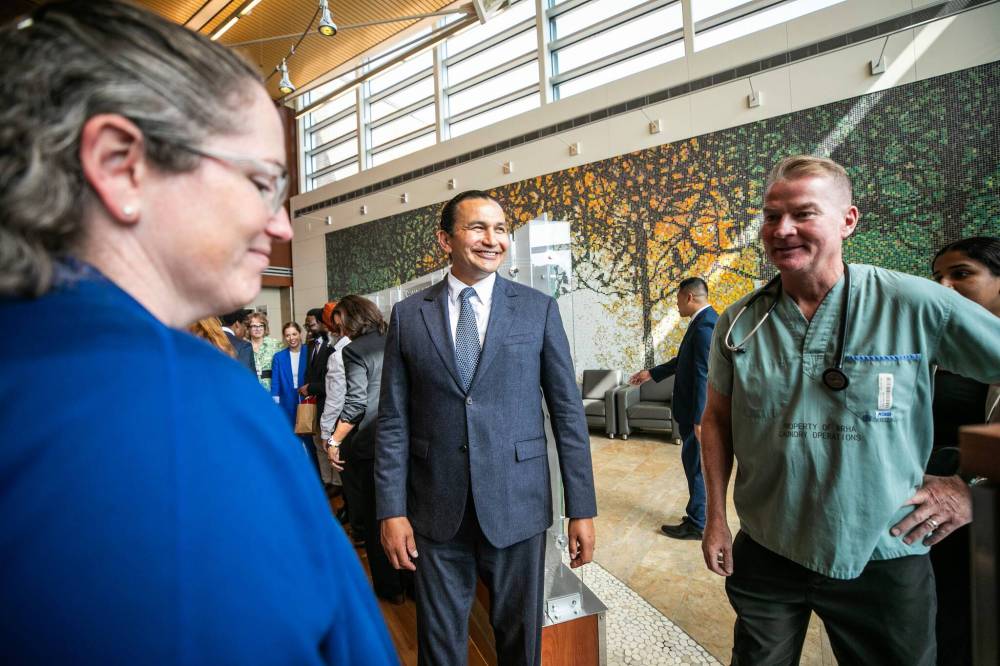
“We also know there’s a lot that needs to be done,” he said at a news conference at Seven Oaks General Hospital in northwest Winnipeg.
“There are still many things to do when it comes to wait times, emergency rooms and urgent cares, and surgeries and diagnostics, but we also know that anything that we want to do in those areas, it has to start with the staffing.”
The NDP government said it has also added 2,152 health-care aides, 67 physician and clinical assistants, 59 resident physicians and six midwives.
“It has to start with the staffing.”
Every health region has recorded increases in staffing, with the figures accounting for retirements or employees who left for other reasons, Kinew said. The data includes full- and part-time employees in public facilities only.
The NDP made a 2023 election promise to hire 400 physicians, 300 nurses in Winnipeg (with a corresponding commitment to rural and northern Manitoba), 200 paramedics, 100 home-care workers and 100 mental-health workers to help address chronic understaffing and “fix” the system.
“Manitoba is still facing critical allied health staffing shortages that are driving up wait times for emergency medical response, testing and treatment,” Jason Linklater, president of the Manitoba Association of Health Care Professionals, said in a statement.
“The metric that matters is whether Manitobans wait less time for care tomorrow than they did yesterday, while also maintaining the highest standards of care.”
Linklater said Manitoba needs more MRI and CT technologists to bring down the highest wait times in Canada, based on Canadian Institute for Health Information data, for those diagnostic tests.
He said vacancy rates of 30 to 40 per cent among respiratory therapists and rural paramedics are dangerously high.
Kinew said work continues to hire more allied health staff.
“It doesn’t matter how many times they explain their math, I don’t get it.”
Manitoba Nurses Union president Darlene Jackson questioned the province’s figures.
“I know they’re saying 1,464 nurses have been hired and it doesn’t matter how many times they explain their math, I don’t get it,” she said.

Doctors Manitoba president Dr. Alon Altman said the province is continuing to close the gap on a major shortage of physicians.
“This is good news for Manitobans searching for a family doctor or waiting for care,” Altman said in a statement. “However, the improved result on recruitment needs to be matched with a stronger focus on retaining the doctors we have. Manitoba loses more physicians to other provinces than it gains, and too many of our own medical graduates move away to practise.”
He said Manitoba can improve retention by reducing the volume of paperwork, expanding team-based care in physician practices and investing in the technology and equipment doctors need to deliver modern and advanced medical care.
Kinew said his government is “on track” to fulfil election promises, including a new ER at Victoria Hospital. The NDP has also promised to reopen ERs at Concordia and Seven Oaks hospitals.
The three emergency rooms were closed between 2017 and 2019 by the previous Progressive Conservative government in a massive and controversial overhaul of Winnipeg’s health-care system.
Emergency room and urgent-care centre wait times in Winnipeg have increased since the last election. The median wait time for all ERs and urgent-care centres in the city in June was 4.32 hours, up from 3.4 hours the previous year, according to Winnipeg Regional Health Authority data.
One in 10 patients waited longer than 12.3 hours, up from 9.18 in June 2025. The Kinew government has blamed the pre-2023 ER closures and other cuts made by the Tories, and cited rising patient numbers for the increase.
“What has changed over the past few years is that the volumes at the emergency rooms and the urgent cares are much greater today, and the acuity. People are sicker today,” Kinew said.
“If you’re talking about an emergency room or an urgent-care centre or a health-care system that today is seeing more people than ever before, sicker patients than in the past, just ask yourself where would we be if we didn’t have these additional 4,725 health-care workers.”
Health Minister Uzoma Asagwara said the total includes 111 net new health-care workers at Seven Oaks.
MIKAELA MACKENZIE / FREE PRESS Jodi-rae Kortje, Seven Oaks’ chief operating officer, says all of the hospital’s emergency physician vacancies are expected to be filled by March 2027.
Jodi-rae Kortje, Seven Oaks’ chief operating officer, who moved to Manitoba from B.C. for work about three years ago, said all of the hospital’s emergency physician vacancies are expected to be filled by March 2027.
She said at least six additional physicians are anticipated to begin working at Seven Oaks over the next four months.
Kortje said the hospital has also added social workers and a triage night nurse, and extended its psychiatric liaison nurse coverage.
“These are important additions for our urgent care (clinic) that is caring for increasingly complex patients facing significant demand,” she said.
The province noted the recent hiring of two physicians.
Dr. Janet Yuen, who began work in Seven Oaks’ urgent-care centre Tuesday, is the first physician to join the hospital through the reinstated family physician emergency medicine training program.
Dr. Ayomikun Soyombo, an emergency medicine physician recruited from England, moved to Winnipeg on Sunday to join Seven Oaks’ urgent-care team. He will also work at Grace Hospital.
MIKAELA MACKENZIE / FREE PRESS Dr. Ayomikun Soyombo, emergency medicine physician (left), accepts gifts from Health Minister Uzoma Asagwara during the provincial announcment at Seven Oaks Hospital Tuesday. 
Soyombo said he wanted to move to Manitoba for a medical elective when he was a student in Nigeria in 2010, but he was not given a visa. He was recently recruited while working in England’s National Health Service.
“After looking at everything, it was Manitoba for me.”
Soyombo said he declined offers from three other provinces when he decided to move to Winnipeg.
“I had to ask myself, ‘OK where do I go? Who appears most serious, most dedicated, most inspiring?’” he said. “And after looking at everything, it was Manitoba for me.”
Asagwara said Manitoba is no longer considered a “flyover” province among potential recruits.
The minister also noted the addition of more than 130 institutional safety officers in Manitoba at a cost of more than $18 million. The officers were deployed after health-care workers at several facilities raised concerns about safety and assaults.
— with files from Malak Abas and Morgan Modjeski
chris.kitching@freepress.mb.ca
Chris Kitching is a general assignment reporter at the Free Press. He began his newspaper career in 2001, with stops in Winnipeg, Toronto and London, England, along the way. After returning to Winnipeg, he joined the Free Press in 2021, and now covers a little bit of everything for the newspaper. Read more about Chris.
Every piece of reporting Chris produces is reviewed by an editing team before it is posted online or published in print — part of the Free Press‘s tradition, since 1872, of producing reliable independent journalism. Read more about Free Press’s history and mandate, and learn how our newsroom operates.
Our newsroom depends on a growing audience of readers to power our journalism. If you are not a paid reader, please consider becoming a subscriber.
Our newsroom depends on its audience of readers to power our journalism. Thank you for your support.
Chris Kitching is a general assignment reporter at the Free Press. He began his newspaper career in 2001, with stops in Winnipeg, Toronto and London, England, along the way. After returning to Winnipeg, he joined the Free Press in 2021, and now covers a little bit of everything for the newspaper. Read more about Chris.
Every piece of reporting Chris produces is reviewed by an editing team before it is posted online or published in print — part of the Free Press‘s tradition, since 1872, of producing reliable independent journalism. Read more about Free Press’s history and mandate, and learn how our newsroom operates.
Our newsroom depends on a growing audience of readers to power our journalism. If you are not a paid reader, please consider becoming a subscriber.
Our newsroom depends on its audience of readers to power our journalism. Thank you for your support.
Related Articles
Winnipeggers hoping for shorter waits in rural ERs delay care for all, Selkirk nurse says







Advertisement Advertise With Us
Advertisement Advertise With Us
History
Updated on Tuesday, August 18, 2026 4:47 PM CDT: Adds details
Updated on Tuesday, August 18, 2026 6:29 PM CDT: Adds quotes, details.
Updated on Tuesday, August 18, 2026 6:43 PM CDT: Adds photos