Europe wildfire risk heightened by early heat waves, drought
Advertisement
Read this article for free:
or
Already have an account? Log in here »
To continue reading, please subscribe:

Digital Subscription
One year of digital access for only $205*
- Enjoy unlimited reading on winnipegfreepress.com
- Read the E-Edition, our digital replica newspaper
- Access News Break, our award-winning app
- Play interactive puzzles
*First annual payment billed as $205.00 + GST for one year. This annual subscription will automatically renew at $233.00 + GST every 52 weeks (10% off the regular annual price of $259.35). Offer available to new and qualified returning subscribers only. Cancel any time.
To continue reading, please subscribe:
Add Free Press access to your Brandon Sun subscription for only an additional
$1 for the first 4 weeks*
- Enjoy unlimited reading on winnipegfreepress.com
- Read the E-Edition, our digital replica newspaper
- Access News Break, our award-winning app
- Play interactive puzzles
*Your next Brandon Sun subscription payment will increase by $1.00 and you will be charged $17.95 plus GST for four weeks. After four weeks, your payment will increase to $24.95 plus GST every four weeks.
Read unlimited articles for free today:
or
Already have an account? Log in here »
Hey there, time traveller!
This article was published 22/06/2022 (1522 days ago), so information in it may no longer be current.
MADRID (AP) — Extended drought conditions in several Mediterranean countries, a heat wave last week that reached northern Germany and high fuel costs for aircraft needed to fight wildfires have heightened concerns across Europe this summer.
And it’s only June.
“Much of the continent is in drought,” said Cathelijne Stoof, an environmental science professor at the Netherlands’ Wageningen University, who called the wildfire outlook “very challenging across Europe.”
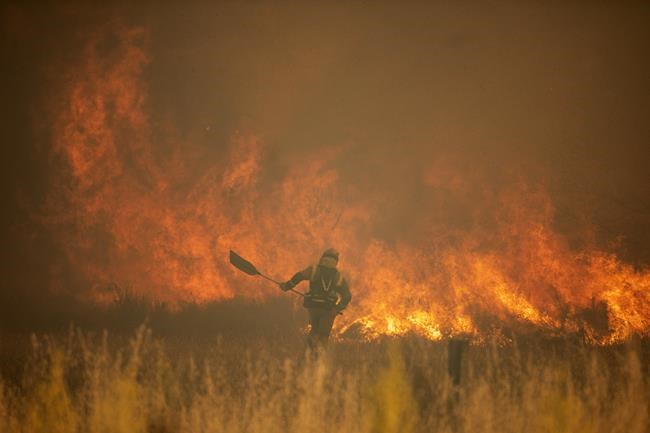
Fires last summer blackened more than 11,000 square kilometers (4,250 square miles) of land — an area more than four times the size of Luxembourg. About half of the damage was in the European Union.
And, experts say, Europe’s wildfires aren’t just a problem for the southern, hotter countries.
“What scientists are warning us is that (fires) are obviously going north and in countries such as the U.K., in countries such as Germany as well as in Scandinavian countries, in the future, we need to expect wildfires to happen more often,” said Catherine Gamper, a climate change adaptation specialist at the Organization for Economic Cooperation and Development.
Wildfires across Spain have destroyed tens of thousands of acres of wooded land, though a recent sharp drop in temperatures is helping firefighters contain them.
Spain’s problems began with the arrival in spring of the earliest heat wave in two decades. Temperatures as high as those normally recorded in August rose above 40 C (104 F) in many Spanish cities.
Neighboring Portugal also saw its warmest May in nine decades, and in France the month was the hottest on record.
“As a result of climate change, heat waves are starting earlier and are becoming more frequent and more severe because of record concentrations of heat-trapping greenhouse gases,” the World Meteorological Organization said last week.
“What we are witnessing today is a foretaste of the future.”
Despite the extensive planning, early-warning surveillance, and prediction models, preparing for wildfires remains a huge challenge. The EU is expanding a shared pool of planes and helicopters on standby this summer to provide cross-border support and is expected to partner with more nations outside the bloc.
“It’s very difficult to predict wildfires,” said Marta Arbinolo, an OECD policy analyst and climate adaptation and resilience specialist.
“We do know that summer (of) 2022 is predicted by weather forecasts to be particularly warm and dry, possibly even more than 2020 or ’21, which was the driest and warmest summer in Europe,” she said. “We can expect that the risk of wildfires in Europe for the summer might be very high.”
In Greece, which suffered some of Europe’s most devastating fires last August, authorities say higher fuel costs have added to challenges facing the fire service, which relies heavily on water-dropping planes to battle blazes in the mountainous country.
Greece will begin using fire retardant chemicals in water drops this year, while the EU is sending more than 200 firefighters and equipment from France, Germany and four other countries to Greece to remain throughout the summer.
Wildfire seasons are also getting longer.
“The concept of a fire season is losing its meaning right now. We have the fire season all year-round,” said Victor Resco de Dios, professor of forest engineering at Lleida University, in Spain’s northeastern Catalonia region, which has been hit hard by summer fires.
“The main changes we are seeing with climate change is a longer duration of fire seasons.”
Laura Vilagra, a senior Catalonia government official, told a regional conference that fire prevention measures this season could include park closures.
“The weather every year is more adverse, and the drought is very evident this year,” she said. “We’re expecting a very complicated summer.”
Resco foresees a bleak future in Spain, arguing that areas currently affected by fires “probably will not experience many fires by the turn of the century. Why? Because forests would be very scarce. There would be nothing left to burn.”
Other experts aren’t as grim.
The OECD’s Gamper and Arbinolo point out that some of the worst fires have actually brought positive developments such as the EU’s Civil Protection Mechanism that facilitates rapid cooperation between countries in emergencies. European countries, they argue, are also opening up to incorporate risk reduction in their planning, rather than simply boosting their firefighting resources.
“The core is the need for integrated fire management, attention to fires all year round rather than just when it is dry, and investment in landscape management,” Stoof said.
Gamper appealed for two things she said would have a major impact. First, reconsider urban planning by not building near forests of extreme risk.
“I think our first sort of appeal to countries is really to think about where you continue to settle,” Gamper said.
“Second of all, enforce your regulations. Countries know what to do.”
___
Derek Gatopoulos reported from Athens, Greece. Hernan Muñoz Ratto contributed to this report from Barcelona, Spain.
___
Follow Ciarán Giles at https://twitter.com/ciarangiles and Derek Gatopoulos https://twitter.com/dgatopoulos
___
Follow AP’s climate coverage at https://apnews.com/hub/climate
Related Articles
Climate change a factor in 'unprecedented' South Asia floods
Advertisement Advertise With Us
Advertisement Advertise With Us