Unpredictable winds make wildfires an erratic adversary: experts

Advertisement

Advertise with us

Hot weather and dry conditions are the usual suspects in any wildfire season, but a complex interplay of topography and unpredictable winds can create particularly challenging adversaries for firefighters, experts say.

Read this article for free:


or

Already have an account? Log in here »

To continue reading, please subscribe:

Subscribe and receive a limited-edition Free Press branded hat or tote.

Digital Subscription

One year of digital access for only $205*

  • Enjoy unlimited reading on winnipegfreepress.com
  • Read the E-Edition, our digital replica newspaper
  • Access News Break, our award-winning app
  • Play interactive puzzles

*First annual payment billed as $205.00 + GST for one year. This annual subscription will automatically renew at $233.00 + GST every 52 weeks (10% off the regular annual price of $259.35). Offer available to new and qualified returning subscribers only. Cancel any time.

To continue reading, please subscribe:

Add Free Press access to your Brandon Sun subscription for only an additional

$1 for the first 4 weeks*

  • Enjoy unlimited reading on winnipegfreepress.com
  • Read the E-Edition, our digital replica newspaper
  • Access News Break, our award-winning app
  • Play interactive puzzles
Start now

*Your next Brandon Sun subscription payment will increase by $1.00 and you will be charged $17.95 plus GST for four weeks. After four weeks, your payment will increase to $24.95 plus GST every four weeks.

Hey there, time traveller!
This article was published 08/08/2022 (1504 days ago), so information in it may no longer be current.

Hot weather and dry conditions are the usual suspects in any wildfire season, but a complex interplay of topography and unpredictable winds can create particularly challenging adversaries for firefighters, experts say.

In British Columbia, shifting wind patterns have been a key concern for crews battling a fire in the south Okanagan that has forced the evacuation of hundreds of homes.

Mary-Ann Jenkins, professor emeritus of atmospheric science at York University in Toronto, said fire generally moves in the same direction the wind is blowing.
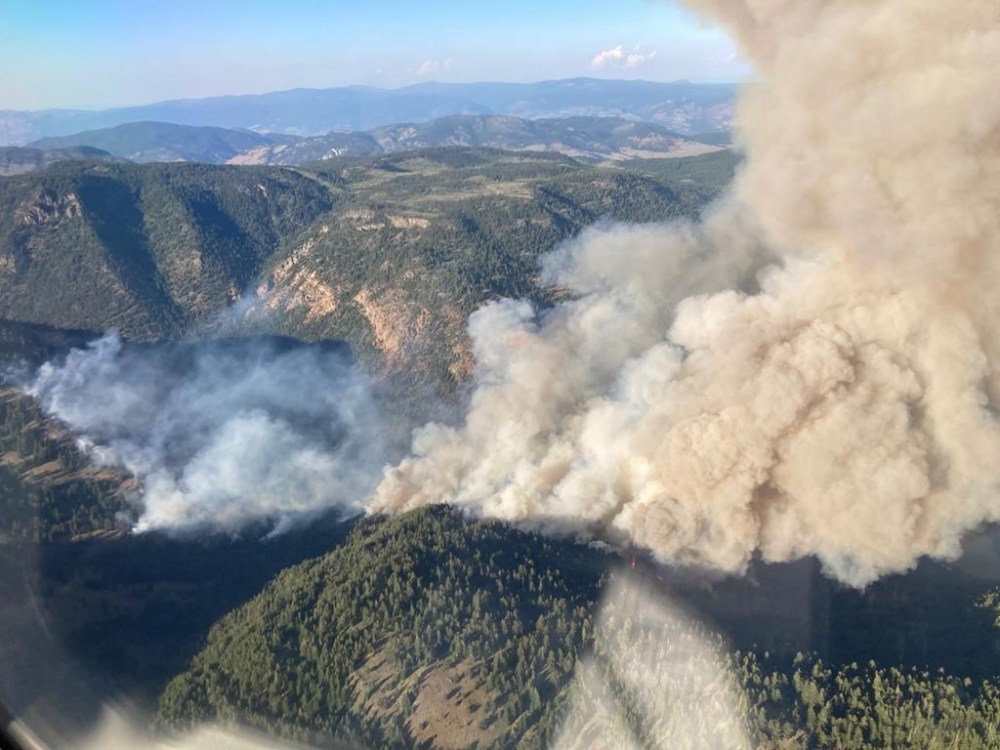
An aerial view of the Keremeos Creek wildfire is shown in a July 29, 2022 handout photo. Hot weather and dry conditions are the usual suspects in any wildfire season, but experts say a complex interplay of topography and unpredictable winds can create particularly challenging adversaries for firefighters. In British Columbia, shifting wind patterns have been a key concern for crews battling a fire in the South Okanagan which has forced the evacuation of hundreds of homes. Mary-Ann Jenkins, professor emeritus of atmospheric science at York University, Toronto, said fire generally moves in the same direction the wind is blowing. But mountains can complicate matters, she said. THE CANADIAN PRESS/HO-BC Wildfire Service **MANDATORY CREDIT**

But mountains can complicate matters, she said.

The Rockies, for instance, influence a range of factors, including humidity and localized wind directions.

“Because of the Rockies, wind can be channelled through valleys. It changes — the wind over ridges in the mountains and also sometimes you have very severe downslope winds,” she said.

“And another thing that people don’t know is that winds going up a hill tend to accelerate. As they go uphill, they get stronger and stronger before they reach the top.”

Jenkins said the Rockies create a unique phenomenon called Chinook winds, which are extremely drying, can be experienced all year around and can add to firefighting woes.

“The weather conditions at the local level in a mountainous region are difficult to forecast. Because there are so many things that can happen due to topography.”

Such unpredictability has been felt acutely around Keremeos, in British Columbia’s south Okanagan. The area’s Indigenous name is “valley of the three winds,” said Tim Roberts, the elected regional director.

On Monday, BC Wildfire Service information officer Bryan Zandberg said winds around the Keremeos Creek fire were light, at about 15 kilometres per hour, which allowed firefighters to make good progress building containment lines.

But the winds still had the potential to push flames south toward the villages of Keremeos and Olalla, as happened last week, he said.

“We’re making really good gains,” he said, but added “if the wind picks up, you know, the wind could take it where it wants to.”

More than 500 homes in the area have been ordered evacuated since the wildfire was reported on July 29.

It’s not just the western side of the country where unpredictable winds can be a factor. In Newfoundland, where a state of emergency was called over the weekend in response to a major fire, changing wind patterns have been making the situation difficult to handle.

The blaze that began in an area called Paradise Lake was within 25 kilometres of the town of Grand Falls-Windsor, and crews were working Monday afternoon to build a fire break to keep the flames from creeping closer to the town, said Jeff Motty, the province’s forest fire duty officer.

In the Northwest Territories, meanwhile, authorities are guarding against a flare-up of a fire on the west side of Marian Lake that had previously been dormant underground.

The Department of Environment and Natural Resources said heavy winds from the south were expected to cause extreme fire behaviour and significant growth of the so-called “zombie fire,” which has grown to about 65 square kilometres.

Prof. Mike Flannigan from Thompson Rivers University said the ingredients for a wildfire include fuel such as grasses and other vegetation, hot and dry weather and winds.

Sometimes it doesn’t even have to be hot, but it has to be dry and windy to fan a fire, said the British Columbia Research Chair in predictive services, emergency management and fire science.

“Once you have a fire started, wind is also really important in how that spreads,” he said in an interview. “It spreads in the direction that the wind is going. So a west wind means the fire is moving from west to east, and it’s most intense in the direction of the wind. It’s like being pushed along by that wind.”

Usually when temperatures drop at night, humidity goes down and winds calm too, he said.

But lately, he said researchers have found nights are staying warm, winds aren’t “possibly” calming as much as they used to, making it challenging for firefighters.

Jenkins said fires also tend to make their own winds because they can create a large convective storm.

A fire can produce a vortex of swirling air along a fire line, she said. Pressure is sucked out of these whirls, which can move erratically, and aren’t easy to observe or predict, she said.

“Sometimes they’re fairly benign, but sometimes they’re not,” Jenkins said. “It spreads fire in a very erratic way and it can take out houses that you didn’t expect, or overwhelm firefighters.”

Flannigan said that fires create hot air that rises, and a void that is filled with a stream of cold air.

“The more quickly it does that, the stronger the winds are,” he said. “Wind is just the movement of air. Fires create their own wind field and the bigger the fire, the more intense the fire, the stronger the wind.”

Even at the scale of a small bonfire, Jenkins said fires create their own winds.

“So, larger fires do very, very interesting things with a degree of magnitude and are fairly more dangerous. That’s a natural aspect of combustion, fuel burning, a wildfire burning.”

This report by The Canadian Press was first published Aug. 8, 2022.
Report Error Submit a Tip

More Stories

A quick look at where provinces and territories stand on time changes

The Canadian Press 2 minute read Preview

A quick look at where provinces and territories stand on time changes

The Canadian Press 2 minute read Friday, Sep. 18, 2026

WINNIPEG - Manitoba's government said Thursday the province will be sticking with daylight time year-round, making it the latest jurisdiction to move away from twice-annual time changes. Here's a look at where things stand across Canada:

British Columbia said in March that it was moving to permanent Pacific daylight time. The change also means that parts of northeastern B.C., which have been on mountain standard time year round, are now in alignment with the rest of the province.

Alberta also switched to permanent daylight time this year in what it calls Alberta time. The change means it now has the same time as Saskatchewan year round.

Saskatchewan has been on permanent central standard time since 1966.

Read
Friday, Sep. 18, 2026

Steinbach Credit Union member warns others after scammer steals $10K

Scott Billeck 5 minute read Preview

Steinbach Credit Union member warns others after scammer steals $10K

Scott Billeck 5 minute read Friday, Sep. 18, 2026

A Winnipeg single mother whose bank account was drained of nearly $10,000 says Steinbach Credit Union needs to warn its members about what she believes is a broader security problem.

The woman, who is not being named to protect her identity, said a scammer gained access to her account earlier this week after calling SCU’s contact centre, claiming to be her and successfully completing the credit union’s authentication process.

She said she knows of at least six others who have experienced similar incidents in which callers impersonate SCU account holders and pass the authentication checks.

The woman discovered something was wrong when her minor son asked why money had been transferred out of an account they jointly hold.

Read
Friday, Sep. 18, 2026

Cabernet Sauvignon star of wine festival

Ben Sigurdson 5 minute read Preview

Cabernet Sauvignon star of wine festival

Ben Sigurdson 5 minute read Yesterday at 3:00 AM CDT

The Winnipeg Wine Festival will celebrate the king of red wine grapes next weekend — the theme of this year’s festival, which takes place Sept. 25 and 26 at the RBC Convention Centre, is Cabernet Sauvignon.

Cab Sauv, as it’s also known, is the world’s most widely planted wine grape of any colour, first coming to prominence in the 1800s in France’s Bordeaux region, where the grape is still popular. Rather than single-variety wines, Bordeaux reds tend to be blends, with those coming from the left bank of the Gironde estuary being Cabernet-dominant, while right-bank wines are Merlot-dominant, with Cabernet Sauvignon playing a supporting role. Cabernet and Merlot work well together and many other countries have followed suit in blending the two.

A team at University of California Davis put Cabernet Sauvignon through a DNA test in 1996 and discovered its parent grapes are Cabernet Franc and Sauvignon Blanc — it’s likely that at some point the two varieties, planted next to each other in some vineyard, crossed and mutated and became the grape we know today. (Someone growing grapes in the 19th century must have had an inkling of what was up, as the grape has been called Cabernet Sauvignon since long before the DNA test.)

Flavour-wise, most Cabernet Sauvignon wines are big and bold, with a core of deep dark berry flavours, some graphite and spice notes and relatively bright acidity. It’s a grape that is well-suited to barrel aging, with most examples seeing at least some time in wood.

Read
Yesterday at 3:00 AM CDT

American Hostage stars recall warmth of Winnipeggers during brutal winter

Randall King 7 minute read Preview

American Hostage stars recall warmth of Winnipeggers during brutal winter

Randall King 7 minute read Friday, Sep. 18, 2026

TORONTO — When you stream the eight-part series American Hostage, a sense of familiarity may strike.

That’s because the show was shot in Winnipeg — especially in the Exchange District — from November of last year to the beginning of February, with Winnipeg portraying Indianapolis circa 1977.

The whole world seemed to be watching that midwest American city that year as a hostage crisis unfolded involving one Tony Kiritsis, an angry man who goes ballistic when a mortgage brokerage was poised to foreclose on property he had dreamed of developing into a shopping centre.

Kiritsis kidnapped his mortgage broker, Richard Hall, wiring a shotgun to the back of his head, and demanded a public airing of his grievances, with the reluctant help of popular radio broadcaster Fred Heckman.

Read
Friday, Sep. 18, 2026

Give-and-take relationship of Roman leaders takes centre stage in Harris’s historical fiction

Reviewed by Kathryne Cardwell 4 minute read Preview

Give-and-take relationship of Roman leaders takes centre stage in Harris’s historical fiction

Reviewed by Kathryne Cardwell 4 minute read Yesterday at 2:01 AM CDT

British novelist Robert Harris’s latest work is a reflection on tyranny, corruption and betrayal among all-powerful political leaders.

You might be forgiven for thinking it’s a contemporary thriller — it’s actually historical fiction set in ancient Rome.

A former BBC journalist, Harris debuted as a novelist in 1992 with Fatherland, an alternative history where Nazi Germany won the Second World War.

Since then, the prolific author has become best-known for his works of historical fiction, especially his ancient Rome trilogy released from 2006-2015 and the novel Conclave, which was published in 2016 and was made into the film of the same name in 2024.

Read
Yesterday at 2:01 AM CDT

Winnipeg Jets at Edmonton Oilers

0 minute read Yesterday at 3:22 PM CDT