Next stop, St. Louis transit security Lessons learned from a Missouri city that also created a transit security force after a wave of violence
Read this article for free:
or
Already have an account? Log in here »
To continue reading, please subscribe:

Digital Subscription
One year of digital access for only $205*
- Enjoy unlimited reading on winnipegfreepress.com
- Read the E-Edition, our digital replica newspaper
- Access News Break, our award-winning app
- Play interactive puzzles
*First annual payment billed as $205.00 + GST for one year. This annual subscription will automatically renew at $233.00 + GST every 52 weeks (10% off the regular annual price of $259.35). Offer available to new and qualified returning subscribers only. Cancel any time.
To continue reading, please subscribe:
Add Free Press access to your Brandon Sun subscription for only an additional
$1 for the first 4 weeks*
- Enjoy unlimited reading on winnipegfreepress.com
- Read the E-Edition, our digital replica newspaper
- Access News Break, our award-winning app
- Play interactive puzzles
*Your next Brandon Sun subscription payment will increase by $1.00 and you will be charged $17.95 plus GST for four weeks. After four weeks, your payment will increase to $24.95 plus GST every four weeks.
Read unlimited articles for free today:
or
Already have an account? Log in here »
Hey there, time traveller!
This article was published 27/12/2023 (1004 days ago), so information in it may no longer be current.
Roughly 1,700 kilometres and an international border separate Robert Chrismas and Kevin Scott — and although they have never met, the two men have something in common.
Both are former police officers tasked with improving transit security in their respective cities, Chrismas in Winnipeg and Scott in St. Louis, Mo.
In Transit
A special series examining the state of Winnipeg’s public transportation system
In anticipation of the City of Winnipeg’s transit security force set to deploy in early 2024, the Free Press reviewed steps taken in St. Louis, and other jurisdictions, to improve transit safety.
The effort identified two prevailing themes: First, improving safety on public transportation relies on collaboration between law enforcement, social organizations and the public service. Second, the perception of safety is nearly as important as safety itself.
“I could teach a whole college semester on my experiences with the transit system here,” said Scott, speaking from St. Louis where he is the general manager of security for Bi-State Developments.
“There’s no question it’s about perception. It’s about making people feel safer… The more people ride the system regularly, the more they will feel comfortable — that’s strength in numbers.”
That is one of the most significant hurdles facing Winnipeg Transit. High-profile incidents of violence have further cemented the public’s belief transit is unsafe and, according to a recent poll, safety must be made a priority for the system to succeed.
SUPPLIED Kevin Scott, general manager of security for Bi-State Developments in St. Louis, says security on transit is about ‘safety in numbers.’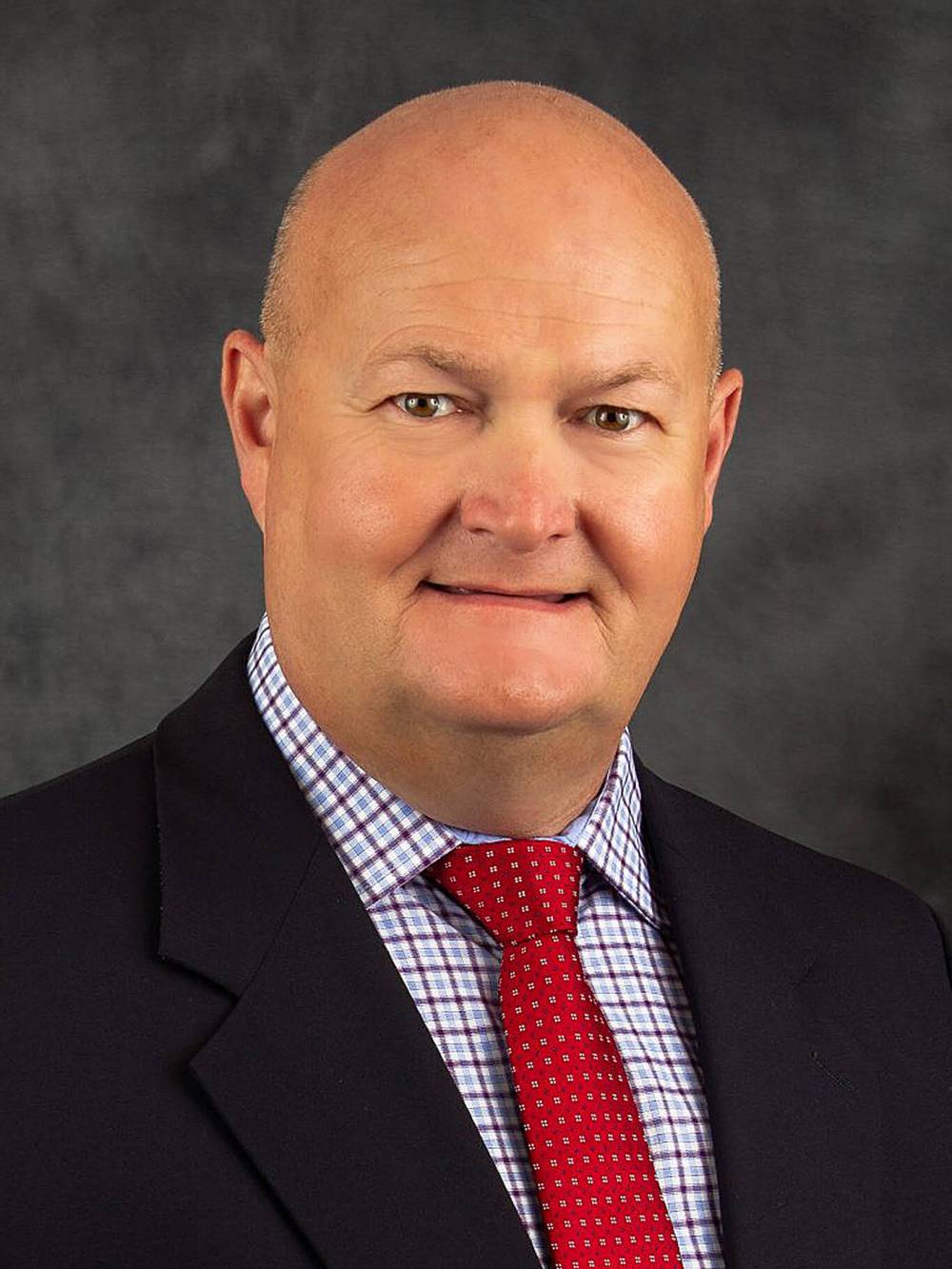
Scott’s purview includes the entirety of MetroLink, a transit system composed of 74 kilometres of light rail and 59 bus routes that service 19.5 million riders a year in St. Louis and neighbouring metropolitan areas.
Bi-State, a third-party organization tasked with overseeing mass transit, hired him in 2019, shortly after a spate of violent incidents on the regional transit system. His experience in the years since has made him somewhat of an expert in the field.
His advice to other jursidictions dealing with similar issues is to start from the ground up — prioritize safety, define the roles of law enforcement and security agents and supplement human resources with technology and infrastructure that make them more efficient.
In 2020, Bi-State sought to strike a balance between law enforcement and private security officers who would share the burden of ensuring rider safety. The process involved deploying more than 200 police, private security agents and other staff.
The efforts, coupled with an advanced closed-circuit surveillance system and other infrastructure investments, have stabilized crime rates in recent years.
Although there is still work to be done, the service has remained at an incident rate of roughly 13 events per 100,000 riders over the past two years, despite an increase in annual ridership of two million, Scott said.
Related Articles
Bus? Pass!








Back in Winnipeg, Chrismas is preparing to implement a similar approach.
“We’re not emulating anyone, but I’ve had some people checking all across the country for lessons learned and everywhere is taking a slightly different approach,” he said, speaking from inside his office at Winnipeg City Hall.
“This is a big beast, but if we are targeted, we should be able to show how this can work. I feel pretty confident that we can turn this ship.”
MIKAELA MACKENZIE / WINNIPEG FREE PRESS Robert Chrismas, leader of the incoming transit security force, is confident ‘we can turn this ship’ on transit safety.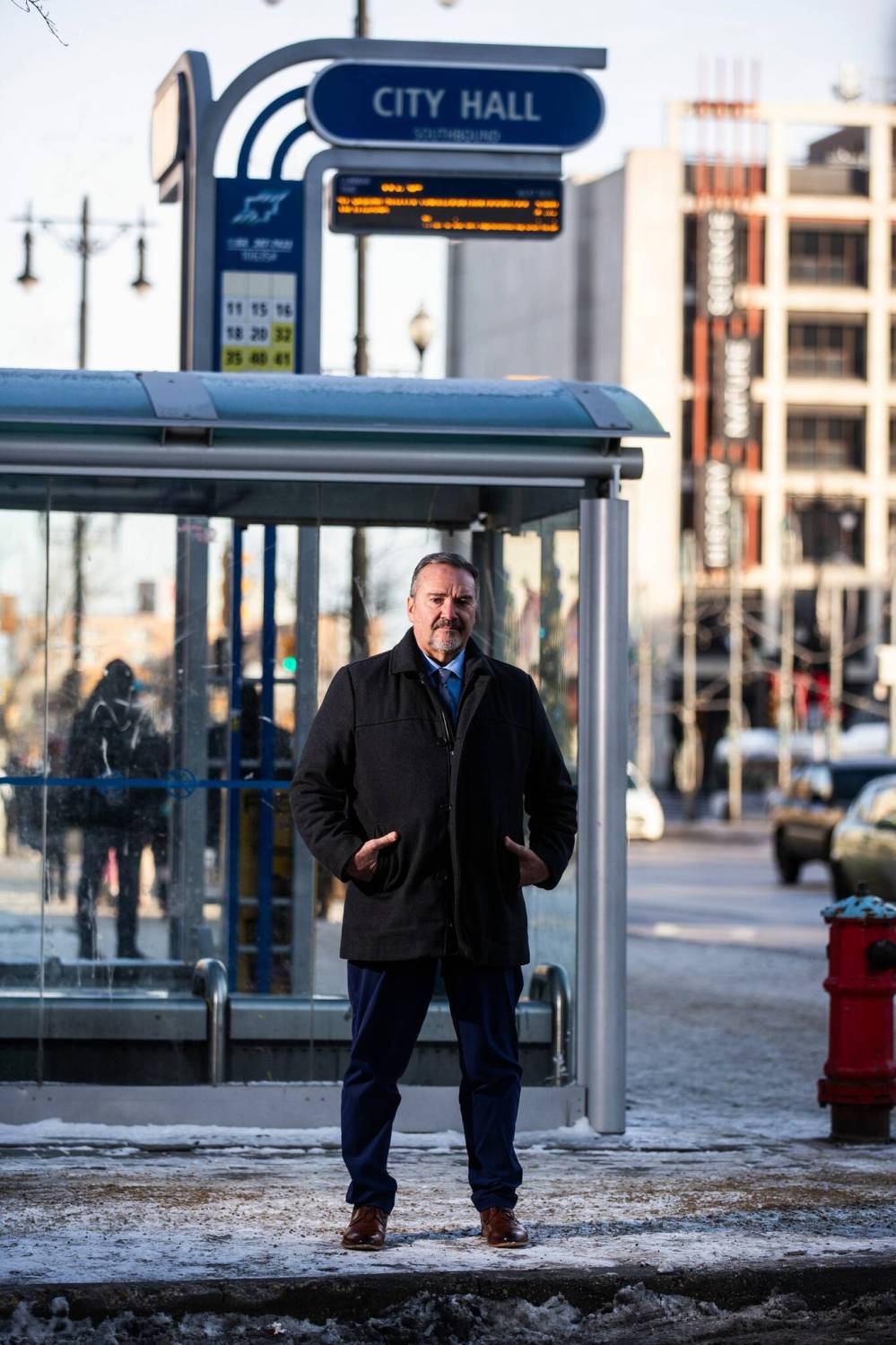
As the head of the city’s new “community safety team,” Chrismas is mandated to reduce the rate of violence on Winnipeg Transit, which has steadily increased in recent years.
His first task involves hiring, training and deploying a team of 21 new security officers and two supervisors — the unit will work with police, social organizations and the Downtown Community Safety Partnership.
The unit will patrol Winnipeg Transit buses and stops to deter crime and connect people who are homeless, mentally ill or addicted to substances with social resources.
The sworn peace officers will be outfitted with highly visible yellow and black uniforms, protective equipment and have the ability to detain unruly passengers through force.
Such officers exist in other Canadian transit jurisdictions, including Vancouver, Toronto, Edmonton and Calgary, where they work with various levels of law enforcement and other security agents.
“In Winnipeg, we’re taking a social justice, human rights approach and trying to be collaborative. It’s more oriented around social work,” Chrismas said. “If they come across an assault in progress, they will detain, and then work with the local police and paramedics.”
“In Winnipeg, we’re taking a social justice, human rights approach and trying to be collaborative. It’s more oriented around social work.”–Robert Chrismas
Working in Chrismas’ favour is government support and rebounding annual transit ridership that has rebounded to 94 per cent of pre-COVID-19 pandemic levels.
City officials have committed $5 million in funding for the first year of the project, and the province will pay to train the unit through an agreement with Assiniboine Community College.
Working against Chrismas is a prevailing feeling of public insecurity and a demand to have the program display immediate results.
A recent Probe Research poll, commissioned by the Free Press, found Winnipeg residents overwhelmingly consider safety and security a primary concern on Winnipeg Transit buses.
Out of 600 respondents who completed an online survey between Nov. 22 and Dec. 1, 59 per cent said an improved sense of safety would make them more, or slightly more, likely to utilize the service. This sentiment was most widely held by older and less regular transit users, while more regular transit riders were more likely to prioritize better connections between routes.
Even respondents who never use transit outlined a clear preference toward safety and security, with 34 per cent identifying such improvements as a potential way of encouraging them to use the service.
The Winnipeg Police Service has logged a total of 236 transit-related violent events from Jan. 1 to Dec. 18 this year. The numbers account for all incidents involving passengers and drivers on board transit vehicles, at transit stops or in shelters. It represents a 113 per cent increase over the five-year average.
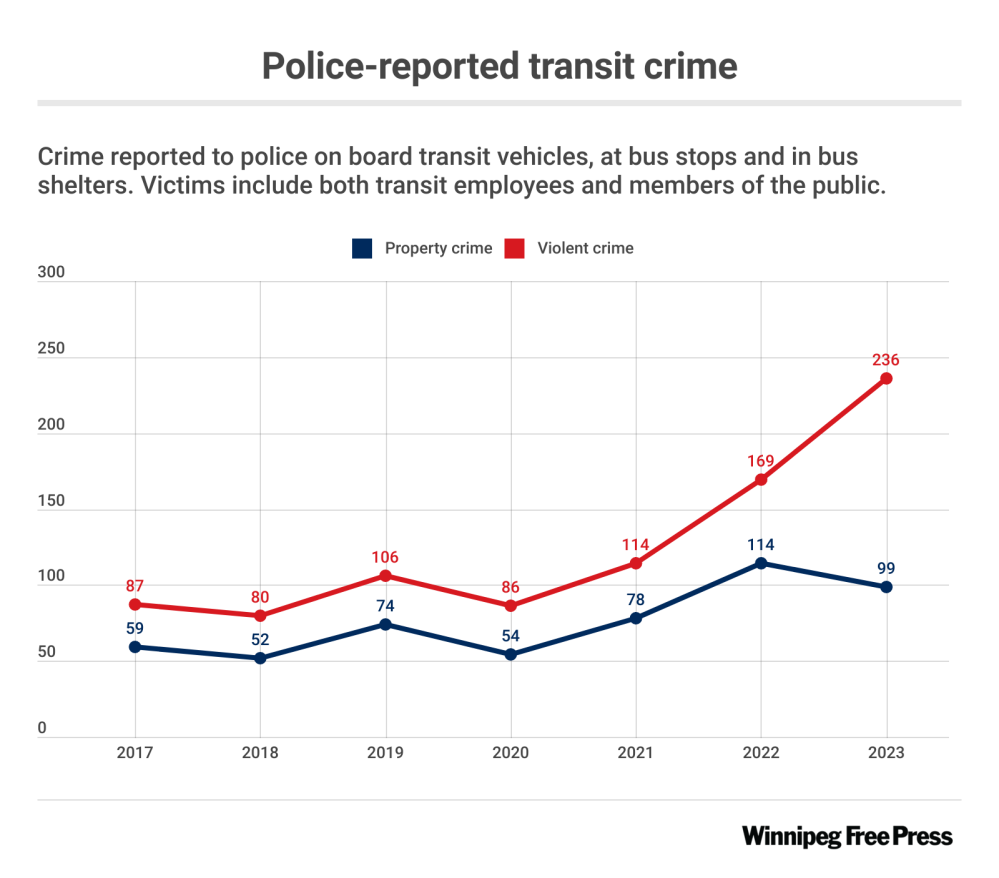
The WPS says transit-related property crime was down over the same time period compared to the previous year, but still up 33 per cent over the five-year average.
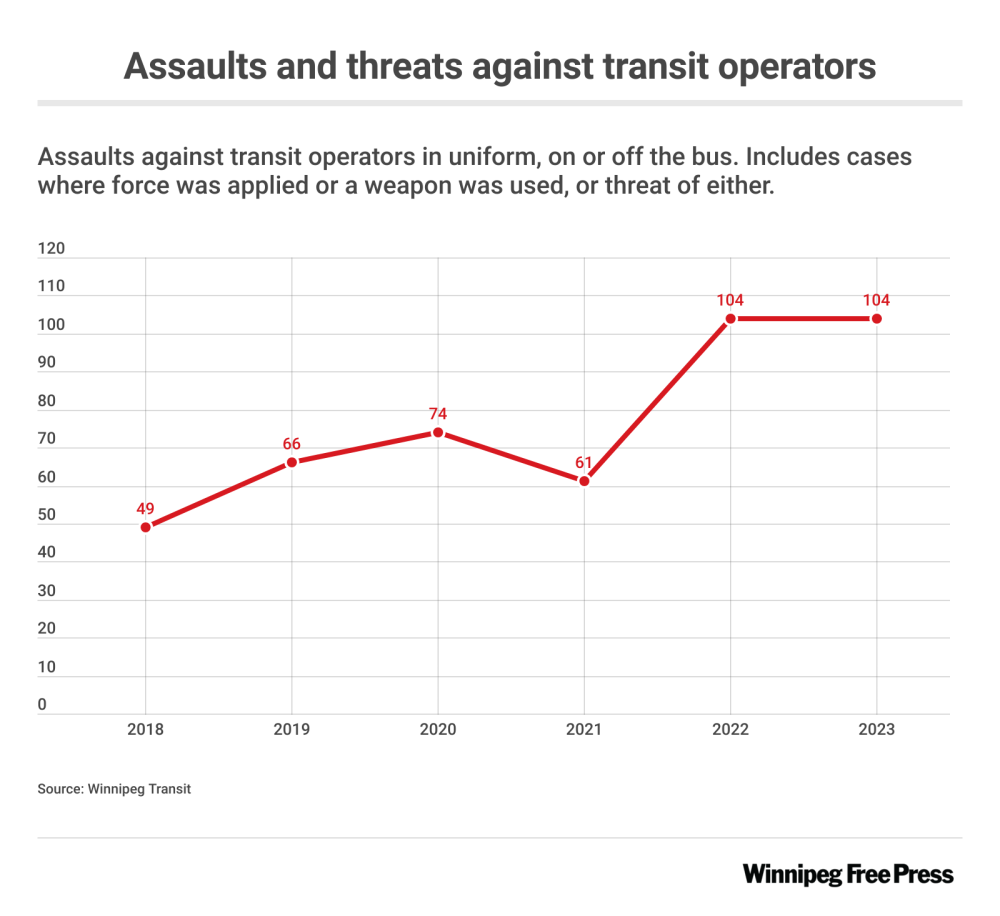
According to Winnipeg Transit, 104 uniformed staff or operators have been threatened or attacked this year to date — a 45 per cent increase over the five-year average.
“It’s disturbing that it seems to be a free reign on the Transit system to do whatever you want with impunity. That’s not the way we want the Transit system to operate and you can’t draw paying customers to a transit service that is perceived that way,” said Chris Scott, president of Amalgamated Transit Union Local 1505.
Scott said his members are cautiously optimistic about the incoming security force, but more needs to be done to assuage their concerns.
He would like to see a crackdown on fare enforcement (something that was a key component to the St. Louis approach) and stricter penalties for offenders, both from the justice system and the Transit service.
In St. Louis, people who commit violence or vandalism, use drugs, fail to pay fares or commit other offenses on transit can be suspended or permanently banned from the service.
While Winnipeg Transit retains similar authority within its code of conduct policy, Scott said there is little drivers can do to enforce such rules. He hopes that responsibility will fall under the purview of transit security.
“They get away with a small thing like not paying a fare when everyone else on the bus has to, then they may move up to harassing a passenger and if they don’t get kicked off, they may escalate to imposing their will on another passenger or a driver,” he said.
“My members would love to see a public message saying, ‘If you assault one of my employees, don’t ever expect to ride the bus again.’ That’s what my members are telling me.”
Finally, Scott says all levels of government must commit to funding resources for the underlying issues contributing to the violence, including supports for mental health, addictions and housing.
People will not be permitted to be unruly or excessively intoxicated while riding public transit, but such riders will not be immediately met with punitive measures from safety officers, he said.
“If people are high, getting on the buses and not paying, that will be an issue we will look at,” Scott said. “But it’s not going to be strictly an enforcement team; we really want to look at the social issues.”
JOHN WOODS / WINNIPEG FREE PRESS The Winnipeg Police Service has logged a total of 236 transit-related violent events from Jan. 1 to Dec. 18 this year.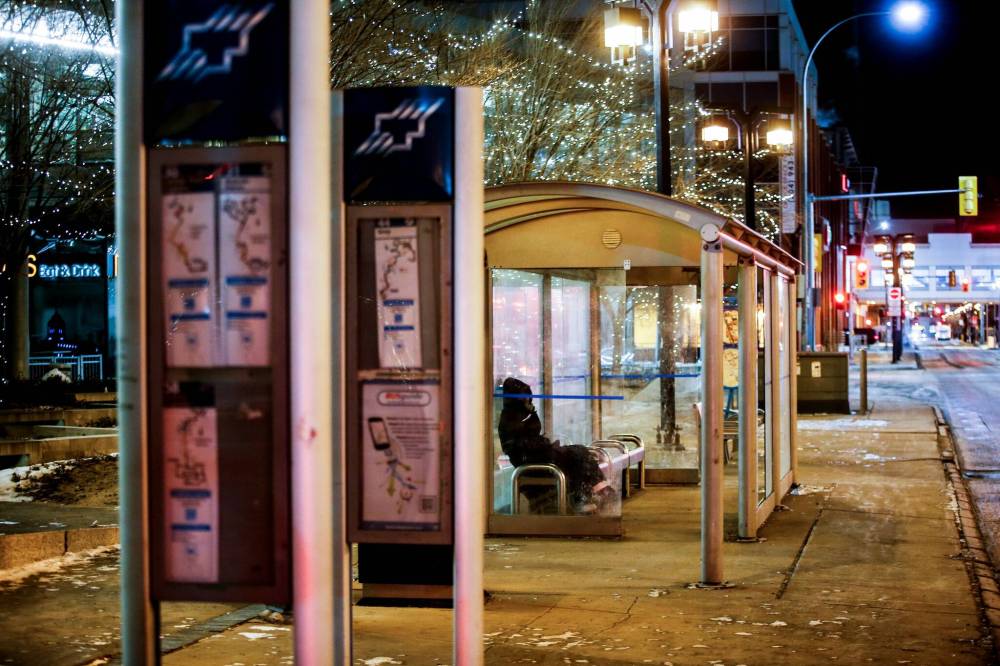
Around the one-year anniversary of the program, Chrismas plans to host focus groups with Transit drivers, community partner agencies and the public to see how the program is being received.
He hopes to measure success by an increase in ridership and the number of people connected to resources and a reduction of incidents.
There will also be other data-based metrics, including hours worked, calls for service, and dollars saved by diverting the need for other police and emergency services, he said.
“I’ve pulled in a lot of resources and great minds on this and we are looking at bench-marking and what the key performance indicators can be. A big one for me is just when people report that they are feeling safer and that it has made a difference.”
Training for the community safety team begins Jan. 15.
tyler.searle@freepress.mb.ca

Tyler Searle is a multimedia producer who writes for the Free Press’s city desk. A graduate of Red River College Polytechnic’s creative communications program, he wrote for the Stonewall Teulon Tribune, Selkirk Record and Express Weekly News before joining the paper in 2022. Read more about Tyler.
Every piece of reporting Tyler produces is reviewed by an editing team before it is posted online or published in print — part of the Free Press‘s tradition, since 1872, of producing reliable independent journalism. Read more about Free Press’s history and mandate, and learn how our newsroom operates.
Our newsroom depends on a growing audience of readers to power our journalism. If you are not a paid reader, please consider becoming a subscriber.
Our newsroom depends on its audience of readers to power our journalism. Thank you for your support.