Worn down but unafraid
Canadian Jews caught off guard by aftermath of barbarity unleashed by Hamas
Advertisement
Read this article for free:
or
Already have an account? Log in here »
To continue reading, please subscribe:

Digital Subscription
One year of digital access for only $205*
- Enjoy unlimited reading on winnipegfreepress.com
- Read the E-Edition, our digital replica newspaper
- Access News Break, our award-winning app
- Play interactive puzzles
*First annual payment billed as $205.00 + GST for one year. This annual subscription will automatically renew at $233.00 + GST every 52 weeks (10% off the regular annual price of $259.35). Offer available to new and qualified returning subscribers only. Cancel any time.
To continue reading, please subscribe:
Add Free Press access to your Brandon Sun subscription for only an additional
$1 for the first 4 weeks*
- Enjoy unlimited reading on winnipegfreepress.com
- Read the E-Edition, our digital replica newspaper
- Access News Break, our award-winning app
- Play interactive puzzles
*Your next Brandon Sun subscription payment will increase by $1.00 and you will be charged $17.95 plus GST for four weeks. After four weeks, your payment will increase to $24.95 plus GST every four weeks.
Read unlimited articles for free today:
or
Already have an account? Log in here »
Hey there, time traveller!
This article was published 09/03/2024 (924 days ago), so information in it may no longer be current.
There’s the old saw about the famous Jewish violinist who was asked why he chose the violin over, say, the piano. “If you’re in a rush,” he responded dryly, “which one is easier to take with you?”
That, in essence, sums up Jewish readiness. Baked into the Jewish DNA over millennia is a cat-like reflex to be prepared for just about anything. In the post Oct. 7 world, in which Israel was terrorized and attacks on Jews worldwide followed surely as night follows day, that instinct has manifested in checking over one’s shoulder while walking to or from synagogue, thinking twice about choices in garb or displaying religious symbols, weathering mobs that shut down traffic and terrorize synagogue-goers, or seeing Jewish-owned businesses vandalized or destroyed. Packing that violin didn’t seem so far-fetched.
If history has taught Jews anything, it’s to be ready; given that history, you can hardly blame them. And if the last 70 years have imparted, Jews must especially be steeled whenever Israel is the focus of the world’s judgment.
While no other foreign conflict routinely triggers domestic backlash that is so fierce and so predictable, I can say with confidence that despite their penchant for readiness, Canadian Jews were caught off guard by the aftermath of the Oct. 7 barbarity unleashed by Hamas against Israel. Numbers confirm what the Jewish public already knows.
Across the country, Jews faced threats, assaults, mischief and arson. In Toronto, police recorded 132 incidents targeting Jews in 2023 — more than any group — doubling the figure from 2022. Antisemitic incidents made up 37 per cent of all hate crimes reported last year.
But since the Oct. 7 attacks, attacks against Toronto Jews zoomed by a staggering 211 per cent over the same period a year earlier.
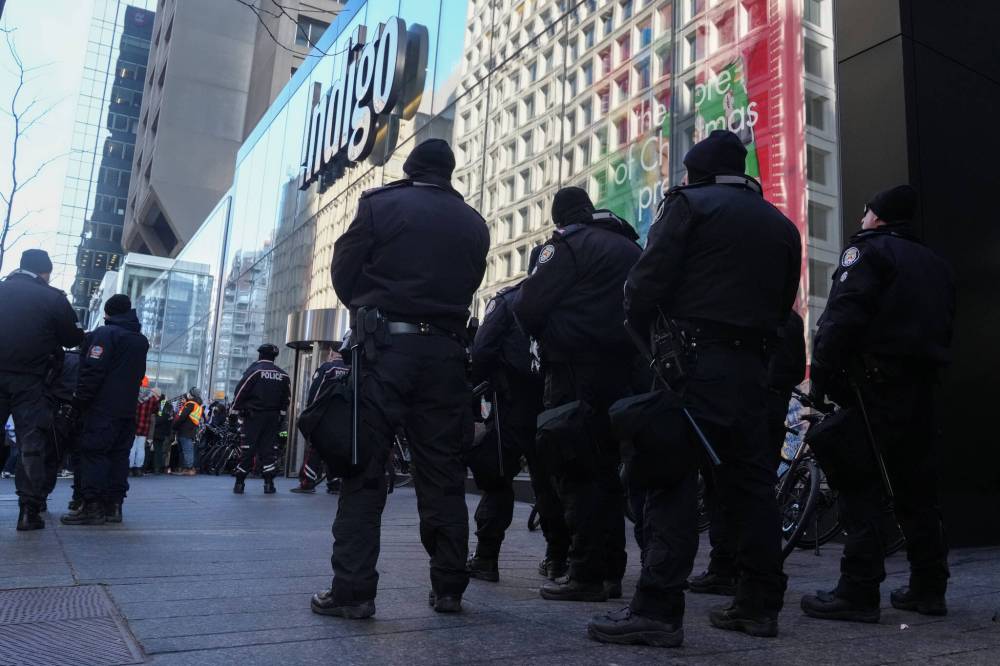
In one chilling episode, the windows of the Jewish-owned Indigo bookstore in Toronto were daubed with red paint and plastered with posters accusing company CEO Heather Reisman of “funding genocide.” This took place precisely on the 85th anniversary of Kristallnacht, when Nazi thugs smashed glass windows and destroyed businesses belonging to Jews across Germany. The so-called “Indigo 11” subsequently arrested for the incident could have picked a different night. I’m guessing they knew what they were doing.
Pro-Palestinian mobs in Toronto have also targeted Mount Sinai Hospital (located amid several hospitals with non-Jewish sounding names), and have blocked access to at least one synagogue. A Jewish-owned food business was firebombed.
All this crosses the line between legitimate protest and antisemitism. Police can do little, save for making the odd arrest.
In October alone, Winnipeg police investigated several vandalism incidents as hate motivated, including a shooting into a home in River Heights.
In Vancouver, 33 of the 47 incidents targeting the Jewish community occurred after the Oct. 7 attacks, according to the Centre for Israel and Jewish Affairs. Nine people have been charged with criminal offences.
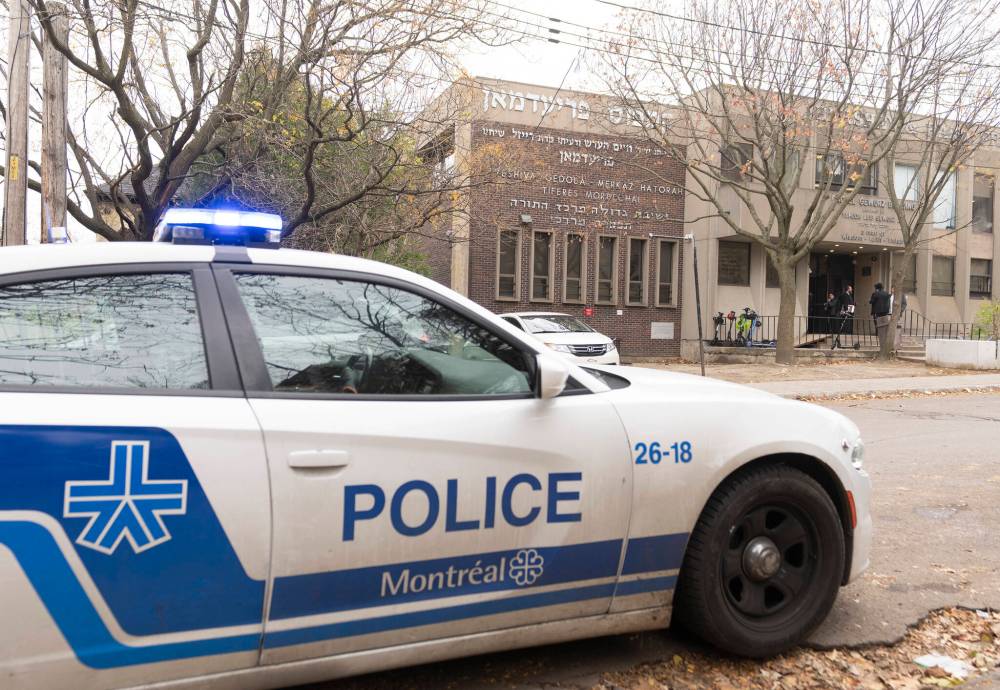
In Montreal since Oct. 7, the Jewish community has been subjected to 125 hate crimes or incidents as of mid-December. Jewish schools were sprayed with bullets three times, and Molotov cocktails were thrown at a synagogue and two other communal facilities. As recently as March 4, an anti-Israel blockade took place at, of all places, the Montreal Holocaust Museum. It was roundly condemned by Quebec politicians as a pro-Hamas hate mob.
I’ve had a front-row seat in the Jewish community for many years as a reporter (now retired) for the weekly Canadian Jewish News and as Canada correspondent for the New York-based Jewish Telegraphic Agency, a newswire service. I can say with no exaggeration that since Oct. 7, I have not witnessed this much jarring antisemitism, fear for personal safety, sense of isolation, outright grief, testing of relationships with friends and colleagues and even concern for the very future of Israel. A Jewish psychologist likened the situation to “having the rug pulled out from under us.”
In the raw days following Oct. 7, Jews talked openly and on social media of removing mezuzahs — small scrolls of parchment inscribed with Hebrew prayers — from their doorposts. Many feared wearing Star of David jewelry and yarmulkes. Parents kept their kids home from Jewish schools. Jewish university students faced a barrage of hostility. People avoided synagogue and prayed at home.
There’s been open talk of defying the law and carrying concealed weapons, even guns.
Friends of Simon Wiesenthal Centre, a Toronto-based Jewish advocacy group, at one point in the aftermath of Oct. 7 recorded 500 calls and emails a day about safety concerns.
Sensitivities and fears, while understandable, have sometimes gone overboard. For example, among the laments I’ve heard over the past few months is, “now I know what it felt like for German Jews in the 1930s.”
With respect, no you don’t.
Beginning with Adolf Hitler’s rise to power in January 1933, German Jews were subjected to a barrage of restrictive laws that severely curtailed, if not outlawed, their participation in the civil service, schools and universities, the medical and legal professions, journalism and the arts. Naturalized Jews (and other “undesirables”) had their citizenship revoked. All that and more happened in the first year of Nazi power.
Until the outbreak of the Second World War in 1939, German Jews felt the brunt of more than 400 decrees, laws and regulations that choked virtually every aspect of their lives. The government did that.
We’re not there. And I say that as someone whose parents were both Holocaust survivors. So were both my wife’s parents. Anyone with a connection to the Holocaust is entitled to heightened sensitivities, among them, knowing that mass murder in the modern age has always begun with words and slogans, propaganda and misinformation, followed by open street violence. It did in Germany, Cambodia, Rwanda, Myanmar, Yugoslavia, and Sudan — much of it in our lifetimes.
Another assertion that should be abandoned is the belief that Hamas could end this war if only it laid down its arms. If there’s one thing we can believe about Hamas it’s that it will never stop trying to rid Israel of Jews. Ever. They have said as much on several occasions. It’s in their founding charter.
Throughout all this, I can say that while I’ve been terribly despondent over the fate of the remaining hostages kidnapped by Hamas from Israel and worried about the war’s endgame, if there is one, I have not been afraid personally, neither for myself nor my family. My antennae are up, for certain, and I’m especially on guard when I volunteer at the Toronto’s recently-opened Holocaust Museum. I’m happy to go through security checkpoints and glad to see guards patrolling the facility.
I take solace in stepped-up police patrols and in two large, imposing police command posts in my neighbourhood in Toronto. It took too long, but pro-Palestinian protests on an overpass along Highway 401 — a few blocks from my house — were finally banned. Of course, Palestinians are free to protest peaceably. But of all the overpasses and bridges along the busy 401, the question remains: Why pick one in a Jewish area?

I have found some consolation in my own faith, and in others: Toronto Rabbi Yael Splansky tells us that the phrase “do not fear” is repeated so often in the Hebrew Bible that some scholars “take it to be a common expression of reassurance.” There’s also the Buddhist concept of impermanence — that, like everything else, this too shall pass (though I wonder how Buddhists cope while things really suck), and Pope John Paul’s oft-repeated exhortation to Catholics: “Be not afraid.”
I am tired. I’m upset. I rail against politicians, weak-kneed universities and global organizations, à la Grandpa Simpson. My teeth are set on edge by words like “genocide” and “settler colonialism.” I’m still in shock at the stomach-churning savagery of the Hamas attacks. I’m angry at protesters who cannot or will not distinguish between support for the Palestinian people and Hamas.
I am wary and weary and worn down. I see no end in sight. But I am not afraid. And I don’t own a violin.
— Originally published in the Anglican Planet
Ron Csillag is a Toronto writer.
The Free Press is committed to covering faith in Manitoba through our Religion in the News project. This reporting continues because readers like you step forward to fund it.
Donate now to support our reporting on religion.
Your donation is eligible for a charitable tax receipt.
BECOME A FAITH JOURNALISM SUPPORTER
The Free Press acknowledges the financial support it receives from members of the city’s faith community, which makes our coverage of religion possible.