Government chatbots? It’s one possibility under Ottawa’s new AI strategy

Advertisement

Advertise with us

OTTAWA - Delayed air passengers, disgruntled phone customers and even hungry people craving a slice of pizza increasingly find their pleas to private companies being answered by artificial intelligence.

Read this article for free:


or

Already have an account? Log in here »

To continue reading, please subscribe:

Subscribe and receive a limited-edition Free Press branded hat or tote.

Digital Subscription

One year of digital access for only $205*

  • Enjoy unlimited reading on winnipegfreepress.com
  • Read the E-Edition, our digital replica newspaper
  • Access News Break, our award-winning app
  • Play interactive puzzles

*First annual payment billed as $205.00 + GST for one year. This annual subscription will automatically renew at $233.00 + GST every 52 weeks (10% off the regular annual price of $259.35). Offer available to new and qualified returning subscribers only. Cancel any time.

To continue reading, please subscribe:

Add Free Press access to your Brandon Sun subscription for only an additional

$1 for the first 4 weeks*

  • Enjoy unlimited reading on winnipegfreepress.com
  • Read the E-Edition, our digital replica newspaper
  • Access News Break, our award-winning app
  • Play interactive puzzles
Start now

*Your next Brandon Sun subscription payment will increase by $1.00 and you will be charged $17.95 plus GST for four weeks. After four weeks, your payment will increase to $24.95 plus GST every four weeks.

Hey there, time traveller!
This article was published 27/07/2024 (748 days ago), so information in it may no longer be current.

OTTAWA – Delayed air passengers, disgruntled phone customers and even hungry people craving a slice of pizza increasingly find their pleas to private companies being answered by artificial intelligence.

Soon Canadians who need to reach out to the federal government could also find themselves talking to an employee who’s been helped by non-human assistants.

Ottawa is working on a strategy to use more AI in the federal public service, and while it’s too soon to say exactly what that could look like, chatbots are one likely possibility.

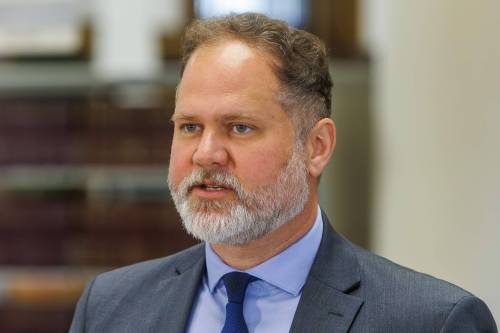
Stephen Burt, the government’s chief data officer, said private-sector call centres are using generative AI chatbots to navigate internal data and help employees find better answers faster when customers call in.

“I can imagine a number of similar applications in the Canadian government context for services we offer to clients, from EI and Old Age Security through to immigration processes,” he said in an interview.

Civil servants could also use AI to sort through massive piles of government data, he said. In the Treasury Board of Canada alone, employees are responsible for government finances, hiring and technology used by the public service.

“There’s a lot of documents with a lot of words on a lot of pages of paper. It’s difficult even for folks inside government to understand in any given situation what is most applicable,” he said.

The federal government will be crafting the AI strategy over the coming months, with the goal of launching it next March. The plan is to encourage departments to experiment openly, so that “they can see what’s working and what’s not.”

“We can’t do everything at once and it’s not clear to me yet what are going to be the (best-use) cases,” Burt said.

When it comes to what won’t be allowed, he said it’s too soon to talk about red lines, though there are “absolutely going to be areas where we need to be more careful.”

Generative AI applications can produce text and images based on vast amounts of data fed into them.

The federal public service has already started tinkering with AI. Joanna Redden, an associate professor at Western University, compiled a database documenting hundreds of government uses of AI in Canada.

It contains a wide range of uses, from predicting the outcome of tax cases and sorting through temporary visa applications to tracking invasive plants and detecting whales from overhead images.

In the European Union, AI legislation bans certain uses, she said, including untargeted scraping of images for facial recognition, the use of emotion recognition systems in workplaces and schools, social scoring, and some types of predictive policing.

At an introductory event for the strategy in May, Treasury Board President Anita Anand said generative AI “isn’t generally going to be used” when it comes to confidential matters, like information available only to cabinet ministers behind closed doors.

According to University of Ottawa law professor Teresa Scassa, the privacy legislation covering government activities needs to be brought up to date.

The federal Privacy Act “really hasn’t been adapted to an information society, or let alone the AI context,” she said.

There could also be issues around use of generative AI and the risk that it could ingest personal or confidential information.

“Somebody might just decide to start answering emails using gen AI, and how do you deal with that? And what kind of information is going into the system and who’s checking it?”

Scassa also questioned whether there would be any recourse if a government chatbot gives someone wrong information.

As Canada’s largest employer, the federal government should be looking into incorporating artificial intelligence, said Concordia University associate professor Fenwick McKelvey.

McKelvey suggested the government could use chatbots to “help users understand and navigate their complex offerings,” as well as to make sure government documents are accessible and more legible.

One example would be filling out complicated tax forms.

Redden had to piece together her database of government AI through news reports, documents tabled in Parliament and access-to-information requests.

Redden has argued that the government should be keeping better track of its own uses of AI and be transparent about its use, but Ottawa appears unlikely to change its approach under the new AI strategy.

This report by The Canadian Press was first published July 27, 2024.

Report Error Submit a Tip

More Stories

Signs the Carney approach is working

Editorial 4 minute read Preview

Signs the Carney approach is working

Editorial 4 minute read Wednesday, Aug. 12, 2026

It was, if nothing else, a glowing review in trying times.

Matt Winkler, the editor in chief emeritus of Bloomberg News, spoke last week on Bloomberg Business News Daily about a recent Bloomberg analysis of the performance of the Canadian economy, and this country as a target for investment

“This is one of the greatest periods for overseas investment in Canada that we’ve seen in the century, and it may be unprecedented, because we have to wait for the rest of the year. … Money is pouring into Canada like we have not seen from everywhere. Stocks and bonds are the obvious beneficiaries,” Winkler said. He argued that Canada is both liked and seen as reasonable.

“The point is… Canada since Mark Carney became prime minister in 2025, has outperformed everyone in America and also the Eurozone and anywhere in the world. The 10 largest stock markets in the world, Canada appreciated the most, more than 40 per cent. … Its bond market is also doing great, partially because the inflation rate in Canada, unlike the Eurozone or America, is actually trending lower, and is outperforming both the Eurozone and the U.S.”

Read
Wednesday, Aug. 12, 2026

Opaskwayak restorative justice court to give offenders opportunity to ‘heal’

Erik Pindera 5 minute read Preview

Opaskwayak restorative justice court to give offenders opportunity to ‘heal’

Erik Pindera 5 minute read Yesterday at 6:00 AM CDT

The Manitoba government, provincial court and Opaskwayak Cree Nation are signing a memorandum of understanding today to establish a community-led court focused on Indigenous restorative justice principles.

Justice Minister Matt Wiebe is in the northern First Nation, which neighbours The Pas, to attend this week’s Opaskwayak Indigenous Days summer festival, ahead of the signing of the nation-to-nation agreement after a pipe ceremony today.

“This is really a pivotal marker on the path to reconciliation for our justice system and an incredible opportunity to begin the process of reconciling the two systems of justice, that being the traditional Indigenous justice system with our colonial system,” Wiebe told the Free Press on Wednesday.

“I’m just excited to be here to have the opportunity to formally mark the collaboration, but really to listen and to hear from community about the best ways, the best path forward.”

Read
Yesterday at 6:00 AM CDT

Presumption of innocence important when politicians criminally charged, but so is public confidence

Tom Brodbeck 5 minute read Preview

Presumption of innocence important when politicians criminally charged, but so is public confidence

Tom Brodbeck 5 minute read 12:56 PM CDT

It’s probably time to stop pretending that elected politicians can simply carry on as usual after being charged with a serious criminal offence.

The case of Transcona Coun. Russ Wyatt has brought an uncomfortable question back to Winnipeg City Hall: what should happen when an elected official is accused of a serious crime but refuses to step away from public office?

Wyatt arrived at city hall Thursday and said he would “absolutely” continue doing his job after being charged this week with sexual assault and administering a noxious substance. Those are serious allegations.

They are also only allegations, and Wyatt is entitled to the presumption of innocence. His lawyer has said he is innocent.

Read
12:56 PM CDT

Icy relationship with U.S. beginning to thaw at border, data shows; American visits to Manitoba hit five-year high

Nicole Buffie 5 minute read Preview

Icy relationship with U.S. beginning to thaw at border, data shows; American visits to Manitoba hit five-year high

Nicole Buffie 5 minute read Yesterday at 5:32 PM CDT

As Canadians begin to lower their elbows and start to cross the U.S. border again, Americans are coming to Manitoba in numbers not seen in years.

Read
Yesterday at 5:32 PM CDT

It’s one thing to climb aboard rail-relocation train, quite another to pay for the ride

Dan Lett 5 minute read Preview

It’s one thing to climb aboard rail-relocation train, quite another to pay for the ride

Dan Lett 5 minute read Wednesday, Aug. 12, 2026

Anyone who wants a brighter, safer, healthier future for the city of Winnipeg should really want the renewed hopes of rail relocation to finally become reality. And the sooner, the better.

Premier Wab Kinew announced Wednesday the province was going to forge a plan to relocate the Canadian Pacific Kansas City central yards and many of other the lines that run through Winnipeg to a bypass that runs around the city.

This “plan to design a plan” strategy was devised by a task force headed up by former federal MP and cabinet minister Lloyd Axworthy, who in 2024 was given a two-year mandate to find the best way to rid the city of some or all of its rail infrastructure.

For the record, Kinew and Axworthy said a relocation would likely take 20 years to complete, which makes this week’s announcement an important statement of intent, but little more. The sobering reality is that this promising idea has been proposed by political leaders, and then abandoned, for decades.

Read
Wednesday, Aug. 12, 2026

Men’s recovery home dedicated to ‘homeless hero’ Faron Hall’s memory

Scott Billeck 14 minute read Preview

Men’s recovery home dedicated to ‘homeless hero’ Faron Hall’s memory

Scott Billeck 14 minute read 12:30 PM CDT

Faron Hall never got the chance to begin recovery. Once heralded as Winnipeg’s “homeless hero” after twice plunging into the Red River to save strangers from drowning, Hall told St. Boniface Street Links executive director Marion Willis shortly before his death in 2014 that he wanted help for his alcoholism.

Read
12:30 PM CDT