Ontario’s opioid strategy outdated, auditor general says

Advertisement

Advertise with us

TORONTO - Ontario's opioid strategy, even with its new abstinence-based model for treatment, is outdated and does not serve the current needs of the people, the auditor general found in her annual report released Tuesday.

Read this article for free:


or

Already have an account? Log in here »

To continue reading, please subscribe:

Subscribe and receive a limited-edition Free Press branded hat or tote.

Digital Subscription

One year of digital access for only $205*

  • Enjoy unlimited reading on winnipegfreepress.com
  • Read the E-Edition, our digital replica newspaper
  • Access News Break, our award-winning app
  • Play interactive puzzles

*First annual payment billed as $205.00 + GST for one year. This annual subscription will automatically renew at $233.00 + GST every 52 weeks (10% off the regular annual price of $259.35). Offer available to new and qualified returning subscribers only. Cancel any time.

To continue reading, please subscribe:

Add Free Press access to your Brandon Sun subscription for only an additional

$1 for the first 4 weeks*

  • Enjoy unlimited reading on winnipegfreepress.com
  • Read the E-Edition, our digital replica newspaper
  • Access News Break, our award-winning app
  • Play interactive puzzles
Start now

*Your next Brandon Sun subscription payment will increase by $1.00 and you will be charged $17.95 plus GST for four weeks. After four weeks, your payment will increase to $24.95 plus GST every four weeks.

Hey there, time traveller!
This article was published 03/12/2024 (655 days ago), so information in it may no longer be current.

TORONTO – Ontario’s opioid strategy, even with its new abstinence-based model for treatment, is outdated and does not serve the current needs of the people, the auditor general found in her annual report released Tuesday.

Shelley Spence said the province needs to develop a new comprehensive strategy to deal with the opioid crisis as the current one has not been updated since 2016.

More than 2,600 Ontarians died last year due to overdoses, the vast majority due to opioid toxicity.

Ontario's auditor general says the province's opioid strategy with its new abstinence-based model for treatment is outdated and does not serve the current needs of the people. A Naloxone anti-overdose kit is held in downtown Vancouver, Friday, Feb. 10, 2017. THE CANADIAN PRESS/Jonathan Hayward

“We concluded that the ministry does not have effective processes in place to meet the challenging and changing nature of the opioid crisis in Ontario,” Spence wrote.

Premier Doug Ford’s Progressive Conservative government has taken a hard line on drug-consumption sites, passing legislation that prohibits and closes any sites within 200 metres of a school or daycare, and effectively stops any new sites from opening.

The government fast-tracked that legislation with reduced debate time and skipped the committee stage entirely.

In their place, the government is launching 19 new “homelessness and addiction recovery treatment hubs,” plus 375 highly supportive housing units at a planned cost of $378 million.

Spence applauded that move.

“Investing more in treatment, recovery and housing is a positive development toward addressing the opioid crisis,” she said at a news conference.

But Spence said the province has not planned properly for the transition to the new hubs.

Her team reviewed internal ministry documents that warned of increasing overdoses and deaths and increased public drug use.

“They identified it as a risk, but they haven’t identified their mitigation processes around that risk,” Spence said.

Health workers, advocates and users of the sites have warned of a spike in deaths when the sites close by March 31, 2025.

The province is set to close 10 supervised consumption sites because they are too close to schools and daycares. More than 1,600 overdoses were reversed at those sites in 2022-23, the auditor general found.

Not a single person died of an overdose at those spots during the same time frame, Spence said.

Health Minister Sylvia Jones said in August when announcing the new hub model that no one would die as a result of the transition.

The ministry did not provide a thorough, evidence-based business case for the hub model and did not provide proper impact analysis or do proper consultations with all affected people, Spence found.

“The ministry has not developed plans to mitigate the risks prior to making the decision, which include the number of impacted individuals, the increased overdoses and risk of death and the financial and operational burden on emergency departments,” Spence said.
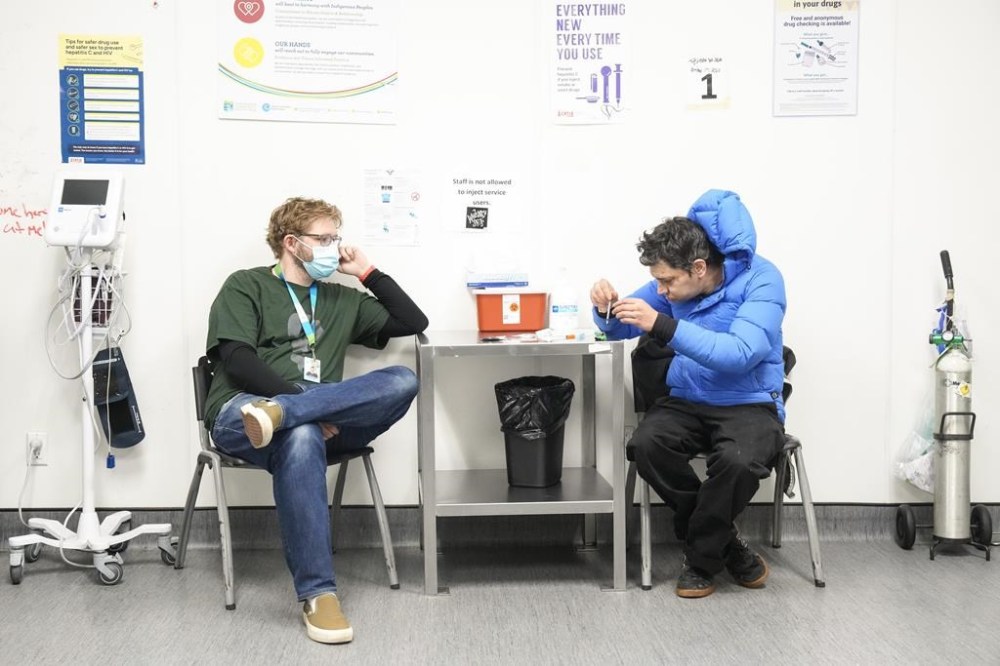
Community Health Worker Callan Pepper sits with a client in the consumption room at Moss Park Consumption and Treatment Service, in Toronto, Tuesday, Dec. 3, 2024. THE CANADIAN PRESS/Chris Young

The auditor general also found multiple branches of ministries are responsible for managing different parts of the opioid crisis with no one taking the lead.

“We found that accountability is lacking and remains unclear, with no specific party being designated as a lead to oversee and co-ordinate the work, no specific goals or targets being set for different parties to work toward and no ongoing monitoring or evaluation of performance and outcomes,” Spence wrote.

Only 10 of 24 performance indicators were tracked by the province. The remainder were either not tracked at all or monitored inconsistently, Spence found.

She also found a lack of data on the number and rate of hospitalizations for opioid overdoses and the percentage of people who are prescribed opioids and develop an addiction, among other oversights.

The ministry has accepted all seven of the auditor general’s recommendations, including the need to develop a new opioid strategy.

Jones did not answer several questions Tuesday about the lack of an opioid-specific strategy, missing mitigation plans or data tracking problems. But she defended her government’s approach to the ongoing opioid crisis.

“We are enabling and investing in a model that I believe will ultimately lead to people getting some hope and getting some pathways to treatment,” Jones said at a news conference.

New Democrat and Opposition leader Marit Stiles blasted Jones for her handling of the opioid crisis, especially the move away from harm reduction and supervised consumption sites.

“More people will die, lives will not be saved in the interim and they had no intention to,” Stiles said.

“They weren’t going to look at the data, they weren’t looking at the science, they weren’t looking at the experience and they certainly didn’t want to hear from any people about how this might impact them.”

This report by The Canadian Press was first published Dec. 3, 2024.

Report Error Submit a Tip

More Stories

Give-and-take relationship of Roman leaders takes centre stage in Harris’s historical fiction

Reviewed by Kathryne Cardwell 4 minute read Preview

Give-and-take relationship of Roman leaders takes centre stage in Harris’s historical fiction

Reviewed by Kathryne Cardwell 4 minute read 2:01 AM CDT

British novelist Robert Harris’s latest work is a reflection on tyranny, corruption and betrayal among all-powerful political leaders.

You might be forgiven for thinking it’s a contemporary thriller — it’s actually historical fiction set in ancient Rome.

A former BBC journalist, Harris debuted as a novelist in 1992 with Fatherland, an alternative history where Nazi Germany won the Second World War.

Since then, the prolific author has become best-known for his works of historical fiction, especially his ancient Rome trilogy released from 2006-2015 and the novel Conclave, which was published in 2016 and was made into the film of the same name in 2024.

Read
2:01 AM CDT

Hellebuyck standoff caused by… Nathan MacKinnon?

Mike McIntyre 6 minute read Preview

Hellebuyck standoff caused by… Nathan MacKinnon?

Mike McIntyre 6 minute read Yesterday at 6:34 PM CDT

Looking for someone to blame in the Connor Hellebuyck fiasco and cast as public enemy No. 1? How about long-time Winnipeg Jets nemesis Nathan MacKinnon?

Allow us to explain as we fire up the time machine and head back to February in Italy.

Oh, what could have been if MacKinnon had been able to score on what appeared to be an open net late in the third period of the men’s gold medal game with Hellebuyck down and seemingly out of position.

Instead, the star forward fired wide, keeping the score deadlocked at 1-1 as the clock ticked down on regulation.

Read
Yesterday at 6:34 PM CDT

A life’s story: activist, educator, organizer knew the true meaning of community

Janine LeGal 7 minute read Preview

A life’s story: activist, educator, organizer knew the true meaning of community

Janine LeGal 7 minute read 3:00 AM CDT

Somewhere between a love for sharing stories and a love of community connections, Michael (Mike) Maunder lived his life. Giving voice to people and neighbourhoods was a passion for the natural-born community organizer.

An author, teacher and principal, Maunder lived in a one-bedroom apartment in West Broadway and devoted himself to community development, education and neighbourhood renewal.

He maintained a connection with Augustine United Church, whose commitment to social justice he appreciated, volunteered at the Sandy-Saulteaux Spiritual Centre, and found comfort in a Buddhist prayer community.

Maunder died on July 15 at the age of 80.

Read
3:00 AM CDT

Gillingham in lead with decided voters

Nicole Buffie 6 minute read Preview

Gillingham in lead with decided voters

Nicole Buffie 6 minute read Yesterday at 6:55 PM CDT

A cloud of uncertainty is hanging over Winnipeg as October’s municipal election nears.

Three months after a poll showed more than 40 per cent of Winnipeggers wanted to see someone other than current mayor Scott Gillingham elected, a new Abacus Data poll indicates more than half of Winnipeg voters are undecided heading into next month’s civic election.

Of decided voters, 55 per cent favour Gillingham compared to 23 per cent for former councillor and provincial cabinet minister Kevin Klein and 11 per cent for funeral director Mike Vogiatzakis.

Of all respondents, just over 50 per cent said they were unsure while 13 per cent said they will not vote.

Read
Yesterday at 6:55 PM CDT

Cabernet Sauvignon star of wine festival

Ben Sigurdson 5 minute read Preview

Cabernet Sauvignon star of wine festival

Ben Sigurdson 5 minute read 3:00 AM CDT

The Winnipeg Wine Festival will celebrate the king of red wine grapes next weekend — the theme of this year’s festival, which takes place Sept. 25 and 26 at the RBC Convention Centre, is Cabernet Sauvignon.

Cab Sauv, as it’s also known, is the world’s most widely planted wine grape of any colour, first coming to prominence in the 1800s in France’s Bordeaux region, where the grape is still popular. Rather than single-variety wines, Bordeaux reds tend to be blends, with those coming from the left bank of the Gironde estuary being Cabernet-dominant, while right-bank wines are Merlot-dominant, with Cabernet Sauvignon playing a supporting role. Cabernet and Merlot work well together and many other countries have followed suit in blending the two.

A team at University of California Davis put Cabernet Sauvignon through a DNA test in 1996 and discovered its parent grapes are Cabernet Franc and Sauvignon Blanc — it’s likely that at some point the two varieties, planted next to each other in some vineyard, crossed and mutated and became the grape we know today. (Someone growing grapes in the 19th century must have had an inkling of what was up, as the grape has been called Cabernet Sauvignon since long before the DNA test.)

Flavour-wise, most Cabernet Sauvignon wines are big and bold, with a core of deep dark berry flavours, some graphite and spice notes and relatively bright acidity. It’s a grape that is well-suited to barrel aging, with most examples seeing at least some time in wood.

Read
3:00 AM CDT

Siloam Mission, WFPS discussing on-site paramedic to reduce staggering number of emergency calls

Scott Billeck 4 minute read Preview

Siloam Mission, WFPS discussing on-site paramedic to reduce staggering number of emergency calls

Scott Billeck 4 minute read Yesterday at 2:00 AM CDT

Winnipeg’s fire-paramedic service and its largest homeless-serving organization are discussing what it would look like to station at least one paramedic at Siloam Mission, as emergency calls to the downtown facility surge.

The ongoing discussions come as Winnipeg Fire Paramedic Service crews were dispatched 1,771 times during the first eight months of the year to the two adjacent Siloam properties at 303 Stanley St. and 300 Princess St.

WFPS said most of the calls were related to overdoses or other consequences of substance use, with the total nearly double the 854 calls recorded over the same period last year. By comparison, there were 831 calls during the same span in 2024, and 591 in 2023.

“The number of emergency calls isn’t sustainable for us as a service, but it’s certainly not sustainable for them as an agency trying to provide services,” WFPS chief Ryan Sneath told the Free Press. “And they recognize that they’re impacting emergency services, not them specifically, but the site in a significant way.”

Read
Yesterday at 2:00 AM CDT