What to know about bidding war between Netflix and Paramount for Warner Bros.

Advertisement

Advertise with us

NEW YORK (AP) — Warner Bros. is telling shareholders of the company that it believes a $72 billion buyout offer from Netflix is superior, and to reject a hostile takeover bid from Paramount Skydance.

Read this article for free:


or

Already have an account? Log in here »

To continue reading, please subscribe:

Subscribe and receive a limited-edition Free Press branded hat or tote.

Digital Subscription

One year of digital access for only $205*

  • Enjoy unlimited reading on winnipegfreepress.com
  • Read the E-Edition, our digital replica newspaper
  • Access News Break, our award-winning app
  • Play interactive puzzles

*First annual payment billed as $205.00 + GST for one year. This annual subscription will automatically renew at $233.00 + GST every 52 weeks (10% off the regular annual price of $259.35). Offer available to new and qualified returning subscribers only. Cancel any time.

To continue reading, please subscribe:

Add Free Press access to your Brandon Sun subscription for only an additional

$1 for the first 4 weeks*

  • Enjoy unlimited reading on winnipegfreepress.com
  • Read the E-Edition, our digital replica newspaper
  • Access News Break, our award-winning app
  • Play interactive puzzles
Start now

*Your next Brandon Sun subscription payment will increase by $1.00 and you will be charged $17.95 plus GST for four weeks. After four weeks, your payment will increase to $24.95 plus GST every four weeks.

Hey there, time traveller!
This article was published 17/12/2025 (276 days ago), so information in it may no longer be current.

NEW YORK (AP) — Warner Bros. is telling shareholders of the company that it believes a $72 billion buyout offer from Netflix is superior, and to reject a hostile takeover bid from Paramount Skydance.

Paramount went hostile with its bid last week, asking shareholders to reject the deal with Netflix favored by the board of Warner Bros.

Paramount is offering $30 per Warner share, or $77.9 billion, to Netflix’s $27.75 per share.
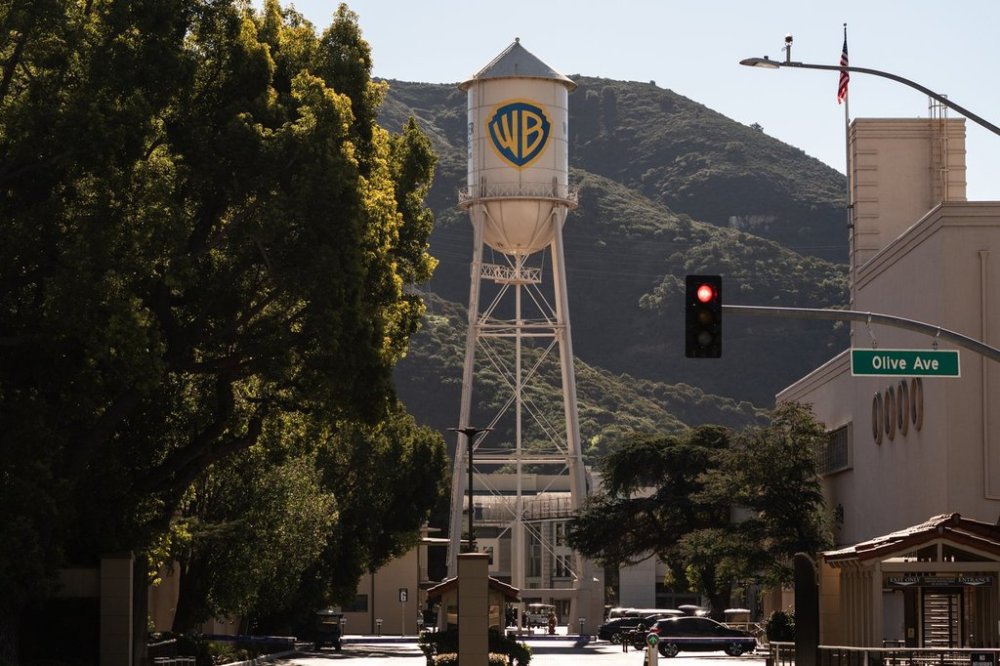
The Warner Bros. water tower is seen at Warner Bros. Studios in Burbank, Calif., Friday, Dec. 5, 2025. (AP Photo/Jae C. Hong)

A Warner Bros. merger with either company would alter the landscape in Hollywood and will face intense scrutiny from U.S. regulators as it would impact movie making, consumer streaming platforms and, in Paramount’s case, a major source of news for millions of people.

The competing offers set the stage for combining some of the most beloved entertainment properties. Netflix’s vast library includes “Stranger Things” and “Squid Game,” while the much smaller Paramount owns its Hollywood studio and major TV networks like CBS and MTV. Both covet Warner, which owns Warner Bros. Pictures, HBO and the Harry Potter franchise.

“Whichever media company, if any, ultimately secures (Warner), controls the calculus of the streaming wars and so much more,” said Mike Proulx, vice president and research director at research firm Forrester.

Both offers will face regulatory scrutiny, an issue President Donald Trump has already weighed in on.

Here’s what to know about the three players and what the bids mean for the entertainment industry.

A look at the offers

CEO David Zaslav has been seeking offers for Warner Bros. Discovery since at least October, when he said the company might be open to selling all or parts of its business.

Paramount said Monday it had submitted six proposals to Warner over a 12 week period before its offer was rejected in favor of Netflix.

So Paramount decided to go straight to Warner shareholders with a bid it says is worth about $79.9 billion, or $30 per share in cash. Paramount, unlike Netflix, is also offering to buy the cable assets of Warner, and asking shareholders of the company to reject the Netflix bid.

Paramount CEO Larry Ellison said the offer is worth about $18 billion more in cash than the competing cash-and-stock bid from Netflix.

The Paramount deal includes help from investors such as Trump’s son-in-law Jared Kushner and funds controlled by the governments of Saudi Arabia and Qatar, according to a regulatory filing.

Netflix is offering a combination of cash and stock valued at $27.75 per Warner share. Its offer values Warner at $72 billion, excluding debt, but it is not bidding on Warner-owned networks such as CNN and Discovery.

Before Paramount’s bid, the Netflix deal was expected to close in the next 12 to 18 months, after Warner completes its previously announced separation of its cable operations.

Competing bids makes an eventual deal more likely

Matthew Dolgin, senior equity analyst at research firm Morningstar, said there are still many unknowns, including whether Netflix will now sweeten its bid.

But, he said, a competing offer makes it more likely that Warner will eventually be acquired.

“With Paramount now also being involved formally with an offer to shareholders, it’s even more likely to us that Warner gets acquired, because it’s no longer a single decision that may or may not hinge on regulatory approval,” he said.

Shareholders have until Jan. 8, 2026, to vote on Paramount’s tender offer.

Donald Trump weighed in earlier

Another wild card could be President Trump. He already weighed in on the deal, saying that the Netflix offer to buy Warner “could be a problem” because of the size of the potential size of the audience.

The Republican president said he will be involved in the decision about whether the federal government should approve the deal.

Paramount’s CEO is the son of Oracle founder Larry Ellison, an ally of Trump. Federal regulators under Trump approved Paramount’s $8 billion merger with Skydance in July.

Regulatory scrutiny awaits either deal

On the Netflix offer, state or federal regulators could be most concerned about the massive size of a combined Netflix and Warner subscription service, said Morningstar’s Dolgin. Netflix is already the world’s largest streaming service.

That’s less of a concern with the Paramount deal, because its streaming service is smaller and has as smaller international footprint than Netflix. But regulators may raise red flags over the combination of the Paramount and Warner film and television studios, because relatively few of those remain, Dolgin said.

A pattern of media acquisitions

As streaming platforms have matured, more media companies are seeking growth through acquisitions.

Warner Bros. Discovery itself was created in 2022 when U.S. telecom giant AT&T Inc. spun off and then combined its WarnerMedia operations with Discovery Inc.

In 2021, Amazon said it would buy MGM, the movie and TV studio behind James Bond, “Legally Blonde” and “Shark Tank.” Disney bought Fox’s entertainment service in 2019.

“Technology always faces this pattern of startups, lots of different players, legacy companies getting in on the action, and then ultimately lots of consolidation,” said Forrester’s Proulx. “And this is the state that we’re in right now in the streaming wars saga, and in 2026 we’ll see continued consolidation.”


Report Error Submit a Tip

More Stories

United Way, other charities fight for dollars as donor base shrinks

Scott Billeck 7 minute read Preview

United Way, other charities fight for dollars as donor base shrinks

Scott Billeck 7 minute read Yesterday at 2:00 AM CDT

Winnipeg’s charitable sector is being squeezed from both sides: demand for help is growing while the pool of donors to meet that need is shrinking.

The imbalance is increasingly being carried by a relatively small group of deep-pocketed donors. Last year, 600 people — about three per cent of United Way Winnipeg’s individual donors — accounted for roughly $8 million, or 55 per cent of individual donations.

The fundraising pitch isn’t getting any easier.

Homelessness and public drug use have become increasingly visible, household budgets remain strained and the problems charities are trying to address can seem so entrenched that donors may reasonably wonder what difference another contribution can make.

Read
Yesterday at 2:00 AM CDT

Cabernet Sauvignon star of wine festival

Ben Sigurdson 5 minute read Preview

Cabernet Sauvignon star of wine festival

Ben Sigurdson 5 minute read 3:00 AM CDT

The Winnipeg Wine Festival will celebrate the king of red wine grapes next weekend — the theme of this year’s festival, which takes place Sept. 25 and 26 at the RBC Convention Centre, is Cabernet Sauvignon.

Cab Sauv, as it’s also known, is the world’s most widely planted wine grape of any colour, first coming to prominence in the 1800s in France’s Bordeaux region, where the grape is still popular. Rather than single-variety wines, Bordeaux reds tend to be blends, with those coming from the left bank of the Gironde estuary being Cabernet-dominant, while right-bank wines are Merlot-dominant, with Cabernet Sauvignon playing a supporting role. Cabernet and Merlot work well together and many other countries have followed suit in blending the two.

A team at University of California Davis put Cabernet Sauvignon through a DNA test in 1996 and discovered its parent grapes are Cabernet Franc and Sauvignon Blanc — it’s likely that at some point the two varieties, planted next to each other in some vineyard, crossed and mutated and became the grape we know today. (Someone growing grapes in the 19th century must have had an inkling of what was up, as the grape has been called Cabernet Sauvignon since long before the DNA test.)

Flavour-wise, most Cabernet Sauvignon wines are big and bold, with a core of deep dark berry flavours, some graphite and spice notes and relatively bright acidity. It’s a grape that is well-suited to barrel aging, with most examples seeing at least some time in wood.

Read
3:00 AM CDT

Grieving child builds backyard rocket ship

Harriet Zaidman 4 minute read 2:01 AM CDT

I Built a Rocket Ship (Kids Can Press, 32 pages, hardcover, $22) by Winnipegger Anna Lazowski is a tender story for children ages 4-8 about a little girl trying to make sense of her mother’s death. The child engages in conversation with her late mom, agreeing and disagreeing about things said as she carries objects (and of course, the cat) to the backyard. There, she is building a rocket ship she will pilot into the skies to find her mom again.

Jennica Lounsbury’s varied perspectives show the range of emotions the little girl experiences.

● ● ●

Northwoods Lullaby by Mary Casanova (University of Minnesota Press, 32 pages, hardover, $25) is a bedtime book for readers up to age eight, perfect to bring a busy, happy day to a close. Just like children who are listening to adults reading the book, all the animal babies are being tucked into their nests and burrows by loving parents: “Thump and scamper,/nimble clover./ Soon it’s time to rest. Baby loon/ nestles in/as Papa floats along.”

Siloam Mission, WFPS discussing on-site paramedic to reduce staggering number of emergency calls

Scott Billeck 4 minute read Preview

Siloam Mission, WFPS discussing on-site paramedic to reduce staggering number of emergency calls

Scott Billeck 4 minute read Yesterday at 2:00 AM CDT

Winnipeg’s fire-paramedic service and its largest homeless-serving organization are discussing what it would look like to station at least one paramedic at Siloam Mission, as emergency calls to the downtown facility surge.

The ongoing discussions come as Winnipeg Fire Paramedic Service crews were dispatched 1,771 times during the first eight months of the year to the two adjacent Siloam properties at 303 Stanley St. and 300 Princess St.

WFPS said most of the calls were related to overdoses or other consequences of substance use, with the total nearly double the 854 calls recorded over the same period last year. By comparison, there were 831 calls during the same span in 2024, and 591 in 2023.

“The number of emergency calls isn’t sustainable for us as a service, but it’s certainly not sustainable for them as an agency trying to provide services,” WFPS chief Ryan Sneath told the Free Press. “And they recognize that they’re impacting emergency services, not them specifically, but the site in a significant way.”

Read
Yesterday at 2:00 AM CDT

American Hostage stars recall warmth of Winnipeggers during brutal winter

Randall King 7 minute read Preview

American Hostage stars recall warmth of Winnipeggers during brutal winter

Randall King 7 minute read Yesterday at 6:13 PM CDT

TORONTO — When you stream the eight-part series American Hostage, a sense of familiarity may strike.

That’s because the show was shot in Winnipeg — especially in the Exchange District — from November of last year to the beginning of February, with Winnipeg portraying Indianapolis circa 1977.

The whole world seemed to be watching that midwest American city that year as a hostage crisis unfolded involving one Tony Kiritsis, an angry man who goes ballistic when a mortgage brokerage was poised to foreclose on property he had dreamed of developing into a shopping centre.

Kiritsis kidnapped his mortgage broker, Richard Hall, wiring a shotgun to the back of his head, and demanded a public airing of his grievances, with the reluctant help of popular radio broadcaster Fred Heckman.

Read
Yesterday at 6:13 PM CDT

Canada must not accept another Iranian autocracy

David Matas 5 minute read 2:01 AM CDT

Iran is a state run by a radical government victimizing its citizens and its neighbours. How do we change that? Any regime change that repeats the mistakes of the past is not a solution.

What went wrong in the past which led to the current regime? One answer is the U.K. and American aided coup which led to the ouster in 1953 of a democratically elected government headed at the time by Mohammad Mossadegh and its replacement with an American friendly autocrat, the Shah of Iran, Mohammad Reza Pahlavi.

The Shah imposed his rule through the Iranian National Intelligence and Security Organization — SAVAK, the acronym of its Persian name. SAVAK systematically inflicted torture, arbitrary killings and extra-judicial killings on perceived opponents of the regime. It was only a matter of time before repression of a regime directed to serving foreign interests would be overthrown.

What replaced the regime of the Shah, in 1979, the current regime of the mullahs, is a regime as intolerant and violent as the regime of the Shah and then some. That was not inevitable. But neither was it surprising. The vicious nature of the current regime, following the example set by the Shah, and its hatred for the United States, reacting to the U.S. aided imposition of the Shah, both echoes and reacts to the past. In 1979, the U.S. reaped what it sowed in 1953.