How springing forward to daylight saving time could affect your health

Advertisement

Advertise with us

WASHINGTON (AP) — Most of America “springs forward” Sunday for daylight saving time. Losing that hour of sleep can do more than leave you tired and cranky the next day; it also could harm your health.

Read this article for free:


or

Already have an account? Log in here »

To continue reading, please subscribe:

Subscribe and receive a limited-edition Free Press branded hat or tote.

Digital Subscription

One year of digital access for only $205*

  • Enjoy unlimited reading on winnipegfreepress.com
  • Read the E-Edition, our digital replica newspaper
  • Access News Break, our award-winning app
  • Play interactive puzzles

*First annual payment billed as $205.00 + GST for one year. This annual subscription will automatically renew at $233.00 + GST every 52 weeks (10% off the regular annual price of $259.35). Offer available to new and qualified returning subscribers only. Cancel any time.

To continue reading, please subscribe:

Add Free Press access to your Brandon Sun subscription for only an additional

$1 for the first 4 weeks*

  • Enjoy unlimited reading on winnipegfreepress.com
  • Read the E-Edition, our digital replica newspaper
  • Access News Break, our award-winning app
  • Play interactive puzzles
Start now

*Your next Brandon Sun subscription payment will increase by $1.00 and you will be charged $17.95 plus GST for four weeks. After four weeks, your payment will increase to $24.95 plus GST every four weeks.

Hey there, time traveller!
This article was published 06/03/2026 (197 days ago), so information in it may no longer be current.

WASHINGTON (AP) — Most of America “springs forward” Sunday for daylight saving time. Losing that hour of sleep can do more than leave you tired and cranky the next day; it also could harm your health.

Darker mornings and more evening light knock your body clock out of whack — which means daylight saving time can usher in sleep trouble for weeks or longer. Studies have even found an uptick in heart attacks and strokes right after the March time change.

There are ways to ease the adjustment, including getting more sunshine to help reset your circadian rhythm for healthful sleep.
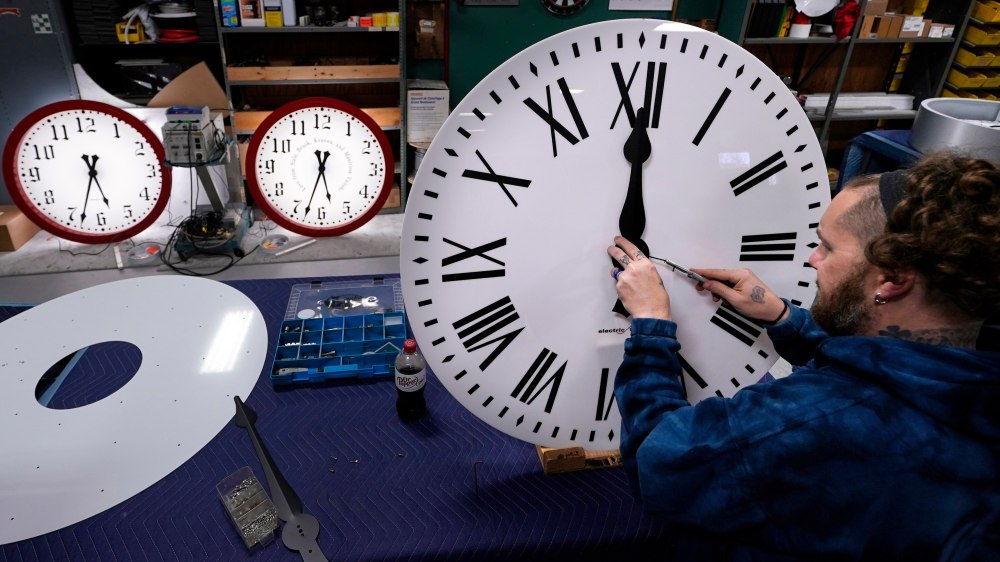
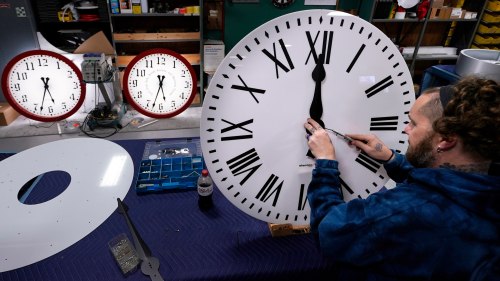
FILE - Ian Roders fastens the hands to a clock at Electric Time Company, Tuesday, Nov. 1, 2022, in Medfield, Mass. (AP Photo/Charles Krupa, file)

When does daylight saving time start?

Daylight saving time begins Sunday at 2 a.m., an hour of sleep vanishing in most of the U.S. The ritual will reverse on Nov. 1 when clocks “fall back” as daylight saving time ends.

Hawaii and most of Arizona don’t make the spring switch, sticking to standard time year-round — along with Puerto Rico, American Samoa, Guam and the U.S. Virgin Islands. Worldwide, dozens of countries also observe daylight saving time, starting and ending at different dates.

Some people try to prepare for daylight saving time by going to bed a little earlier two or three nights ahead. While getting back on schedule after an hour’s change may not be that difficult for some people, it’s an added challenge for the third of U.S. adults who already don’t get the recommended seven hours of nightly shuteye.

What happens to your brain when it’s lighter later?

The brain has a master clock that is set by exposure to sunlight and darkness. This circadian rhythm is a roughly 24-hour cycle that determines when we become sleepy and when we’re more alert. The patterns change with age, one reason that early-to-rise youngsters evolve into hard-to-wake teens.

Morning light resets the rhythm. By evening, levels of a hormone called melatonin begin to surge, triggering drowsiness. Too much light in the evening — that extra hour from daylight saving time — delays that surge and the cycle gets out of sync.

Sleep deprivation is linked to heart disease, cognitive decline, obesity and numerous other problems. And that circadian clock affects more than sleep, also influencing things like heart rate, blood pressure, stress hormones and metabolism.

How does the time change affect your health?

Fatal car crashes temporarily jump the first few days after the spring time change, according to a study of U.S. traffic fatalities. The risk was highest in the morning, and researchers attributed it to sleep deprivation.

Then there’s the cardiac connection. The American Heart Association points to studies that suggest an uptick in heart attacks on the Monday after daylight saving time begins, and in strokes for two days afterward.

Doctors already know that heart attacks, especially severe ones, are a bit more common on Mondays generally — and in the morning, when blood is more clot-prone.

Researchers don’t know why the time change would add to that Monday connection but it’s possible the abrupt circadian disruption exacerbates factors such as high blood pressure in people already at risk.

How to adjust to daylight saving time

Go outside for early morning sunshine that first week of daylight saving time, which can help reset your body’s internal clock. Moving up daily routines, like dinner time or when you exercise, also may help cue your body to start adapting, sleep experts advise.

Afternoon naps and caffeine as well as evening light from phones and other electronic devices can make adjusting to an earlier bedtime even harder.

Will the U.S. ever eliminate the time change?

Every year there’s talk about ending the time change. Before starting his second term, President Donald Trump promised to eliminate daylight saving time. A bipartisan bill named the Sunshine Protection Act to make daylight saving time permanent has repeatedly stalled in Congress.

But that’s the opposite of what some health groups recommend. The American Medical Association and American Academy of Sleep Medicine agree it’s time to do away with time switches but say sticking with standard time year-round aligns better with the sun — and human biology — for more consistent sleep.

___

The Associated Press Health and Science Department receives support from the Howard Hughes Medical Institute’s Science and Educational Media Group and the Robert Wood Johnson Foundation. The AP is solely responsible for all content.

Report Error Submit a Tip

More Stories

American Hostage stars recall warmth of Winnipeggers during brutal winter

Randall King 7 minute read Preview

American Hostage stars recall warmth of Winnipeggers during brutal winter

Randall King 7 minute read Yesterday at 6:13 PM CDT

TORONTO — When you stream the eight-part series American Hostage, a sense of familiarity may strike.

That’s because the show was shot in Winnipeg — especially in the Exchange District — from November of last year to the beginning of February, with Winnipeg portraying Indianapolis circa 1977.

The whole world seemed to be watching that midwest American city that year as a hostage crisis unfolded involving one Tony Kiritsis, an angry man who goes ballistic when a mortgage brokerage was poised to foreclose on property he had dreamed of developing into a shopping centre.

Kiritsis kidnapped his mortgage broker, Richard Hall, wiring a shotgun to the back of his head, and demanded a public airing of his grievances, with the reluctant help of popular radio broadcaster Fred Heckman.

Read
Yesterday at 6:13 PM CDT

Siloam Mission, WFPS discussing on-site paramedic to reduce staggering number of emergency calls

Scott Billeck 4 minute read Preview

Siloam Mission, WFPS discussing on-site paramedic to reduce staggering number of emergency calls

Scott Billeck 4 minute read Yesterday at 2:00 AM CDT

Winnipeg’s fire-paramedic service and its largest homeless-serving organization are discussing what it would look like to station at least one paramedic at Siloam Mission, as emergency calls to the downtown facility surge.

The ongoing discussions come as Winnipeg Fire Paramedic Service crews were dispatched 1,771 times during the first eight months of the year to the two adjacent Siloam properties at 303 Stanley St. and 300 Princess St.

WFPS said most of the calls were related to overdoses or other consequences of substance use, with the total nearly double the 854 calls recorded over the same period last year. By comparison, there were 831 calls during the same span in 2024, and 591 in 2023.

“The number of emergency calls isn’t sustainable for us as a service, but it’s certainly not sustainable for them as an agency trying to provide services,” WFPS chief Ryan Sneath told the Free Press. “And they recognize that they’re impacting emergency services, not them specifically, but the site in a significant way.”

Read
Yesterday at 2:00 AM CDT

Manitoba abandoning spring, fall clock changes

Carol Sanders 8 minute read Preview

Manitoba abandoning spring, fall clock changes

Carol Sanders 8 minute read Updated: Yesterday at 8:48 AM CDT

Time’s up for the time change in Manitoba.

Manitobans won’t be setting their clocks back an hour in November. The province has decided to permanently stay on daylight time after surveying residents on the twice annual clock adjustment.

“We heard from Manitobans loud and clear — no more changing the clocks in Manitoba,” Premier Wab Kinew said in a news release Thursday.

Most of the 72,000 votes submitted in an online EngageMB survey — 92 per cent — said they would like to see the practice end. The survey asked if they preferred earlier sunrises in winter with standard time or the later sunsets in summer with daylight time. More than half of survey participants (58 per cent) indicated a preference to stay on permanent daylight time; 34 per cent voted to eliminate the time change but stay on standard time.

Read
Updated: Yesterday at 8:48 AM CDT

How springing forward to daylight saving time could affect your health

Lauran Neergaard, The Associated Press 4 minute read Preview

How springing forward to daylight saving time could affect your health

Lauran Neergaard, The Associated Press 4 minute read Friday, Mar. 6, 2026

WASHINGTON (AP) — Most of America “springs forward” Sunday for daylight saving time. Losing that hour of sleep can do more than leave you tired and cranky the next day; it also could harm your health.

Darker mornings and more evening light knock your body clock out of whack — which means daylight saving time can usher in sleep trouble for weeks or longer. Studies have even found an uptick in heart attacks and strokes right after the March time change.

There are ways to ease the adjustment, including getting more sunshine to help reset your circadian rhythm for healthful sleep.

When does daylight saving time start?

Read
Friday, Mar. 6, 2026

Give-and-take relationship of Roman leaders takes centre stage in Harris’s historical fiction

Reviewed by Kathryne Cardwell 4 minute read Preview

Give-and-take relationship of Roman leaders takes centre stage in Harris’s historical fiction

Reviewed by Kathryne Cardwell 4 minute read 2:01 AM CDT

British novelist Robert Harris’s latest work is a reflection on tyranny, corruption and betrayal among all-powerful political leaders.

You might be forgiven for thinking it’s a contemporary thriller — it’s actually historical fiction set in ancient Rome.

A former BBC journalist, Harris debuted as a novelist in 1992 with Fatherland, an alternative history where Nazi Germany won the Second World War.

Since then, the prolific author has become best-known for his works of historical fiction, especially his ancient Rome trilogy released from 2006-2015 and the novel Conclave, which was published in 2016 and was made into the film of the same name in 2024.

Read
2:01 AM CDT

Klein has burned bridges with PM, Gillingham says

Joyanne Pursaga 3 minute read Preview

Klein has burned bridges with PM, Gillingham says

Joyanne Pursaga 3 minute read Yesterday at 5:51 PM CDT

One mayoral candidate accused another of writing a column so critical it could compromise his ability to work with the federal government.

Read
Yesterday at 5:51 PM CDT